


Saudi king Salman's Bali beach holiday turns into military exercise

March 4, 2017

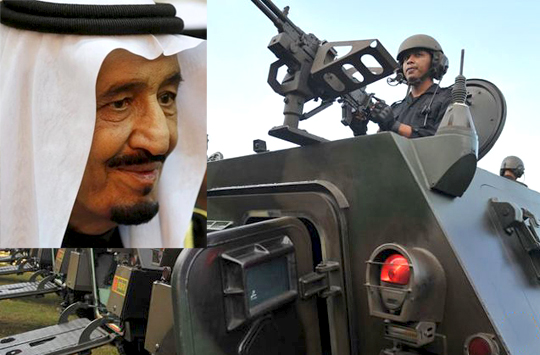
Indonesia, Mar 4: A Bali beach holiday for Saudi Arabia's King Salman and his considerable entourage has turned into a military exercise for host Indonesia. The octogenarian monarch and his entourage of 1,500, including 25 princes and 10 ministers, flies on Saturday to Indonesia's Bali island aboard nine passenger jets for a private vacation. They will be guarded by at least 2,500 police and military personnel, as well as naval vessels parked offshore.
kingsold

The king's Boeing 747-jet will be met at the airport by his usual gold coloured escalator. Flown in ahead of the visit were two plane loads of cargo, including plates, carpets and two bullet-proof Mercedes, said customs official Budi Harjanto.

King Salman's tour of Asia aims to build the kingdom's ties with fast-growing Asian economies and drum up investment to diversify the Saudi economy away from dependence on oil. The extravagance of his official trip, punctuated by holidays, comes after an austerity drive at home caused by low oil prices.

On the white sand beach in front of Bali's St. Regis resort, one in a row of five-star hotels where the Saudis will stay, two metre (7-foot) high screens have been put up to shield guests from prying eyes. A wooden staircase has been built for the royals to access the water.

“There will definitely be marine security because there's a section of beach where the (king) will be staying,” said Bali's Udayana military chief Major General Kustanto Widiatmoko.

Widiatmoko said six ships would be deployed along with anti-terrorism police and snipers, adding he hoped security would not impinge on the Saudi group's privacy.

CONTROVERSIAL VACATIONS

The king's vacations have been controversial at times due to the disruption they caused. He cut short a 2015 French Riviera holiday after local outrage erupted when the public beach at Vallauris was shut and concrete poured on the sand for a temporary lift.

After kicking off his Asian tour in Malaysia on Feb. 26, King Salman will also visit Brunei, Japan, China, the Maldives and Jordan on his month-long swing through the region promoting the kingdom as an investment destination.

Asia's top oil supplier plans to privatise state assets, cultivate non-oil private sectors and open its markets to foreign investors, after a plunge in oil prices slashed state revenues and opened a gaping budget deficit. A hallmark of the plan is to sell shares in state oil giant Saudi Aramco, which Saudi authorities have said could raise up to $100 billion, in what would be, by far, the world's biggest listing.

The king's three-day state visit in Jakarta this week focused on building cultural and religious ties and promoting education, as well as efforts to contain radical Islam in the world's most populous Muslim country.

Secular Indonesia has grown increasingly concerned about security, after several attacks over the past year blamed on supporters of Islamic State.

Islamist militants bombed a nightclub in the Bali resort of Kuta in 2002, killed 202 people, most of them foreign tourists.

MIDDLE EAST TOURISM

Bali's business community is hoping the king's visit will encourage more Middle East tourists to visit the “Island of the gods”.

“When they find out that the king and his entourage have come to Bali, they will realise that Bali is a world-class tourist destination, so automatically they will think about coming to Bali as tourists too,” Ketut Ardana, chairman of the Bali branch of the Indonesian Travel Agents Association (ASITA) told Reuters.

Mila Artini, a representative for the Blue Bird taxi group at Bali's Ngurah Rai International Airport, said the Saudis had booked the group's entire fleet of limousines up until the end of the king's visit on March 12.

An additional 200 Mercedes limousines had been brought in from Jakarta for the visit, said Arif, a Muslim taxi driver, who said the Saudis would be welcome in predominantly Hindu Bali.

“The religion here is different, but that's no problem because there are also a lot of Muslims here. There's halal food in all areas,” he said.

Indonesia aims to more than double the number of Muslim tourists it received last year to 5 million by 2019, said the head of the Indonesian tourism ministry's Halal Tourism Development and Acceleration team.

“Other than the large number of potential visitors from Muslim countries, their spending power is also larger,” said Riyanto Sofyan, noting Muslim tourists spend around $1,700 per visit, compared to $1,100 on average by other foreigners.

CAMEL RIDES

On the approach to Nusa Dua, a peninsula on the southern tip of Bali where the king is staying, police in fluorescent vests checked cars at an impromptu checkpoint.

While not especially brought in for the Saudi visitors, the beach at Nusa Dua does have something to make the visitors feel right at home – camels.

Minarto, who runs camel rides in front of the Hilton Bali Resort, said the Saudi group had requested 100 half-hour rides.

“We're busy and they wanted too many. We only have a limited number of camels,” said Minarto, who looks after five camels brought in from Australia years ago.

Comments

Add new comment

  • Coastaldigest.com reserves the right to delete or block any comments.
  • Coastaldigset.com is not responsible for its readers’ comments.
  • Comments that are abusive, incendiary or irrelevant are strictly prohibited.
  • Please use a genuine email ID and provide your name to avoid reject.
Agencies
June 24,2020

Seoul, Jun 24: North Korea on Wednesday said leader Kim Jong Un suspended a planned military retaliation against South Korea, possibly slowing the pressure campaign it has waged against its rival amid stalled nuclear negotiations with the Trump administration.

Last week, the North had declared relations with the South as fully ruptured, destroyed an inter-Korean liaison office in its territory and threatened unspecified military action to censure Seoul for a lack of progress in bilateral cooperation and for activists floating anti-Pyongyang leaflets across the border.

Analysts say North Korea, after weeks deliberately raising tensions, may be pulling away just enough to make room for South Korean concessions.

Pyongyang's official Korean Central News Agency said Kim presided by video conference over a meeting Tuesday of the ruling Workers' Party's Central Military Commission, which decided to postpone plans for military action against the South brought up by the North's military leaders.

KCNA didn't specify why the decision was made. It said other discussions included bolstering the country's "war deterrent".

Yoh Sang-key, spokesman of South Korea's Unification Ministry, said Seoul was "closely reviewing" the North's report but didn't further elaborate.

Yoh also said it was the first report in state media of Kim holding a video conferencing meeting, but he didn't provide a specific answer when asked whether that would have something to do with the coronavirus.

The North says there hasn't been a single COVID-19 case on its territory, but the claim is questioned by outside experts.

Kim Dong-yub, an analyst from Seoul's Institute for Far Eastern Studies, said it's likely that the North is waiting for further action from the South to salvage ties from what it sees as a position of strength, rather than softening its stance on its rival.

"What's clear is that the North said (the military action) was postponed, not cancelled," said Kim, a former South Korean military official who participated in inter-Korean military negotiations.

Other experts say the North would be seeking something major from the South, possibly a commitment to resume operations at a shuttered joint factory park in Kaesong, which was where the liaison office was located, or restart South Korean tours to the North's Diamond Mountain resort.

Those steps are prohibited by the international sanctions against the North over its nuclear weapons programme.

The public face of the North's recent bashing of the South has been Kim Yo Jong, the powerful sister of leader Kim Jong Un, who has been confirmed as his top official on inter-Korean affairs.

Issuing harsh statements through state media, she had said the North's demolishing of the liaison office would be just the first in a series of retaliatory action against the enemy South and that she would leave it to the North's military to come up with the next steps.

The General Staff of the North's military has said it would send troops to the mothballed inter-Korean cooperation sites in Kaesong and Diamond Mountain and restart military drills in frontline areas.

Such steps would nullify a set of deals the Koreas reached during a flurry of diplomacy in 2018 that prohibited them from taking hostile action against each other.

Also condemning the South over North Korean refugees floating anti-Pyongyang leaflets across the border, the North said Monday it printed 12 million of its own propaganda leaflets to be dropped over the South in what would be its largest ever anti-Seoul leafleting campaign.

It wasn't immediately clear whether Kim's decision to hold back military action would affect the country's plans for leafleting. The North's military had said it would open border areas on land and sea and provide protection for civilians involved in the leafleting campaigns.

The North has a history of dialling up pressure against the South when it fails to get what it wants from the United States. The North's recent steps came after months of frustration over Seoul's unwillingness to defy US-led sanctions and restart the inter-Korean economic projects that would breathe life into its broken economy.

Nuclear negotiations between Pyongyang and Washington largely stalled after Kim's second summit with President Donald Trump last year in Vietnam, where the Americans rejected North Korea's demands for major sanctions relief in exchange for a partial surrender of its nuclear capabilities.

Comments

Add new comment

  • Coastaldigest.com reserves the right to delete or block any comments.
  • Coastaldigset.com is not responsible for its readers’ comments.
  • Comments that are abusive, incendiary or irrelevant are strictly prohibited.
  • Please use a genuine email ID and provide your name to avoid reject.
News Network
April 26,2020

Seoul, Apr 26: A train presumed to belong to North Korean's Kim Jong-un has been spotted at a station in the state's eastern coastal town of Wonsan amid speculation about the leader's health, a US monitor said on Sunday, citing commercial satellite imagery on the region, Yonhap news agency reported.

According to 38 North-- a website devoted to analysis about North Korea, the imagery showed a train "probably belonging to Kim Jong Un parked at the Leadership Railway Station servicing his Wonsan compound since at least April 21."

"The approximately 250-metre long train, although partially covered by the station's roof, can be seen at a railway station reserved for use by the Kim family. It was not present on April 15 but was present on both April 21 and 23," it said.

"The train's presence does not prove the whereabouts of the North Korean leader or indicate anything about his health, but it does lend weight to reports that Kim is staying at an elite area on the country's eastern coast," it added.

The report came as rumours about his health have spread as Kim apparently skipped an important annual visit to the Kumsusan Palace of the Sun on the occasion of the April 15 birthday of late state founder and his grandfather, Kim Il-sung.

CNN intensified the speculation by reporting earlier last week that the United States is looking into intelligence that Kim is "in grave danger" after surgery.

Seoul officials have disputed recent media reports about Kim, saying there have been no unusual signs from the North. Some said that Kim is presumed to be staying in Wonsan for unspecified reasons.

Washington has also dismissed the reports, with US President Donald Trump calling such reports "incorrect" in a press briefing late last week.

On Saturday, other media reports stated that China has dispatched a team of medical doctors and officials to North Korea "to advise on" Kim, citing multiple unnamed people familiar with the situation.

North Korea's state media, however, has not made any mention of Kim's public activity for two weeks since he was last seen in April 11 presiding over a major party meeting, though it has reported on his handling of routine state affairs, such as sending diplomatic letters.
But not all speculation has proven to be false.

When he was absent from public for about a month in 2014, speculation arose about his health and a political crisis in the secretive state. He later reemerged with a cane and a limp reportedly after having a cyst removed from his ankle.

The 36-year-old leader is known to have various health problems apparently caused by obesity and heavy smoking. He took office as leader of the communist state after his father, Kim Jong-il, died of a heart attack in late 2011.

Comments

Add new comment

  • Coastaldigest.com reserves the right to delete or block any comments.
  • Coastaldigset.com is not responsible for its readers’ comments.
  • Comments that are abusive, incendiary or irrelevant are strictly prohibited.
  • Please use a genuine email ID and provide your name to avoid reject.
Agencies
January 21,2020

Fifty-six journalists were killed in 2019 and most of them died outside conflict zones, a United Nations spokesperson said.

The number dropped by nearly half from the year 2018, but perpetrators enjoyed almost total impunity, Xinhua news agency quoted Stephane Dujarric, spokesperson for UN Secretary-General Antonio Guterres, as saying on Monday citing Unesco figures.

The figure was published in the 'Unesco Observatory of Killed Journalists' on Monday.

In total, Unesco recorded 894 journalist killings in the decade from 2010 to 2019, an average of almost 90 per year. The number in 2019 was 99.

Journalists were murdered in all regions of the world, with Latin America and the Caribbean recording 22 killings, the highest number, followed by 15 in Asia-Pacific, and 10 in Arab States.

"The figures show that journalists not only suffer extreme risks when covering violent conflict, but that they are also targeted when reporting on local politics, corruption and crime - often in their hometowns," the Unesco said.

Almost two thirds (61 per cent) of the cases in 2019 occurred in countries not experiencing armed conflict, a notable spike in a wider trend in recent years, and a reversal of the situation of 2014, when this figure was one third.

More than 90 per cent of cases recorded in 2019 concerned local journalists, consistent with previous years, it added.

In response to these figures, Audrey Azoulay, the Director-General of Unesco, said: "Unesco remains deeply troubled by the hostility and violence directed at all too many journalists around the world.

"As long as this situation lasts, it will undermine democratic debate."

Comments

Add new comment

  • Coastaldigest.com reserves the right to delete or block any comments.
  • Coastaldigset.com is not responsible for its readers’ comments.
  • Comments that are abusive, incendiary or irrelevant are strictly prohibited.
  • Please use a genuine email ID and provide your name to avoid reject.