


Saudi king Salman's Bali beach holiday turns into military exercise

March 4, 2017

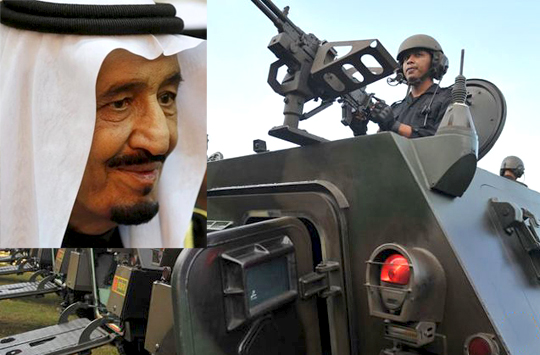
Indonesia, Mar 4: A Bali beach holiday for Saudi Arabia's King Salman and his considerable entourage has turned into a military exercise for host Indonesia. The octogenarian monarch and his entourage of 1,500, including 25 princes and 10 ministers, flies on Saturday to Indonesia's Bali island aboard nine passenger jets for a private vacation. They will be guarded by at least 2,500 police and military personnel, as well as naval vessels parked offshore.
kingsold

The king's Boeing 747-jet will be met at the airport by his usual gold coloured escalator. Flown in ahead of the visit were two plane loads of cargo, including plates, carpets and two bullet-proof Mercedes, said customs official Budi Harjanto.

King Salman's tour of Asia aims to build the kingdom's ties with fast-growing Asian economies and drum up investment to diversify the Saudi economy away from dependence on oil. The extravagance of his official trip, punctuated by holidays, comes after an austerity drive at home caused by low oil prices.

On the white sand beach in front of Bali's St. Regis resort, one in a row of five-star hotels where the Saudis will stay, two metre (7-foot) high screens have been put up to shield guests from prying eyes. A wooden staircase has been built for the royals to access the water.

“There will definitely be marine security because there's a section of beach where the (king) will be staying,” said Bali's Udayana military chief Major General Kustanto Widiatmoko.

Widiatmoko said six ships would be deployed along with anti-terrorism police and snipers, adding he hoped security would not impinge on the Saudi group's privacy.

CONTROVERSIAL VACATIONS

The king's vacations have been controversial at times due to the disruption they caused. He cut short a 2015 French Riviera holiday after local outrage erupted when the public beach at Vallauris was shut and concrete poured on the sand for a temporary lift.

After kicking off his Asian tour in Malaysia on Feb. 26, King Salman will also visit Brunei, Japan, China, the Maldives and Jordan on his month-long swing through the region promoting the kingdom as an investment destination.

Asia's top oil supplier plans to privatise state assets, cultivate non-oil private sectors and open its markets to foreign investors, after a plunge in oil prices slashed state revenues and opened a gaping budget deficit. A hallmark of the plan is to sell shares in state oil giant Saudi Aramco, which Saudi authorities have said could raise up to $100 billion, in what would be, by far, the world's biggest listing.

The king's three-day state visit in Jakarta this week focused on building cultural and religious ties and promoting education, as well as efforts to contain radical Islam in the world's most populous Muslim country.

Secular Indonesia has grown increasingly concerned about security, after several attacks over the past year blamed on supporters of Islamic State.

Islamist militants bombed a nightclub in the Bali resort of Kuta in 2002, killed 202 people, most of them foreign tourists.

MIDDLE EAST TOURISM

Bali's business community is hoping the king's visit will encourage more Middle East tourists to visit the “Island of the gods”.

“When they find out that the king and his entourage have come to Bali, they will realise that Bali is a world-class tourist destination, so automatically they will think about coming to Bali as tourists too,” Ketut Ardana, chairman of the Bali branch of the Indonesian Travel Agents Association (ASITA) told Reuters.

Mila Artini, a representative for the Blue Bird taxi group at Bali's Ngurah Rai International Airport, said the Saudis had booked the group's entire fleet of limousines up until the end of the king's visit on March 12.

An additional 200 Mercedes limousines had been brought in from Jakarta for the visit, said Arif, a Muslim taxi driver, who said the Saudis would be welcome in predominantly Hindu Bali.

“The religion here is different, but that's no problem because there are also a lot of Muslims here. There's halal food in all areas,” he said.

Indonesia aims to more than double the number of Muslim tourists it received last year to 5 million by 2019, said the head of the Indonesian tourism ministry's Halal Tourism Development and Acceleration team.

“Other than the large number of potential visitors from Muslim countries, their spending power is also larger,” said Riyanto Sofyan, noting Muslim tourists spend around $1,700 per visit, compared to $1,100 on average by other foreigners.

CAMEL RIDES

On the approach to Nusa Dua, a peninsula on the southern tip of Bali where the king is staying, police in fluorescent vests checked cars at an impromptu checkpoint.

While not especially brought in for the Saudi visitors, the beach at Nusa Dua does have something to make the visitors feel right at home – camels.

Minarto, who runs camel rides in front of the Hilton Bali Resort, said the Saudi group had requested 100 half-hour rides.

“We're busy and they wanted too many. We only have a limited number of camels,” said Minarto, who looks after five camels brought in from Australia years ago.

Comments

Add new comment

  • Coastaldigest.com reserves the right to delete or block any comments.
  • Coastaldigset.com is not responsible for its readers’ comments.
  • Comments that are abusive, incendiary or irrelevant are strictly prohibited.
  • Please use a genuine email ID and provide your name to avoid reject.
News Network
April 24,2020

Toronto, Apr 25: Canadian Prime Minister Justin Trudeau on Thursday (local time) announced a new CAD 1.1 billion package supporting vaccine research and clinical trials as well as expanded testing capacity.

"We are putting in place an additional CAD 1.1 billion dollars for a national medical and research strategy to address COVID-19," Trudeau said during his daily novel coronavirus pandemic briefing on Thursday.

"This plan has three pillars -- research on vaccines and other treatments, support for clinical trials and expanding national testing and modelling," he added.

Trudeau pointed out that CAD 82 million of the total sum will be directed to the development of a vaccine and treatments against the virus, while CAD 471 million will go towards supporting clinical trials.

A further CAD 249 million is being allocated for expanding testing capacity and modelling, the Prime Minister added.

According to Trudeau, this funding will be allotted to a new "immunity task force" commissioned with conducting serology testing -- blood tests looking for the presence of antibodies indicative of exposure to the virus and subsequent immune response.

He said the taskforce, comprising the country's top medical experts, including Chief Public Health Officer Dr Theresa Tam, will test at least a million Canadians over the next two years.

The funding announced today comes in addition to the CAD 200 million committed for COVID-19-related research on March 11.

Trudeau has repeatedly stressed the daily constraints that much of the population is adhering to will be the new normal until a vaccine is developed.

As of Thursday, Canada has confirmed a total of 40,824 COVID-19 cases since the onset of the outbreak, out of which more than 2,000 have proven to be fatal, according to the latest figures from the country's public health agency.

Comments

Add new comment

  • Coastaldigest.com reserves the right to delete or block any comments.
  • Coastaldigset.com is not responsible for its readers’ comments.
  • Comments that are abusive, incendiary or irrelevant are strictly prohibited.
  • Please use a genuine email ID and provide your name to avoid reject.
News Network
June 23,2020

Jun 23: US President Donald Trump has issued a proclamation to suspend issuing of H-1B visas, which is popular among Indian IT professionals, along with other foreign work visas for the rest of the year.

Trump said the step was essential to help millions of Americans who have lost their jobs due to the current economic crisis.

Issuing the proclamation ahead of the November presidential elections, Trump has ignored the mounting opposition to the order by various business organisations, lawmakers and human rights bodies.

The proclamation that comes into effect on June 24, is expected to impact a large number of Indian IT professionals and several American and Indian companies who were issued H-1B visas by the US government for the fiscal year 2021 beginning October 1.

They would now have to wait at least till the end of the current year before approaching the US diplomatic missions to get stamping. It would also impact a large number of Indian IT professionals who are seeking renewal of their H-1B visas.

“In the administration of our Nation's immigration system, we must remain mindful of the impact of foreign workers on the United States labour market, particularly in the current extraordinary environment of high domestic unemployment and depressed demand for labour,” said the proclamation issued by Trump.

In his proclamation, Trump said that the overall unemployment rate in the United States nearly quadrupled between February and May of 2020 -- producing some of the most extreme unemployment rates ever recorded by the Bureau of Labor Statistics.

While the May rate of 13.3 percent reflects a marked decline from April, millions of Americans remain out of work.

The proclamation also extends till the end of the year his previous executive order that had banned issuing of new green cards of lawful permanent residency.

Green card holders, once admitted pursuant to immigrant visas, are granted "open-market" employment authorisation documents, allowing them immediate eligibility to compete for almost any job, in any sector of the economy, he said.

“American workers compete against foreign nationals for jobs in every sector of our economy, including against millions of aliens who enter the United States to perform temporary work. Temporary workers are often accompanied by their spouses and children, many of whom also compete against American workers,” Trump said.

“Under ordinary circumstances, properly administered temporary worker programmes can provide benefits to the economy. But under the extraordinary circumstances of the economic contraction resulting from the COVID-19 outbreak, certain non-immigrant visa programmes authorising such employment pose an unusual threat to the employment of American workers,” he said.

For example, Trump said, between February and April of 2020, more than 17 million United States jobs were lost in industries in which employers are seeking to fill worker positions tied to H-2B nonimmigrant visas.

“During this same period, more than 20 million United States workers lost their jobs in key industries where employers are currently requesting H-1B and L workers to fill positions,” he said.

“Also, the May unemployment rate for young Americans, who compete with certain J non-immigrant visa applicants, has been particularly high -- 29.9 percent for 16-19-year-olds, and 23.2 percent for the 20-24-year-old group,” he said.

“The entry of additional workers through the H-1B, H-2B, J, and L non-immigrant visa programmes, therefore, presents a significant threat to employment opportunities for Americans affected by the extraordinary economic disruptions caused by the COVID-19 outbreak,” Trump said.

Trump observed that excess labour supply is particularly harmful to workers at the margin between employment and unemployment -- those who are typically "last in" during an economic expansion and "first out" during an economic contraction.

In recent years, these workers have been disproportionately represented by historically disadvantaged groups, including African Americans and other minorities, those without a college degree, and Americans with disabilities, he said.

The proclamation suspends and limits entry into the US of H-1B, H-2B and L visas and their dependents till December 31, 2020. It also includes certain categories of J visas like an intern, trainee, teacher, camp counselor, or summer work travel programme.

The new rule would apply only to those who are outside the US, do not have a valid non-immigrant visa and an official travel document other than a visa to enter the country.

According to the proclamation, it does not have an impact on lawful permanent residents of the United States and foreign nationals who are spouses or child of an American citizen.

Foreign nationals seeking to enter the US to provide temporary labour or services essential to the food supply chain are also exempted from the latest proclamation.

Comments

Add new comment

  • Coastaldigest.com reserves the right to delete or block any comments.
  • Coastaldigset.com is not responsible for its readers’ comments.
  • Comments that are abusive, incendiary or irrelevant are strictly prohibited.
  • Please use a genuine email ID and provide your name to avoid reject.
News Network
April 12,2020

Apr 12: India and other South Asian countries are likely to record their worst growth performance in four decades this year due to the coronavirus outbreak, the World Bank said on Sunday.

The South Asian region, comprising eight countries, is likely to show economic growth of 1.8 per cent to 2.8 per cent this year, the World Bank said in its South Asia Economic Focus report, well down from the 6.3 per cent it projected six months ago.

India's economy, the region's biggest, is expected to grow 1.5 per cent to 2.8 per cent in the fiscal year that started on April 1. The World Bank has estimated it will grow 4.8 per cent to 5 per cent in the fiscal year that ended on March 31.

"The green shoots of a rebound that were observable at the end of 2019 have been overtaken by the negative impacts of the global crisis," the World Bank report said.

Other than India, the World Bank forecast that Sri Lanka, Nepal, Bhutan and Bangladesh will also see sharp falls in economic growth.

Three other countries - Pakistan, Afghanistan and the Maldives - are expected to fall into recession, the World Bank said in the report, which was based on country-level data available as of April 7.

Measures taken to counter the coronavirus have disrupted supply chains across South Asia, which has recorded more than 13,000 cases so far - still lower than many parts of the world.

India's lockdown of 1.3 billion people has also left millions out of work, disrupted big and small businesses and forced an exodus of migrant workers from the cities to their homes in villages.

In the event of prolonged and broad national lockdowns, the report warned of a worst-case scenario in which the entire region would experience an economic contraction this year.

To minimize short-term economic pain, the Bank called for countries in the region to announce more fiscal and monetary steps to support unemployed migrant workers, as well as debt relief for businesses and individuals.

India has so far unveiled a $23 billion economic plan to offer direct cash transfers to millions of poor people hit by its lockdown. In neighbouring Pakistan, the government has announced a $6 billion plan to support the economy.

"The priority for all South Asian governments is to contain the virus spread and protect their people, especially the poorest who face considerable worse health and economic outcomes," said senior World Bank official Hartwig Schafer.

Comments

Add new comment

  • Coastaldigest.com reserves the right to delete or block any comments.
  • Coastaldigset.com is not responsible for its readers’ comments.
  • Comments that are abusive, incendiary or irrelevant are strictly prohibited.
  • Please use a genuine email ID and provide your name to avoid reject.