


Saudi King's Month-Long Journey In Asia With Traveling Court Of 1,000

March 11, 2017

Mar 11: Saudi King Salman bin Abdul Aziz's month-long journey through Asia has been eye-catching because of its scale. The world's most powerful royal is touring seven countries with a traveling court of more than 1,000 people, including 25 princes and 10 ministers.
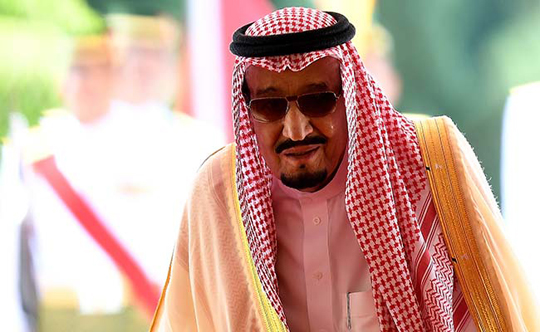
salman

The entourage's total baggage weighs a reported 506 tons.

This week, Salman decided to extend his stay at a luxury resort on the scenic Indonesian island of Bali - perhaps an easy decision - ahead of stops in Japan and China. Salman began his trip in Malaysia, where he oversaw the inking of lucrative oil pacts and was apparently the subject of a foiled assassination attempt before he called on the sultan of Brunei.

The trip has huge implications, both for regional politics and for Washington. The Saudis are deeply aware of the need to diversify their economy, which is heavily dependent on oil exports, and are keen to attract investment from major Asian economies in addition to spreading their own largesse. They also see Southeast Asia, with its huge population of Sunni Muslims, as a realm where they can exert power.

At a time when uncertainty and political paralysis seems to be gripping the West, a pivot to Asia makes a great deal of sense. "There can also be no doubt that the not-too-subtle subtext of the king's tour is a signal that Saudi Arabia will preserve its flexibility when it comes to its dealings with the United States," wrote Gerald Feierstein in Foreign Affairs.

But one arena for Saudi expansion is perhaps surprising: the Maldives, which Salman will visit on the way back to Riyadh. The nation made of Indian Ocean islands may have a tiny population - about 400,000 people - but it is a vast ocean state, spanning some 1,000 kilometers across some of the world's most significant shipping routes. Controversy is swirling there about a reported Saudi plan to invest billions of dollars in Faafu atoll, which comprises 26 islands.

The Maldivian government, led by President Abdulla Yameen, has argued that the deal would lead to infrastructure investment and new housing in a country imperiled by rising sea levels. Critics insist the government is essentially handing a chunk of the country to foreign buyers in order to line its own pockets.

A government statement this week rejected such claims. "The administration categorically rebuts allegations that the atoll has been 'sold off' to a foreign entity," it read. But little has been revealed about the plans for the atoll or the nature of the investment deal.

"I find it very difficult to believe this is a straightforward commercial enterprise," said opposition leader Mohamed Nasheed during a trip to Washington. "Usually you have to have a proper, transparent bidding process, but President Yameen has chosen to do it in the dark."

Nasheed, who lives in exile in London, endured years of imprisonment as a political dissident before helping bring down a three-decade-long dictatorship. He won the Maldives' first free and fair democratic elections in 2008, but his rule was cut short by what most international observers characterized as a coup in 2012.

A tumultuous period followed, in which Nasheed won fresh elections, was thwarted by political opponents and eventually ended up in jail once more on trumped-up charges. The work of an international team of lawyers, including Amal Clooney, won him medical leave last year and led him to claim asylum in Britain.

But Nasheed has not given up the fight, and he said he worries about the corrosive influence the Saudis may have on his country. "It's one thing not to have democracy and freedom of expression, to have a dictator," Nasheed said. "But it's another thing to lose an atoll, to lose sovereignty. I am sure that the Maldivian people are very worried, and they may see how they want to push back these designs."

The disquiet extends beyond simply the Saudi role in the atoll deal. The Maldives is an almost-exclusively Sunni Muslim country. In recent years, a troubling religious radicalization has taken root in what was historically one of the most laissez-faire corners of the Muslim world. An estimated 200 to 300 Maldivians have gone to Syria to join jihadist groups, an astonishing statistic when you consider the size of the nation's population. (If Americans went to Syria in the same proportion, there would be just under 165,000 of them - at minimum.)

Nasheed lays this in part at the feet of the Saudis, who have spent decades spreading their stridently orthodox brand of Islam to other Muslim-majority nations. In Indonesia, the world's most populous Muslim country, a network of Saudi-built schools, mosques and medical facilities has bred both goodwill toward the kingdom and a new generation of adherents to its uncompromising faith. "This very narrow version of Islam favors their authoritarian rule," Nasheed said of the Saudis. "It has been propagated in the Maldives for many years and has created a breeding ground for radical Islam."

The Saudis aren't the only outside power interested in the Maldives. China sees the Maldives as a key linchpin in its vision of a "new maritime Silk Route," threading Chinese energy and trade interests to the Middle East. Beijing has been steadily expanding its footprint in the Indian Ocean and deepening ties with Yameen's government.

Nasheed suggests Beijing may also have a role in the Saudi atoll project and may use its increasing leverage over the Maldives to shoulder aside its regional rival, India. The Maldivian government last year gave a Chinese state-run company a 50-year lease on an uninhabited island near the capital isle, Male.

"We do not want to sit in the middle of a Cold War in between countries," Nasheed said.

But when the mammoth entourage of the Saudi monarch eventually circles over the Maldives' turquoise lagoons, it will be hard not to see the start of a new Great Game in Asia.

Comments

Add new comment

  • Coastaldigest.com reserves the right to delete or block any comments.
  • Coastaldigset.com is not responsible for its readers’ comments.
  • Comments that are abusive, incendiary or irrelevant are strictly prohibited.
  • Please use a genuine email ID and provide your name to avoid reject.
News Network
March 28,2020

Mar 28: Just hours after Prime Minister Narendra Modi spoke to the Abu Dhabi crown prince on the Coronavirus Pandemic, India “thanked the UAE authorities for accommodating the 19 Indian nationals who were stuck at Dubai airport for past several days”.

The Indian mission in Dubai tweeted, “They got stranded due to various restrictions to deal with Covid-19 pandemic. Hotel rooms have been given to them inside the airport. Our Consulate had been in constant touch with the Indian nationals and UAE and Indian authorities. We had also provided some financial help to enable our stranded passengers to buy food. The situation was tough due to the pandemic situation.”

During their conversation last evening, Abu Dhabi crown prince Sheikh Mohammed Bin Zayed Al Nahyan had “assured Prime Minister Narendra Modi about the welfare of the over two million Indians living in UAE and contributing to its economy”. PM Modi “thanked the Crown Prince for his personal attention to the health and safety of Indian expatriates in the present situation”.    

A statement issued late on Thursday night by the MEA said, “The two leaders exchanged information and views on the ongoing COVID-19 pandemic, the situation in their respective countries, as well as the steps being taken by their Governments. They agreed that the next few weeks would be crucial to control the spread of the virus, and required concerted and coordinated efforts by all countries. In this context, they appreciated the organisation of a Virtual Summit among G20 Leaders earlier in the day, to discuss the pandemic.

Both leaders emphasised the importance they attach to the strength and richness of the bilateral relationship. They agreed to maintain regular consultations between their officials in the present situation, particularly to ensure continuity of logistical supply lines.”

Comments

Add new comment

  • Coastaldigest.com reserves the right to delete or block any comments.
  • Coastaldigset.com is not responsible for its readers’ comments.
  • Comments that are abusive, incendiary or irrelevant are strictly prohibited.
  • Please use a genuine email ID and provide your name to avoid reject.
Agencies
April 2,2020

Ankara, Apr 2: Saudi Arabia on Thursday declared a 24-hour lockdown in all parts of Makkah and Medina cities as part of measures to stem the spread of the coronavirus.

"The 24-hour curfew will be imposed in all parts of the cities of Makkah and Medina, with a ban on entry and exit from both cities," the Saudi Interior Ministry said on Twitter.

The lockdown starts from Thursday “until further notice.”

All commercial activities inside the residential neighborhoods of the two cities were also prohibited, except for pharmacies, food products stores, gas stations and banking services, the ministry said.

After first appearing in Wuhan, China last December, the virus has spread to at least 180 countries and regions, according to U.S.-based Johns Hopkins University.

Its data shows the number of confirmed cases worldwide have surpassed 962,900, with the death toll over 49,100 and more than 202,700 recoveries.

Anadolu Agency website contains only a portion of the news stories offered to subscribers in the AA News Broadcasting System (HAS), and in summarized form. Please contact us for subscription options.
Related topics

Comments

Add new comment

  • Coastaldigest.com reserves the right to delete or block any comments.
  • Coastaldigset.com is not responsible for its readers’ comments.
  • Comments that are abusive, incendiary or irrelevant are strictly prohibited.
  • Please use a genuine email ID and provide your name to avoid reject.
News Network
May 5,2020

Dubai, May 5: A Saudi ministerial decision issued on Monday allows companies in the private sector to reduce salaries by 40 per cent and allows termination of contracts owing to the economic hardships resulting from the COVID-19 pandemic, according to daily newspaper Al Sharq Awsat.

The new decision was still not published by the cabinet according to the newspaper.

The decision which the newspaper saw a copy of was signed by Saudi Ministry of Human Resources and Social Development to regulate the labour contract in the current period, allows employers to reduce the employees salaries by 40 percent of the actual effective wage for a period of 6 months, in proportion to the hours of work and allowing the termination of employee contract after 6 months of the COVID-19 circumstances.

The new decision has also included a provision in which the employer would be allowed to cut wages even he or she benefits from the subsidy provided by the goverment, such as those for helping pay workers wages or exemption from government fees.

The decision also stressed that employers are not allowed to terminate any employee, unless three conditions are met.

1.            First the passing of six months since the measures of salary cut has been taken

2.            Reducing pay, annual leave and exceptional leave were all used

3.            Company proves that its facing financial troubles due to the circumstances.

The memo, which goes into affect as soon as its published in the government’s official newspaper, ensures that the employee will receive his/her salary if on annual leave within the period of 6 months.

Comments

Add new comment

  • Coastaldigest.com reserves the right to delete or block any comments.
  • Coastaldigset.com is not responsible for its readers’ comments.
  • Comments that are abusive, incendiary or irrelevant are strictly prohibited.
  • Please use a genuine email ID and provide your name to avoid reject.