Saudi makes ‘intense efforts’ in identifying terror cells

February 17, 2017

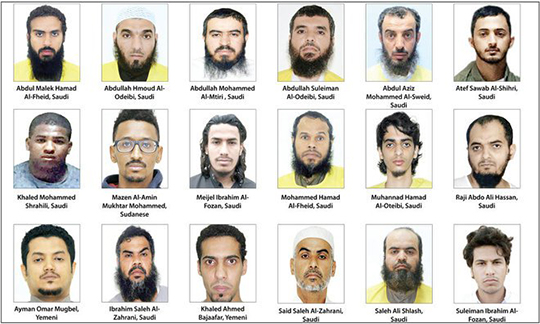
Riyadh, Feb 17: Security forces in Saudi Arabia are undertaking “intense efforts” to identify terror cells, an official has said.

rogues

Maj. Gen. Bassam Attia, director of the Investigations and Strategic Planning Center of the Interior Ministry, and ministry spokesman Maj. Gen. Mansour Al-Turki, described in a press conference how security agencies immediately start investigating information received about suspected criminals.

Such was the case last Saturday, when information was received about individuals from four separate regions of Saudi Arabia, who were suspected of being involved in terrorist cells. Arrests were made days later.

“Even if we fail the first time to arrest some of the individuals about whom we have confirmation that they are connected with terrorist cells, we will know their names,” said Al-Turki.

“In many cases we will have announced the results of the investigation and the names of those involved, or any evidence confirming their links to terrorist cells.

“Security authorities exert intense efforts to identify such cells. We cannot be certain about the number of cells still in operation, but often these are cells that are logistically important to the organization; they remain under the radar because their members are not directly linked to terrorist activities and are also careful.”

Attia said the Kingdom is actively coordinating with international authorities in combating terrorism funding, especially to Daesh.

Comments

Add new comment

  • Coastaldigest.com reserves the right to delete or block any comments.
  • Coastaldigset.com is not responsible for its readers’ comments.
  • Comments that are abusive, incendiary or irrelevant are strictly prohibited.
  • Please use a genuine email ID and provide your name to avoid reject.
Agencies
June 9,2020

Dubai, Jun 9: Dubai's Emirates airline has begun laying off employees to reduce cost and save cash as the carrier looks to rightsize its workforce.

"We at Emirates have been doing everything possible to retain the talented people that make up our workforce for as long as we can. However, given the significant impact that the pandemic has had on our business, we simply cannot sustain excess resources and have to rightsize our workforce in line with our reduced operations. After reviewing all scenarios and options, we deeply regret that we have to let some of our people go," the spokesperson said in the statement.

Citing sources, Reuters and Bloomberg earlier reported that a majority of those being made redundant are cabin crew workers as well as a minority of its engineers and pilots, including those flew the Airbus A380.

"This was a very difficult decision and not one that we took lightly. The company is doing everything possible to protect the workforce wherever we can. Where we are forced to take tough decisions we will treat people with fairness and respect. We will work with impacted employees to provide them with all possible support," said the statement.

The spokesperson, however, didn't disclose how many employees are being made redundant in this latest round of rightsizing the workforce.

Emirates on Sunday confirmed that it extended the period of reduced pay for its staff for another three months till September. It had previously reduced basic wages by 25 to 50 per cent for three months from April, with junior employees exempted.

The airline had employed around 60,000 people at the end of its 2019-20 financial year.

Saj Ahmad, chief analyst at StrategicAero Research, said the announced job cuts at Emirates will likely not be the last given the unprecedented damage that Covid-19 has had not just on air travel, but on the entire aviation industry as a whole.

"Emirates' massive international network means that job reductions were always a last resort option as the company staves off cash burn and expenses at a time when revenues are dried up. While Emirates SkyCargo is enjoying a resurgence in activities, the reality is that this income will never offset the lost money from passenger operations," he added.

"Whilst some salary reduction schemes have prevented bigger job cuts for now, the absence of a cure or medicinal suppressant of Covid-19 means that air travel is unlikely to even reach pre-9/11 levels within 3-5 years, let alone pre-Covid-19 levels in that same time period. For that reason, Emirates' reduction in headcount is necessary to stay competitive, agile and be ready for when air travel can resume with a degree of normalcy that we have been accustomed to for decades," said Ahmad.

Comments

Add new comment

  • Coastaldigest.com reserves the right to delete or block any comments.
  • Coastaldigset.com is not responsible for its readers’ comments.
  • Comments that are abusive, incendiary or irrelevant are strictly prohibited.
  • Please use a genuine email ID and provide your name to avoid reject.
News Network
April 26,2020

Abu Dhabi, Apr 26: Indian Ambassador to the UAE Pavan Kapoor says he is appalled after the bodies of three Indians flown back to India were returned to Abu Dhabi on Friday.

The three deceased Indian nationals had died of non-coronavirus causes and were flown to Delhi on Thursday but were promptly returned by authorities there.

“We are appalled at what has happened,” Kapoor told Gulf News. “We do not know if the bodies were returned because of coronavirus-related restrictions, but we are obviously not sending the remains of people [who have passed away from COVID-19],” he added.

“[As we understand], it happened because of new protocols at the airport and we are trying to sort it out,” he said.

Sent back a few hours later

“The remains were not offloaded from the plane, and were sent back a few hours later,” Kapoor explained.

The deceased were Kamlesh Bhatt, who passed away on April 17, and Sanjeev Kumar and Jagsir Singh who both died on April 13.

According to reports in Indian media, Kamlesh Bhat was 23 years old, and hailed from Tehri Garhwal district. He allegedly died of cardiac arrest. Along with the remains Kumar and Singh, Bhatt’s body was initially repatriated on an Etihad Airways flight, then sent back, even though his relatives had been on their way to collect them.

Kapoor explained the procedure through which remains are normally returned to family members back home, saying that the worker’s employer typically makes arrangements with cargo companies to repatriate bodies on cargo aircraft.

The employer applies for a No Objection Certificate from the Indian Embassy, which is granted once the Embassy ensures that all local formalities have been completed. The cargo company then applies for airport clearance, and the airline obtains approvals from the receiving airport.

“If airport protocols have changed, it means cargo companies have to be more careful about the clearance they’re getting,” Kapoor advised.

Additional costs
The ambassador added there may eventually be additional costs to repatriate the bodies but that it is first necessary to sort out the concerns.

The global coronavirus outbreak has spawned difficulties in repatriating mortal remains as a result of the travel restrictions imposed by countries. Remains of people dying from COVID-19 are not being sent back, but the caution surrounding the handling of bodies often affects the repatriation of those who succumb to other causes.

As Gulf News reported, Kerala chief minister Pinarayi Vijayan reached out to Indian Prime Minister Narendra Modi on Friday for intervention in bringing back the bodies of Keralites who have died in the Gulf from non-COVID-19 causes.

“I would like to draw your attention to the grievances received from Non-resident Keralites Associations (NRKs) in the Gulf Cooperation Council (GCC) countries on the delay caused in bringing home the mortal remains of NRKs who had expired due to reasons other than the COVID-19 infection,” read the letter by the CM.

“It is learnt that a ‘clearance certificate’ from the Indian Embassies is required to process the application of bringing home the mortal remains of the dead. The Embassies are [further] insisting on the production of a no-objection certificate from the Ministry of Home Affairs (MHA), New Delhi. To enable to bring back the bodies of the NRIs whose deaths occurred due to reasons other than COVID-19 infection, without necessary procedural hassles, I request your kind intervention,” Vijayan has requested.


Comments

Add new comment

  • Coastaldigest.com reserves the right to delete or block any comments.
  • Coastaldigset.com is not responsible for its readers’ comments.
  • Comments that are abusive, incendiary or irrelevant are strictly prohibited.
  • Please use a genuine email ID and provide your name to avoid reject.
Agencies
July 31,2020

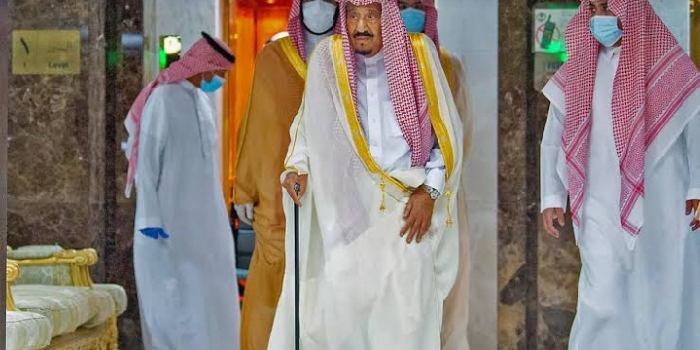
Makkah, Jul 31: Organising this year's scaled-down hajj required "double efforts" by Saudi authorities amid the coronavirus pandemic, King Salman said Friday after being discharged from hospital following gall bladder surgery.

Only up to 10,000 people already residing in the kingdom are participating in this year's pilgrimage, compared with 2019's gathering of some 2.5 million from around the world.

"Holding the ritual in the shadow of this pandemic... required reducing the numbers of pilgrims, but it obliged various official agencies to put in double efforts," 84-year-old King Salman said in a speech read out on state television by acting media minister Majid Al-Qasabi.

"The hajj this year was restricted to a very limited number of people from multiple nationalities, ensuring the ritual was completed despite the difficult circumstances," he said.

The speech came on the occasion of Eid al-Adha, the Muslim festival of sacrifice, a day after the king left hospital following a 10-day stay for surgery to remove his gall bladder.

The hajj, which began on Wednesday, is one of the five pillars of Islam and a must for able-bodied Muslims at least once in their lifetime.

Authorities implemented the "highest health precautions" during the rituals, the king said.

Pilgrims, who were all tested for the virus, are required to wear masks and observe social distancing.

For Friday's "stoning of the devil", the last major ritual of the hajj, Saudi authorities offered the pilgrims pebbles that were sanitised to protect against the pandemic.

In a sign that its strict measures were working, the health ministry reported no coronavirus cases in the holy sites on Wednesday or Thursday.

Comments

Add new comment

  • Coastaldigest.com reserves the right to delete or block any comments.
  • Coastaldigset.com is not responsible for its readers’ comments.
  • Comments that are abusive, incendiary or irrelevant are strictly prohibited.
  • Please use a genuine email ID and provide your name to avoid reject.