



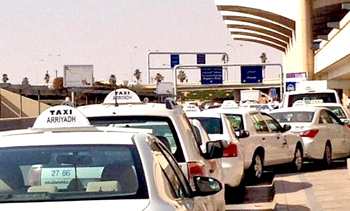
Saudi: Passenger insurance a must for taxis

November 9, 2014

taxis insuranceJeddah, Nov 9: The Ministry of Transport has decided to implement new regulations for taxis, whether owned by individuals or firms, starting from mid-February.

The new regulations involve extensive amendments, mainly insurance coverage to include third parties, the passengers and drivers through an insurance company licensed to operate in the Kingdom.

Also, vehicles must be equipped with GPS and automated tracking, and guiding systems linked with the headquarters of the facility in accordance with the terms and conditions issued by the ministry.

About one percent of the total number of cars operating under the facility’s management should be equipped with means to commute passengers using wheelchairs.Individuals may operate in this field of business after acquiring the necessary permits and in accordance with the conditions laid down in this regard.

The conditions stipulate that the vehicle must be owned and registered by the driver himself; however, exempted are cars funded and owned under the program of installments of firms offering taxi loans.

The driver must have a first-category driving license, and he should drive the vehicle himself.

The automobile liability insurance policy must cover third parties and passengers through an insurance company licensed to operate in the Kingdom.

The regulations allow firms and individuals to commute passengers from the city that issues the vehicle’s license to another city. Transporting the passengers must be done through taxi offices authorized to operate between cities, and the driver of the vehicle, on reaching the city of destination, should not operate his taxi in that city.

Such firms and individuals operating in the transport sector may transport passengers from airports, seaports, railways and public places. They should comply with the regulations and directions of the bodies of jurisdiction in this regard, including their required fee payments.

The regulations envisage that the driver must have first category driving license, should be able to read and write, in particular read road signs and maps.

The driver must produce a medical report stating he is free of infectious diseases.

Any facility operating a number of taxis must make its drivers follow a dress code (uniforms) after the approval of the ministry.

They should see to it that all drivers comply with the regulations; it becomes obligatory for them to fasten seatbelts for drivers and passengers in accordance with traffic regulations. The drivers must abstain from seeking clients, either by calling them or blowing the horn, or in any other manner that causes nuisance.

Drivers must also refrain from loading luggage other than hand baggage inside the car’s boot or passengers’ compartment. They should help passengers with special needs and elders to board the vehicle and alight from it.

Smoking is banned inside vehicles for both drivers and passengers; also drivers should not switch on their audiovisual equipment if disliked by the passengers.

The regulation also bans drivers from going about the streets in search of passengers. Passenger belongings left behind in the vehicles should be handed over by the drivers to their company executives who, in turn, should hand them to the nearest police station with a report stating the description of the items.

The life span of the vehicle in use should not be older than six years since its manufacture. The firm or individual operating the vehicle must install two identification boards — the first one should be installed in a place visible to the passenger in front and the other behind the driver’s seat for the passengers seated behind, in accordance with the directions and specifications adopted by the ministry.

The data displayed in the vehicle should include the authorized number to operate the vehicle, the number of the vehicle’s registration plate, the name of the individual or company owning the vehicle, the contact phone number, the name of the driver and their commitment to work under the regulations.

Also, details of social insurance and the directions of the Ministry of Labor related to employment of Saudi nationals and adherence to the Saudization ratio should also form part of the data on display.

Comments

Add new comment

  • Coastaldigest.com reserves the right to delete or block any comments.
  • Coastaldigset.com is not responsible for its readers’ comments.
  • Comments that are abusive, incendiary or irrelevant are strictly prohibited.
  • Please use a genuine email ID and provide your name to avoid reject.
Agencies
June 28,2020

Kuwait, Jun 28: Measures imposed to curb the spread of the novel coronavirus in Kuwait are believed to have increased suicide cases in the country, according to a media report.

Forty suicide cases and 15 failed attempts, mainly among Asian expatriates, have been recorded in Kuwait since late February, Gulf News quoted the Al Qabas newspaper report, citing sources as saying on Saturday.

Investigations into the majority of cases have revealed that those who committed suicide had experienced psychological and economic troubles due to dire financial circumstances after their employers stopped to pay them as a result of economic fallout from the coronavirus-related measures.

In one case, an expat livestreamed his suicide while chatting with his fiancee on a social networking platform, the newspaper report said.

Suicide cases have increased by around 40 per cent since the start of the COVID-19 crisis, according to the sources.

Some 70 to 80 suicide cases are recorded annually in Kuwait. Last year, they reached 80 suicides against 77 in 2018.

"Suicide cases have started to go up in Kuwait during the coronavirus pandemic due to fear, anxiety, isolation and instability experienced by people and absence of daily aims that could help the person to spend time regularly as before," the newspaper quoted social psychology consultant Samira Al Dosari as saying.

Uncertainty for some expatriates, whose countries have refused to take them in, is another motive for attempting suicide, according to Jamil Al Muri, a sociology professor at the Kuwait University.

"This is in addition to greed of the iqamat traders, who have brought into the country workers in names of phantom companies and abandoned them on the streets," he added.

Starting from Tuesday, Kuwait will embark on the second phase of a stepwise plan to bring life to normal, Gulf News reportd.

According to Phase 2, a nationwide night-time curfew will be reduced by one hour to run daily from 8 p.m. until 5 a.m. for three weeks.

Kuwait has so far reported 44,391 COVID-19 cases, with 344 deaths.

Comments

Angry indian
 - 
Tuesday, 30 Jun 2020

YA ALLah save all dispressed people in the earth..

Add new comment

  • Coastaldigest.com reserves the right to delete or block any comments.
  • Coastaldigset.com is not responsible for its readers’ comments.
  • Comments that are abusive, incendiary or irrelevant are strictly prohibited.
  • Please use a genuine email ID and provide your name to avoid reject.
News Network
February 5,2020

The Organisation of Islamic Cooperation (OIC) has said it rejects US President  Donald Trump 's recently unveiled Middle East plan.

The 57-member body, which held a summit on Monday  to discuss the plan in Saudi Arabia's Jeddah, said in a statement that it "calls on all member states not to engage with this plan or to cooperate with the US administration in implementing it in any form".

Requested by the Palestinian leadership, the meeting of the body came two days after the Arab League rejected Trump's so-called "deal of the century", saying: "It does not meet the minimum rights and aspirations of Palestinian people."

Addressing a pro-Israel audience at the White House with Israeli Prime Minister Benjamin Netanyahu by his side, Trump on Tuesday described his long-delayed plan for resolving the Israeli-Palestinian conflict as a "win-win solution" for both sides.

The US president said his proposed deal would ensure the establishment of a two-state solution, promising Palestinians a state of their own with a new capital in Abu Dis, a suburb just outside Jerusalem. Trump also said Jerusalem would be the "undivided capital" of Israel. The Palestinians want both occupied East Jerusalem and the West Bank to be part of a future state.

Palestinian leaders, who were absent during the announcement and had rejected the proposal even before its release, denounced the plan as "a new Balfour Declaration" that heavily favoured Israel and would deny them a viable independent state.

The OIC said in a statement on Twitter on Sunday that its "open-ended executive committee meeting" at the level of foreign ministers would "discuss the organisation's position after the US administration announced its peace plan".

With member states from four continents, the OIC is the second-largest intergovernmental organisation in the world after the United Nations, with a collective population reaching more than 1.8 billion.

The majority of its member states are Muslim-majority countries, while others have significant Muslim populations, including several African and South American countries. While the 22 members of the Arab League are also part of the OIC, the organisation has several significant non-Arab member states, including Turkey, Iran and Pakistan. It also has five observer members, including Russia and Thailand.

Iran 'barred'

Meanwhile, Iran on Monday accused its regional rival Saudi Arabia of blocking its officials from attending the OIC meeting.

"The government of Saudi Arabia has prevented the participation of the Iranian delegation in the meeting to examine the 'deal of the century' plan at the headquarters of the Organization of Islamic Cooperation," Fars news agency quoted Abbas Mousavi, spokesman for Iran's foreign ministry, as saying.

Mousavi said Iran - one of the countries to strongly condemn Trump's plan - had filed a complaint with the OIC and accused its regional rival of misusing its position as the host for the organisation's headquarters.

There was no immediate comment from Saudi officials.

Following the unveiling of Trump's plan, the Saudi foreign ministry expressed appreciation for Trump's efforts and support for direct peace negotiations under Washington's auspices, while state media reported that King Salman had called Palestinian President Mahmoud Abbas to reassure him of Riyadh's unwavering commitment to the Palestinian cause.

The announcement of Trump's plan drew mixed responses from Arab states.

Observers said the reaction was indicative of the division among Arab countries and their inability to prioritise the Palestinian people's plight over domestic economic agendas and political calculations in relation to the Trump administration.

Comments

Add new comment

  • Coastaldigest.com reserves the right to delete or block any comments.
  • Coastaldigset.com is not responsible for its readers’ comments.
  • Comments that are abusive, incendiary or irrelevant are strictly prohibited.
  • Please use a genuine email ID and provide your name to avoid reject.
Agencies
May 7,2020

Dubai, May 7: Indians in the UAE have voiced scepticism about a "massive" operation announced by New Delhi to bring home some of the hundreds of thousands of nationals stranded by coronavirus restrictions.

"It is just propaganda," said Ishan, an Indian expatriate in Dubai, one of seven emirates in the UAE and long a magnet for foreign workers.

He was reacting to his government's announcement this week that it would deploy passenger jets and naval ships to bring home citizens stuck in a host of countries.

India's consulate in Dubai said it received about 200,000 requests from nationals seeking repatriation -- mostly workers who have lost their jobs in the pandemic.

One vessel was heading to the UAE, India's government said, while two flights were scheduled to depart the UAE for India on Thursday.

But the plans drew scorn from Ishan, who was a manager at a luxury services company before he was made redundant last month.

"It's like throwing a dog a bone," the 35-year-old complained on Wednesday, dismissing the Indian government's efforts as a drop in the ocean.

"Let's say they repatriate 400 people on the first day, and about 5,000 people in 10 days, what difference has it made?"

India banned all incoming commercial flights in late March as it imposed one of the world's strictest lockdowns to tackle the spread of coronavirus.

The UAE is home to a 3.3-million-strong Indian community, who make up around 30 per cent of the Gulf state's population.

To the anger of some Indian expatriates, the evacuees will have to pay for their passage home and spend two weeks in quarantine on arrival.

"We are upset over the failure of our government," Ishan said. "What about the people with no money? How are you helping them?"

The Indian consulate could not be reached for comment.

Ibrahim Khalil, head of the Kerala Muslim Cultural Center in Dubai, said the consulate had asked him to select 100 Indian nationals for repatriation.

"We are planning to pay for the tickets of those who cannot afford it," he said, adding that the elderly, pregnant and those suffering from illnesses were a priority.

But one Indian woman, eight months pregnant in the neighbouring emirate of Sharjah, was not one of the lucky ones chosen to go back home in one of Thursday's planned departures.

"We called them but nobody would pick up," the 26-year-old, who requested anonymity, told AFP.

She arrived in the UAE a few months ago to visit her husband, who lives in a shared apartment with another family to save money.

"We have no insurance here and the medical expenses are too costly," said the woman, who was anxious to leave to give birth at home.

"I just hope that I am chosen to go back to India. I don't know why I haven't been considered."

Comments

Add new comment

  • Coastaldigest.com reserves the right to delete or block any comments.
  • Coastaldigset.com is not responsible for its readers’ comments.
  • Comments that are abusive, incendiary or irrelevant are strictly prohibited.
  • Please use a genuine email ID and provide your name to avoid reject.