


Saudi-Peruvian cooperation accord in the works

December 5, 2016

Riyadh, Dec 5: Saudi Arabia and Peru, a South American nation with a high human development index, are working on a comprehensive framework agreement to boost cooperation in all sectors following the opening of the Saudi Embassy in the Peruvian capital Lima last year.
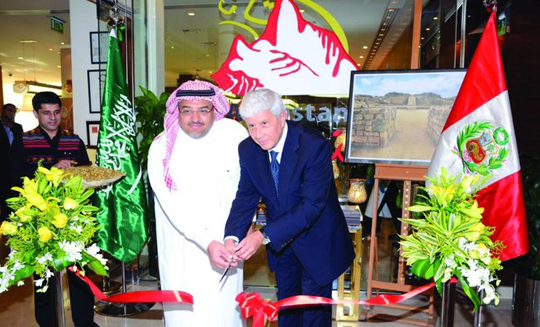
Peruvian

The proposed accord will cover economy, trade, investment, culture and other areas of cooperation.

“Negotiations for this framework agreement are about to be completed soon,” said Carlos Zapata, Peruvian ambassador, here on Sunday. “The accord is expected to be signed sometime next year,” said Zapata, adding that the goal is to further strengthen bilateral relations, as well as to ensure more “cultural closeness.”

The Peruvian envoy was speaking after formally opening a cultural festival at the local InterContinental Hotel here.

Referring to the exchange of visits of top Saudi and Peruvian officials, the ambassador said that “the visit of a business delegation from Lima to the Kingdom is in the cards.” He pointed out that Peru opened its embassy in Riyadh in 2012. Peru and Saudi Arabia still face a huge task in building relations, but the two countries seek to work on all avenues for improving and strengthening cooperation, he added.

Zapata cited the case of Saudi entrepreneur Adnan Kayal, who has opened seven Peruvian restaurants in Jeddah, to drive home his point that cultural relations can be promoted by anyone. Kayal, who studied in the United States where he developed a taste and love for Peruvian cuisine, has announced plans to open five more restaurants in Jeddah and Riyadh in the near future.

Peruvian dishes will be served at the hotel’s Bustan Restaurant as part of the week-long festival, which will conclude on Dec 10. Lima was awarded the title of the “World’s Best Gastronomy Capital” for three consecutive years.

The Peru cultural fest at the InterContinental also includes a ladies’ workshop, which will teach female Saudi chefs and entrepreneurs about advantages and wonderful properties of the “quinoa” grains, and how to prepare Peruvian dishes. The hotel manager said that the hotel has lined up several cultural events including food festivals during 2017.

Comments

Add new comment

  • Coastaldigest.com reserves the right to delete or block any comments.
  • Coastaldigset.com is not responsible for its readers’ comments.
  • Comments that are abusive, incendiary or irrelevant are strictly prohibited.
  • Please use a genuine email ID and provide your name to avoid reject.
News Network
May 20,2020

Cairo, May 20: A senior Kuwaiti lawmaker has called for imposing a tax on expatriates’ remittances to shore up the country’s finances.

MP Khalil Al Saleh, the head of the parliament’s Human Resources Committee, has presented a draft law on the proposed tax to the legislature.

“Imposing fees on expatriates’ transfers will have a role in improving the state's revenues and diversify sources of income,” he told Al Rai newspaper.

Migrant workers transfer about 4.2 billion dinars annually from Kuwait, he added, citing figures from Kuwait’s Central Bank.

“This system is in effect in most countries of the world and in more than one Gulf country. Expats there have not objected to it. Allowing this money to exit the country is very dangerous and has a direct effect on economy,” MP Al Saleh said.

“We do not target brotherly expats because imposing symbolic fees on financial transfers will not affect their money, but will have a positive effect on the state’s sources,” he said. “This has become a necessity after the money transferred outside Kuwait has reached 4.2 billion dinars annually without the state [Kuwait] making any benefit from this.”

Foreign workers make up 3.3 million of Kuwait’s 4.6 million population.

Several Kuwaiti public figures have recently pushed for redrawing the demographic imbalance in the country, accusing expatriates of straining health facilities and increasing the Covid-19 threat.

Comments

Add new comment

  • Coastaldigest.com reserves the right to delete or block any comments.
  • Coastaldigset.com is not responsible for its readers’ comments.
  • Comments that are abusive, incendiary or irrelevant are strictly prohibited.
  • Please use a genuine email ID and provide your name to avoid reject.
coastaldigest.com news network
June 29,2020

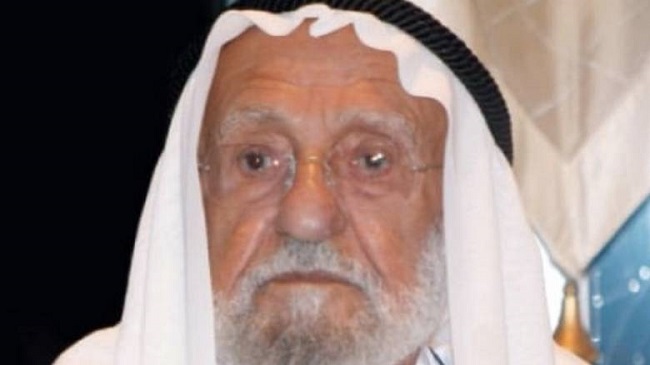
Dubai, Jun 29: Saeed bin Ahmed Al Lootah, a pioneering Emirati businessman and the founder of the world's first Islamic bank, is no more. He breathed his last on June 28.

Born in 1923, Saeed was instrumental in setting up the Dubai Islamic Bank (DIB) in 1975 to provide the community with a Sharia-compliant alternative to conventional banking.

He established several companies, organisations and societies, including the Dubai Consumer Cooperative. He also established the Islamic Education School in 1983 and the Dubai Medical College for Girls in 1986.

In 1992, Haj Saeed established the first College of Pharmacology in Dubai. Later he launched the Dubai Centre for Environmental Research, the Dubai Specialised Medical Centre, and the Medical Research Labs for health control and research into medicinal herbs and Islamic (Nabawi) medicine. He also set up an orphanage.

Saeed bin Ahmed Al Lootah was a self-made businessman who progressed from being a seafarer and trader to an accomplished tutor, author, economist, banker, entrepreneur, businessman and visionary community leader.

According to details available on the S.S. Lootah Group website, his "fervent adherence to the core values of education, cooperation and economy" helped empower "people to excel at everything they do".

"He realised the need to build permanent houses and ventured into construction. His 'capital' at that time were his skills, knowledge and hard work," the website said.

He laid the foundation of S.S.Lootah Contracting Company as a joint venture with his brother Sultan in 1956. "With the enduring values of education, cooperation and economy set as the foundations of his work, Haj Saeed started a number of businesses as well as not-for-profit education and research ventures, with an aim to serve the people of the UAE.

"Thanks to his vision and leadership, our home grown ventures continue to demonstrate unique values that extend well beyond its functional benefits - creating greater economic, social and environmental benefits for people in UAE and beyond."

Sheikh Mohammed bin Rashid Al Maktoum, Vice-President and Prime Minister of the UAE and Ruler of Dubai, took to Twitter on Sunday to offer his respects.

Sheikh Mohammed said: "He was a trader who started with nothing. His touch is visible in several aspects of the Dubai economy."

Calling the deceased a "wise and smart man", Sheikh Mohammed said: "May Allah bless his soul and grant his family the strength to endure and persevere."

Sheikh Hamdan bin Mohammed bin Rashid Al Maktoum, Crown Prince of Dubai, also paid his respects. "He combined economic leadership with charitable work. He launched charitable educational institutions and sponsored many orphans. His memory will live on. May Allah have mercy on him and grant his family patience."

Comments

Add new comment

  • Coastaldigest.com reserves the right to delete or block any comments.
  • Coastaldigset.com is not responsible for its readers’ comments.
  • Comments that are abusive, incendiary or irrelevant are strictly prohibited.
  • Please use a genuine email ID and provide your name to avoid reject.
Agencies
April 8,2020

Riyadh, Apr 8: Saudi Arabia's health minister has warned the number of COVID-19 cases in the country could reach 200,000 in coming weeks.

As of Tuesday, the kingdom registered a total of 2,795 coronavirus infections, including 41 deaths.

"Within the next few weeks, studies predict the number of infections will range from a minimum of 10,000 to a maximum of 200,000," health minister Tawfiq al-Rabiah was cited as saying by the official Saudi Press Agency on Tuesday.

On Monday, Saudi Arabia extended the duration of daily curfews in four governorates and five cities to 24 hours.

The kingdom imposed round-the-clock lockdowns in the capital Riyadh, Tabuk, Dammam, Dhahran and Hofuf, the interior ministry said on Twitter.

The same measures were also imposed on the governorates of Jeddah, Taif, Qatif and Khobar, the ministry added.

Authorities had already sealed off the holy cities of Mecca and Medina, barring people from entering and exiting as well as prohibiting movement between all provinces.

Last month, Saudi Arabia suspended the year-round "Umrah" pilgrimage over fears of the coronavirus pandemic spreading to Islam's holiest cities.

Authorities are yet to announce whether they will proceed with this year's Hajj, scheduled for the end of July. Last week, authorities urged Muslims to temporarily defer preparations for the annual pilgrimage.

Last year, about 2.5 million people travelled to Saudi Arabia to take part in the Hajj, which all Muslims must perform at least once in their lives if able.

The Arab world's biggest economy has also closed down cinemas, malls and restaurants and halted flights as it steps up efforts to contain the virus.

King Salman has warned of a "more difficult" fight ahead against the virus, as the kingdom faces the economic double blow of virus-led shutdowns and crashing oil prices

Comments

Add new comment

  • Coastaldigest.com reserves the right to delete or block any comments.
  • Coastaldigset.com is not responsible for its readers’ comments.
  • Comments that are abusive, incendiary or irrelevant are strictly prohibited.
  • Please use a genuine email ID and provide your name to avoid reject.