


Saudi-Peruvian cooperation accord in the works

December 5, 2016

Riyadh, Dec 5: Saudi Arabia and Peru, a South American nation with a high human development index, are working on a comprehensive framework agreement to boost cooperation in all sectors following the opening of the Saudi Embassy in the Peruvian capital Lima last year.
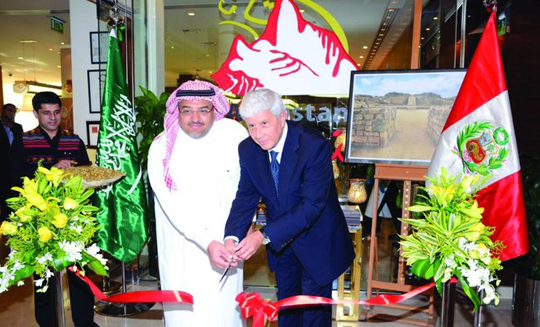
Peruvian

The proposed accord will cover economy, trade, investment, culture and other areas of cooperation.

“Negotiations for this framework agreement are about to be completed soon,” said Carlos Zapata, Peruvian ambassador, here on Sunday. “The accord is expected to be signed sometime next year,” said Zapata, adding that the goal is to further strengthen bilateral relations, as well as to ensure more “cultural closeness.”

The Peruvian envoy was speaking after formally opening a cultural festival at the local InterContinental Hotel here.

Referring to the exchange of visits of top Saudi and Peruvian officials, the ambassador said that “the visit of a business delegation from Lima to the Kingdom is in the cards.” He pointed out that Peru opened its embassy in Riyadh in 2012. Peru and Saudi Arabia still face a huge task in building relations, but the two countries seek to work on all avenues for improving and strengthening cooperation, he added.

Zapata cited the case of Saudi entrepreneur Adnan Kayal, who has opened seven Peruvian restaurants in Jeddah, to drive home his point that cultural relations can be promoted by anyone. Kayal, who studied in the United States where he developed a taste and love for Peruvian cuisine, has announced plans to open five more restaurants in Jeddah and Riyadh in the near future.

Peruvian dishes will be served at the hotel’s Bustan Restaurant as part of the week-long festival, which will conclude on Dec 10. Lima was awarded the title of the “World’s Best Gastronomy Capital” for three consecutive years.

The Peru cultural fest at the InterContinental also includes a ladies’ workshop, which will teach female Saudi chefs and entrepreneurs about advantages and wonderful properties of the “quinoa” grains, and how to prepare Peruvian dishes. The hotel manager said that the hotel has lined up several cultural events including food festivals during 2017.

Comments

Add new comment

  • Coastaldigest.com reserves the right to delete or block any comments.
  • Coastaldigset.com is not responsible for its readers’ comments.
  • Comments that are abusive, incendiary or irrelevant are strictly prohibited.
  • Please use a genuine email ID and provide your name to avoid reject.
Agencies
February 27,2020

Riyadh, Feb 27: Saudi Arabia on Thursday halted travel to the holiest sites in Islam over fears about a new viral epidemic just months ahead of the annual hajj pilgrimage, a move coming as the Mideast has over 220 confirmed cases of the illness.

The extraordinary decision by Saudi Arabia stops foreigners from reaching the holy city of Mecca and the Kaaba, the cube-shaped structure the world's 1.8 billion Muslims pray toward five times a day. It also said travel was suspended to Prophet Muhammad's mosque in Medina.

The decision showed the worry about the outbreak potentially spreading into Saudi Arabia, whose oil-rich monarchy stakes its legitimacy on protecting Islam's holy sites. The epicenter in the Mideast's most-affected country, Iran, appears to be in the holy Shiite city of Qom, where a shrine there sees the faithful reach out to kiss and touch it in reverence.

"Saudi Arabia renews its support for all international measures to limit the spread of this virus, and urges its citizens to exercise caution before traveling to countries experiencing coronavirus outbreaks," the Saudi Foreign Ministry said in a statement announcing the decision.

"We ask God Almighty to spare all humanity from all harm." Disease outbreaks always have been a concern surrounding the hajj, required of all able-bodied Muslims once in their life, especially as pilgrims come from all over the world.

The earliest recorded outbreak came in 632 as pilgrims fought off malaria. A cholera outbreak in 1821, for instance, killed an estimated 20,000 pilgrims. Another cholera outbreak in 1865 killed 15,000 pilgrims and then spread worldwide.

More recently, Saudi Arabia faced a danger from a related coronavirus that caused Middle East respiratory syndrome, or MERS. The kingdom increased its public health measures in 2012 and 2013, though no outbreak occurred.

While millions attend the 10-day hajj, this year set for late July into early August, millions more come during the rest of the year to the holy sites in the kingdom.

"It is unprecedented, at least in recent times, but given the worldwide spread of the virus and the global nature of the umrah, it makes sense from a public health and safety point of view," said Kristian Ulrichsen, a research fellow at the James A Baker III Institute for Public Policy at Rice University. "Especially since the Iranian example illustrates how a religious crossroads can so quickly amplify the spread and reach of the virus." The virus that causes the illness named COVID-19 has infected more than 80,000 people globally, mainly in China. The hardest-hit nation in the Mideast is Iran, where Health Ministry spokesman Kianoush Jahanpour said 19 people have died among 139 confirmed cases.

Experts are concerned Iran may be underreporting cases and deaths, given the illness's rapid spread from Iran across the Persian Gulf. For example, Iran still has not confirmed any cases in Mashhad, even though a number of cases reported in Kuwait are linked to the Iranian city.

In Bahrain, which confirmed 33 cases as of Thursday morning, authorities halted all flights to Iraq and Lebanon. It separately extended a 48-hour ban overflights from Dubai and Sharjah in the United Arab Emirates, through which infected travellers reached the island kingdom off the coast of Saudi Arabia.

Iranian President Hassan Rouhani said there were no immediate plans to quarantine cities but acknowledged it may take "one, two or three weeks” to get control of the virus in Iran.

As Iran's 80 million people find themselves increasingly isolated in the region by the outbreak, the country's sanctions-battered economy saw its currency slump to its lowest level against the US dollar in a year on Wednesday.

Comments

Add new comment

  • Coastaldigest.com reserves the right to delete or block any comments.
  • Coastaldigset.com is not responsible for its readers’ comments.
  • Comments that are abusive, incendiary or irrelevant are strictly prohibited.
  • Please use a genuine email ID and provide your name to avoid reject.
News Network
April 27,2020

Riyadh, Apr 27: The government of Saudi Arabia has signed a SR995 million (approx. Dh972m) contract with China to provide Covid-19 tests for nine million people in the Kingdom.

The Saudi Press Agency, SPA, reported that the decision came "as a result of a phone call made today (Sunday) between the Custodian of the Two Holy Mosques King Salman bin Abdulaziz Al Saud and Chinese President Xi Jinping."

The contract includes providing necessary equipment and supplies, making available of 500 Chinese specialists and technicians who are specialised in performing tests, establishing six large regional laboratories throughout the Kingdom; including a mobile laboratory with a capacity of performing 10,000 tests per day. Saudi cadres will also be trained to conduct daily tests and comprehensive field tests, under the new agreement

The contract was co-signed by the National Unified Procurement Company and Chinese company Huo-yan Laboratories by Dr. Abdullah Al Rabeeah, Advisor at the Royal Court, on behalf of the Government of Saudi Arabia, and Chinese Ambassador to the Kingdom Chen Weiqing, as a representative of the Chinese Government.

The contract is one of the largest contracts that will provide diagnostic tests for the novel Coronavirus.

Tests were also purchased from several other companies from the United States, Switzerland and South Korea, bringing the number of available tests to 14.5 million, covering around 40 percent of Saudi Arabia's population, SPA added.

Comments

Add new comment

  • Coastaldigest.com reserves the right to delete or block any comments.
  • Coastaldigset.com is not responsible for its readers’ comments.
  • Comments that are abusive, incendiary or irrelevant are strictly prohibited.
  • Please use a genuine email ID and provide your name to avoid reject.
News Network
April 23,2020

Riyadh, Apr 22: In an extraordinary initiative, the government of the Kingdom of Saudi Arabia has decided to facilitate the travel of expatriates who have an exit and reentry visa or final exit visa to return to their countries.

This is in line with the order of Custodian of the Two Holy Mosques King Salman, according to the Saudi Press Agency.

According to the initiative, called “Auda” (return), expatriates can apply seeking permission for travel to their countries through the Absher portal of the ministry.

Announcing this, Saudi's Ministry of Interior said that the initiative will be implemented in cooperation with a number of relevant government agencies.

Requests for travel from expatriates will be received and approved in coordination with the relevant authorities to complete their travel procedures on board international flights.

As per the initiative, a text message will be sent to the beneficiary stating the travel date, ticket number and reservation details, and by which the beneficiary can obtain his travel ticket and complete the travel procedures.

Clarifying the procedures for the travel, the ministry said that the applicant shall select the icon (Auda) after visiting the Absher portal and fill the following fields: iqama (residency permit) number, date of birth, mobile number, departure city and airport of arrival.

It is not mandatory for the expatriate to have his own Absher account for availing of the service, the ministry said, adding that this facility is to enable expatriates to benefit from this initiative.

The departure will be through the following airports: King Khalid International Airport in Riyadh, King Abdulaziz International Airport in Jeddah, Prince Muhammad International Airport in Madinah, and King Fahd International Airport in Dammam.

Those expatriates who are outside these cities can benefit from the service through entering airport of departure after completion of their travel procedures in sufficient period of time.

Comments

Add new comment

  • Coastaldigest.com reserves the right to delete or block any comments.
  • Coastaldigset.com is not responsible for its readers’ comments.
  • Comments that are abusive, incendiary or irrelevant are strictly prohibited.
  • Please use a genuine email ID and provide your name to avoid reject.