


Saudi warship hit by Houthi suicide attack returns to base

February 6, 2017

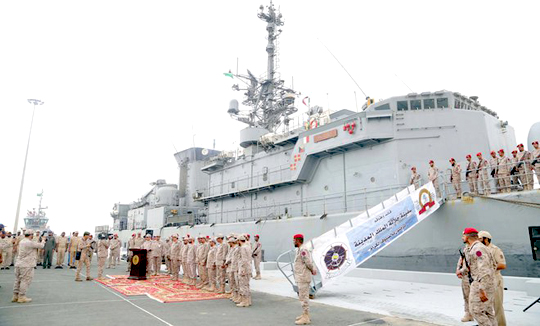
Jeddah, Feb 6: A Saudi warship targeted last month by Houthi suicide attackers returned to base on Sunday after completing its mission.
Southi

The Al-Madinah warship of the Royal Saudi Navy was in late January hit by a terrorist boat attack off the Yemeni port of Hodeidah, killing two crew members.

It returned early Sunday to the King Faisal Naval Base in Jeddah, after completing its duties according to the scheduled timeframe, without any delay as a result of the attack by the Iran-backed insurgents.

Senior officers welcomed the warship back to the naval base.

They included Lt. Gen. Abdul Rahman bin Saleh Al-Bunyan, chief of staff of the Saudi armed forces, Gen. Abdullah bin Sultan Al-Sultan, commander of the Royal Saudi Navy, and Western Fleet Commander Saeed bin Mohammed Al-Zahrani.

The chief of staff met with the ship’s crew and officers and conveyed to them the greetings of Deputy Crown Prince Mohammed bin Salman, second premier and minister of defense, who praised the crew’s courage in dealing with the attack.

Al-Bunyan listened to a briefing by the captain of the warship regarding the terrorist attack, how it was countered, and how a resulting fire was swiftly tackled.

He expressed pride in the members of the Royal Saudi Navy for participating in military operations carried out by the alliance to support legitimacy in Yemen.

Two Saudi crew members were killed and three others were injured in the suicide attack on the Saudi patrol frigate, the Arab coalition headquarters said last week.

The Saudi navy warship reacted to the attack as required, but one of the Houthi boats rear-ended the vessel, resulting in an explosion and fire at the rear of the Saudi ship, which was extinguished by the crew.

The frigate was patrolling the coast of Yemen when the attack by three suicide boats took pace, the coalition in support of the legitimate Yemeni government said earlier.

The warship’s mission involved protecting the territorial waters of the Kingdom and Yemen, in addition to ensuring the safety of international navigation lines in the strategic Bab Al-Mandab Strait.

Al-Bunyan stressed that the damage to the warship was limited to a small area at the back of the vessel, due to the collision with the terrorist’s boat.

He added that the incident will not prevent the coalition forces from continuing their military operations, until they achieve their key target of helping the Yemeni people and the legitimate government in restoring the state and protecting it from Houthi militias.

Retired Gen. Shami Al-Zahiri, who was the first captain of the frigate in 1985, recalled memories during his more than six years as commander of the ship.

“After spending all this time, it was painful for me to hear that this ship came under attack by Houthi militias,” he told Arab News.

The retired general defended the warship’s technical abilities and its ability to counter a terror attack of this nature.

“I heard how some media outlets have been criticizing the ship’s technical abilities and its leadership after the terrorist attack. I think they need to read more about the circumstances of the incident such as the weather condition and how the terrorist’s boat approached the ship before they make pre-judgmental accusations,” he said.

Comments

Add new comment

  • Coastaldigest.com reserves the right to delete or block any comments.
  • Coastaldigset.com is not responsible for its readers’ comments.
  • Comments that are abusive, incendiary or irrelevant are strictly prohibited.
  • Please use a genuine email ID and provide your name to avoid reject.
News Network
June 12,2020

Beirut, Jun 12: Angry Lebanese protesters blocked roads across the country with burning tyres, debris and their vehicles, incensed over the local currency's depreciation by more than 25 percent in just two days.

The demonstrations from northern Akkar and Tripoli to central Zouk, the eastern Bekaa Valley, Beirut and southern Tyre and Nabatieh on Thursday were some of the most widespread in months of upheaval over a calamitous economic and financial crisis.

Protesters set ablaze a branch of the Central Bank, vandalised several private banks and clashed with security forces in several areas. At least 41 people were injured in Tripoli alone, according to the Lebanese Red Cross.

"I'm really pissed off, that's all. If politicians think they can burn our hearts like this the fire is going to reach them too," unemployed computer engineer Ali Qassem, 26, told Al Jazeera after pouring fuel onto smouldering tyres on a main Beirut thoroughfare.

Tens of thousands of Lebanese have lost jobs in the past six months and hundreds of businesses have shuttered as a dollar shortage led the Lebanese pound to slide from 1,500 to $1 last summer - where it was pegged for 23 years - to roughly 4,000 for each US dollar last month.

But the slide turned into a freefall between Wednesday and Thursday when the pound plummeted to roughly 5,000 to $1 on black markets, which have become a main source of hard currency. There was widespread speculation the rate hit 6,000 or even 7,000 pounds to the dollar, though most markets stopped trading.

Protesters began amassing on streets across the country before sunset and increased into the thousands across the country as the night fell.

Prime Minister Hassan Diab cancelled all meetings scheduled for Friday to hold an emergency cabinet session at 9:30am and another at 3pm at the presidential palace to be headed by President Michel Aoun.

The pound's collapse is the perhaps the biggest challenge yet for Diab's young cabinet, which gained confidence in February after former prime minister Saad Hariri's government was toppled by an unprecedented October uprising that had the country's economic crisis at its core.

Economy Minister Raoul Nehme told Al Jazeera that there was "disinformation" being circulated about the exchange rate on social media and said he was investigating possible currency manipulation.

"I don't understand how the exchange rate increased by so much in two days," he said.

Many protesters have pitted blame on Central Bank governor Riad Salameh, nominally in charge of  keeping the currency stable. But they have also called on the government to resign.

"If people want reform between dawn and dusk, that's not going to work, and if someone thinks they can do a better job then please come forward," Nehme said.

"But what we can't have is a power vacuum - then the exchange rate won't be 5000, it'll be a catastrophe."

'Everyone paying the price'

When protesters set a large fire in Beirut's Riad al-Solh Square, which lies at the foot of a grand Ottoman-era building that serves as the seat of government, firefighters did not intervene to extinguish it.

It later became clear why: Civil Defence told local news channel LBCI they had run out of diesel to fuel their firetrucks.

Basic imports such as fuel have been hit hard by the currency crisis, making already-weak state services increasingly feeble.

A half-dozen or so police officers with Lebanon's Internal Security Forces observed the scene unfolding in front of them in the square.

"Why do you destroy shops and things and attack us security forces - do you think we're happy? Go and f****** break that wall or go to the politicians' houses," one police officer told Al Jazeera, referring to a large concrete barrier separating protesters from the seat of government.

"In the end we are with you and we want the country to change. Don't you dare think we're happy. My salary is now worth $130," the officer said.

The currency's spectacular fall seems to have pushed many Lebanese to put common interests above their differences.

Large convoys of men on motorbikes from Shia-majority areas of southern Beirut joined the demonstrations on Thursday, though they have clashed with protesters many times before - including at a protest on Saturday.

Some chanted sectarian insults, leading to brief clashes in areas that were formerly front lines during the country's devastating 15-year civil war.

Instead, the motorbike-riding demonstrators on Thursday chanted: "Shia, Sunni, F*ck sectarianism."

"We are Shia, and Sunnis and Christian are our brothers," Hisham Houri, 39, told Al Jazeera, perched on a moped with his fiancee behind him just a few metres from a pile of burning tyres.

The blaze sent thick black smoke into the sky towards an iconic blue-domed mosque and church in downtown Beirut.

"Politicians play on these sectarian issues and sometimes succeed, but in the end, they'll fail because all the people have been hurt," he said. "The dollar isn't just worth 6,000 for Shias or for Sunnis, everyone is paying that price."

Comments

Add new comment

  • Coastaldigest.com reserves the right to delete or block any comments.
  • Coastaldigset.com is not responsible for its readers’ comments.
  • Comments that are abusive, incendiary or irrelevant are strictly prohibited.
  • Please use a genuine email ID and provide your name to avoid reject.
News Network
May 11,2020

May 11: Saudi Arabia will triple its value-added tax rate and suspend a cost of living allowance for state workers, it said on Monday, seeking to shield finances hit by low oil prices and a slump in demand for its lifeline export worsened by the new coronavirus.

Historic oil output cuts agreed by Riyadh and other major producers have given only limited support to prices after they sank on oversupply caused by a war for petroleum market share between the kingdom and its fellow oil titan Russia.

Saudi Arabia, the world's largest oil exporter, is also being hit hard by measures to fight the new coronavirus, which are likely to curb the pace and scale of economic reforms launched by Crown Prince Mohammed bin Salman.

"The cost of living allowance will be suspended as of June 1, and the value added tax will be increased to 15% from 5% as of July 1," Finance Minister Mohammed al-Jadaan said in a statement reported by the state news agency. "These measures are painful but necessary to maintain financial and economic stability over the medium to long term...and to overcome the unprecedented coronavirus crisis with the least damage possible."

The austerity measures come after the kingdom posted a $9 billion budget deficit in the first quarter.

The minister said non-oil revenues were affected by the suspension and decline in economic activity, while spending had risen due to unplanned strains on the healthcare sector and the initiatives taken to support the economy.

"All these challenges have cut state revenues, pressured public finances to a level that is hard to deal with going forward without affecting the overall economy in the medium to long term, which requires more spending cuts and measures to support non-oil revenues stability," he added.

The government has cancelled and put on hold some operating and capital expenditures for some government agencies, and cut allocations for some reform initiatives and projects worth a total 100 billion riyals ($26.6 billion), the statement said.

Central bank foreign reserves fell in March at their fastest rate in at least 20 years and to their lowest since 2011, while oil revenues in the first three months of the year fell 24% from a year earlier to $34 billion, pulling total revenues down 22%.

"The reforms are positive from a fiscal side as greater adjustment is essential. However, the tripling of VAT is unlikely to help that much in 2020 revenue wise with the expected fall in consumption," said Monica Malik, chief economist at Abu Dhabi Commercial Bank.

She said she kept unchanged her deficit forecast of 16.3% of GDP for this year, which already factors in a greater than previously announced spending cut.

About 1.5 million Saudis are employed in the government sector, according to official figures released in December.

In 2018, Saudi Arabia's King Salman ordered a monthly payment of 1,000 riyals ($267) to every state employee to compensate them for the rising living costs after the government hiked domestic gas prices and introduced value-added tax.

DIFFICULT TIMES

A committee has been formed to study all financial benefits paid to public sector employees and contractors, and will submit recommendations within 30 days, the statement said.

In late 2015, when oil prices fell from record highs, the kingdom slashed lavish bonuses, overtime payments and other benefits once considered routine perks in the public sector.

In a country without elections and with political legitimacy resting partly on distribution of oil revenue, the ability of citizens to adapt to such reforms is crucial for stability.

"Tripling the VAT will test the limits of the balance between revenues and consumption as the economy dives into a deep recession. The move will impact consumption and could also lower the expected revenues," said John Sfakianakis, a Gulf expert at the University of Cambridge.

"These are pro-austerity and pro-revenue moves rather than pro-growth ones," he said.

Hasnain Malik, head of equity strategy at Tellimer, said the VAT rise could bring about $24-$26.5 billion in additional non-oil fiscal revenue. The rise would hit consumer spending further but was a needed step towards fiscal sustainability, he said.

Comments

Add new comment

  • Coastaldigest.com reserves the right to delete or block any comments.
  • Coastaldigset.com is not responsible for its readers’ comments.
  • Comments that are abusive, incendiary or irrelevant are strictly prohibited.
  • Please use a genuine email ID and provide your name to avoid reject.
News Network
April 5,2020

Ajman, Apr 5: A bakery worker in Ajman has been detained for spitting in the bread dough as he prepared bread at the bakery, police said.

The General Command of Ajman Police arrested the Asian worker in coordination with Ajman Municipality after investigators suggested that he intentionally spat in the dough while preparing bread at a bakery which is located in Ajman.

Lt. Col. Muhammad Mubarak Al-Ghafli, Director of Al-Jarf Al-Shamel Police Station, said a team from police had immediately gone to arrest the worker after receiving a report from the municipality confirming that the man spat in the bread dough.

Officials said a customer had filmed the Asian as he spat in the dough while preparing the bread at the bakery during the evening.

The customer then filed a complaint to the municipality with the supporting evidence of a video as the worker was doing the buzzer act.

Police said the man was taken for for psychological examination as he's being prepared to be referred to the public prosecution.

Meanwhile, the bakery has been shut down by the municipality for violating food hygiene and public health rules.

Lt. Col. Al-Ghafli has appealed to the public to report persons or any acts that could harm the health and safety of the public.

Comments

Add new comment

  • Coastaldigest.com reserves the right to delete or block any comments.
  • Coastaldigset.com is not responsible for its readers’ comments.
  • Comments that are abusive, incendiary or irrelevant are strictly prohibited.
  • Please use a genuine email ID and provide your name to avoid reject.