


Saudi warship hit by Houthi suicide attack returns to base

February 6, 2017

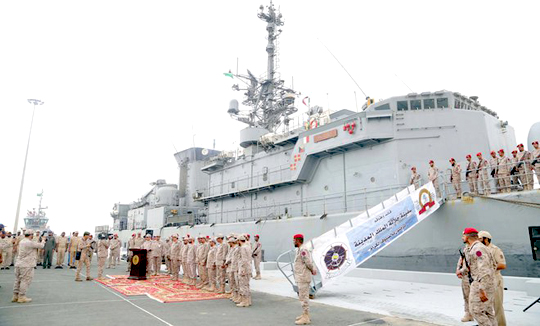
Jeddah, Feb 6: A Saudi warship targeted last month by Houthi suicide attackers returned to base on Sunday after completing its mission.
Southi

The Al-Madinah warship of the Royal Saudi Navy was in late January hit by a terrorist boat attack off the Yemeni port of Hodeidah, killing two crew members.

It returned early Sunday to the King Faisal Naval Base in Jeddah, after completing its duties according to the scheduled timeframe, without any delay as a result of the attack by the Iran-backed insurgents.

Senior officers welcomed the warship back to the naval base.

They included Lt. Gen. Abdul Rahman bin Saleh Al-Bunyan, chief of staff of the Saudi armed forces, Gen. Abdullah bin Sultan Al-Sultan, commander of the Royal Saudi Navy, and Western Fleet Commander Saeed bin Mohammed Al-Zahrani.

The chief of staff met with the ship’s crew and officers and conveyed to them the greetings of Deputy Crown Prince Mohammed bin Salman, second premier and minister of defense, who praised the crew’s courage in dealing with the attack.

Al-Bunyan listened to a briefing by the captain of the warship regarding the terrorist attack, how it was countered, and how a resulting fire was swiftly tackled.

He expressed pride in the members of the Royal Saudi Navy for participating in military operations carried out by the alliance to support legitimacy in Yemen.

Two Saudi crew members were killed and three others were injured in the suicide attack on the Saudi patrol frigate, the Arab coalition headquarters said last week.

The Saudi navy warship reacted to the attack as required, but one of the Houthi boats rear-ended the vessel, resulting in an explosion and fire at the rear of the Saudi ship, which was extinguished by the crew.

The frigate was patrolling the coast of Yemen when the attack by three suicide boats took pace, the coalition in support of the legitimate Yemeni government said earlier.

The warship’s mission involved protecting the territorial waters of the Kingdom and Yemen, in addition to ensuring the safety of international navigation lines in the strategic Bab Al-Mandab Strait.

Al-Bunyan stressed that the damage to the warship was limited to a small area at the back of the vessel, due to the collision with the terrorist’s boat.

He added that the incident will not prevent the coalition forces from continuing their military operations, until they achieve their key target of helping the Yemeni people and the legitimate government in restoring the state and protecting it from Houthi militias.

Retired Gen. Shami Al-Zahiri, who was the first captain of the frigate in 1985, recalled memories during his more than six years as commander of the ship.

“After spending all this time, it was painful for me to hear that this ship came under attack by Houthi militias,” he told Arab News.

The retired general defended the warship’s technical abilities and its ability to counter a terror attack of this nature.

“I heard how some media outlets have been criticizing the ship’s technical abilities and its leadership after the terrorist attack. I think they need to read more about the circumstances of the incident such as the weather condition and how the terrorist’s boat approached the ship before they make pre-judgmental accusations,” he said.

Comments

Add new comment

  • Coastaldigest.com reserves the right to delete or block any comments.
  • Coastaldigset.com is not responsible for its readers’ comments.
  • Comments that are abusive, incendiary or irrelevant are strictly prohibited.
  • Please use a genuine email ID and provide your name to avoid reject.
News Network
July 23,2020

Beirut, Jul 23: The pandemic will exact a heavy toll on Arab countries, causing an economic contraction of 5.7% this year, pushing millions into poverty and compounding the suffering of those affected by armed conflict, a U.N. report said Thursday.

The U.N.'s Economic and Social Commission for Western Asia expects some Arab economies to shrink by up to 13%, amounting to an overall loss for the region of $152 billion.

Another 14.3 million people are expected to be pushed into poverty, raising the total number to 115 million — a quarter of the total Arab population, it said. More than 55 million people in the region relied on humanitarian aid before the COVID-19 crisis, including 26 million who were forcibly displaced.

Arab countries moved quickly to contain the virus in March by imposing stay-at-home orders, restricting travel and banning large gatherings, including religious pilgrimages.

Arab countries as a whole have reported more than 830,000 cases and at least 14,717 deaths. That equates to an infection rate of 1.9 per 1,000 people and 17.6 deaths per 1,000 cases, less than half the global average of 42.6 deaths, according to the U.N.

But the restrictions exacted a heavy economic toll, and authorities have been forced to ease them in recent weeks. That has led to a surge in cases in some countries, including Lebanon, Iraq and the Palestinian territories.

Wealthy Gulf countries were hit by the pandemic at a time of low oil prices, putting added strain on already overstretched budgets. Middle-income countries like Jordan and Egypt have seen tourism vanish overnight and a drop in remittances from citizens working abroad.

War-torn Libya and Syria have thus far reported relatively small outbreaks. But in Yemen, where five years of civil war had already generated the world's worst humanitarian crisis, the virus is running rampant in the government-controlled south while rebels in the north conceal its toll.

Rola Dashti, the head of the U.N. commission, said Arab countries need to “turn this crisis into an opportunity” and address longstanding issues, including weak public institutions, economic inequality and over-reliance on fossil fuels.

“We need to invest in survival, survival of people and survival of businesses,” she said.

Comments

Add new comment

  • Coastaldigest.com reserves the right to delete or block any comments.
  • Coastaldigset.com is not responsible for its readers’ comments.
  • Comments that are abusive, incendiary or irrelevant are strictly prohibited.
  • Please use a genuine email ID and provide your name to avoid reject.
News Network
March 23,2020

Dubai, Mar 23: The United Arab Emirates announced on Monday it will temporarily suspend all passenger and transit flights amid the novel coronavirus outbreak.

The Emirati authorities "have decided to suspend all inbound and outbound passenger flights and the transit of airline passengers in the UAE for two weeks as part of the precautionary measures taken to curb the spread of the COVID-19", reported the official state news agency, WAM.

It said the decision -- which is subject to review in two weeks -- will take effect in 48 hours, adding: "Cargo and emergency evacuation flights would be exempt."

The UAE, whose international airports in Abu Dhabi and Dubai are major hubs, announced on Friday its first two deaths from the COVID-19 disease, having reported more than 150 cases so far.

Monday's announcement came hours after Dubai carrier Emirates announced it would suspend all passenger flights by March 25.

But the aviation giant then reversed its decision, saying it "received requests from governments and customers to support the repatriation of travellers" and will continue to operate passenger flights to 13 destinations.

Emirates had said it will continue to fly to the United Kingdom, Switzerland, Hong Kong, Thailand, Malaysia, the Philippines, Japan, Singapore, South Korea, Australia, South Africa, the United States and Canada.

"We continue to watch the situation closely, and as soon as things allow, we will reinstate our services," said the airline's chairman and CEO, Sheikh Ahmed bin Saeed Al-Maktoum.

Gulf countries have imposed various restrictions to combat the spread of the novel coronavirus pandemic, particularly in the air transport sector.

The UAE has stopped granting visas on arrival and forbidden foreigners who are legal residents but are outside the country from returning.

Comments

Add new comment

  • Coastaldigest.com reserves the right to delete or block any comments.
  • Coastaldigset.com is not responsible for its readers’ comments.
  • Comments that are abusive, incendiary or irrelevant are strictly prohibited.
  • Please use a genuine email ID and provide your name to avoid reject.
News Network
July 10,2020

Dubai, Jul 10: Saudi Minister of Culture Prince Badr bin Abdullah bin Farhan has appointed Dina Amin as CEO of the Visual Arts Commission.

She will take the lead in implementing the ministry’s vision and directions in promoting and developing visual arts in the Kingdom and empowering practitioners in the field.

Amin is a leading Saudi specialist in visual arts and the international contemporary art field. She gained a bachelor’s degree in art history and architecture from Wellesley College, in the US, and also attended a collaborative program in architecture at Massachusetts Institute of Technology.

During her career, spanning more than two decades, she has held senior positions in prominent international arts companies, including most recently Phillips, a global auction house for art, design, watches, jewels, and more.

She has also worked at Christie’s, one of the world’s most famous auction houses, employed in senior roles at the company’s international offices including New York, Dubai, and London.

The Visual Arts Commission is one of 11 new cultural bodies recently launched by the Ministry of Culture in line with the Saudi Vision 2030 reform plan to manage the empowerment and development of the Kingdom’s cultural sector. The commission will be responsible for managing and developing the visual arts sector to help achieve the ministry’s goals.

Comments

Add new comment

  • Coastaldigest.com reserves the right to delete or block any comments.
  • Coastaldigset.com is not responsible for its readers’ comments.
  • Comments that are abusive, incendiary or irrelevant are strictly prohibited.
  • Please use a genuine email ID and provide your name to avoid reject.