


SC to examine constitutional validity of polygamy, 'nikah halala' among Muslims

Agencies
March 26, 2018

New Delhi, Mar 26: The Supreme Court of India today agreed to examine the constitutional validity of the practices of polygamy and 'nikah halala' among the Muslims and sought responses from the Centre and the Law Commission.

A bench headed by Chief Justice Dipak Misra considered the submission that an earlier five-judge constitution bench, in its 2017 verdict, had kept open the issue of polygamy and 'nikah halala' while quashing triple talaq.

Today, the bench, which also comprised Justices A M Khanwilkar and D Y Chandrachud, said a fresh five-judge constitution bench would be set up to deal with the constitutionality of 'nikah halala' and polygamy.

While polygamy allows a Muslim man to have four wives, 'nikah halala' deals with the process in which a Muslim woman has to marry another person and get divorced from him before being allowed to marry her divorcee husband again.

By a majority of 3:2, a five-judge constitution bench had earlier held triple talaq as unconstitutional in its judgement last year.

The bench was hearing at least three petitions including some PILs challenging the practices on various grounds including that they violate Right to Equality and gender justice.

Delhi BJP leader Aswini Kumar Upadhyay, who filed a PIL on March 5, claimed that the ban on polygamy and 'nikah-halala' was the need of the hour to secure basic rights.

The harm caused to the women due to the practices of triple talaq, polygamy and 'nikah-halala' is violative of Articles 14, 15 and 21 of the Constitution and injurious to public order, morality and health, Upadhyay's petition said.

He sought a declaration "that the provisions of the IPC are applicable on all Indian citizens and triple talaq is a cruelty under section 498A (husband or relative of husband of a woman subjecting her to cruelty) of the IPC, 'nikah-halala' is rape under section 375 (rape) of the IPC, and polygamy is an offence under section 494 (marrying again during lifetime of husband or wife) of the IPC."

On March 14, a Delhi-based woman, had moved the apex court saying that by virtue of Muslim Personal Law, section 494 of IPC (marrying again during lifetime of husband or wife) was rendered inapplicable to this community and no married Muslim woman has the avenue of filing a complaint against her husband for the offence of bigamy.

She sought to declare the Dissolution of Muslim Marriages Act, 1939, unconstitutional and violative of Articles 14, 15, 21 and 25 (freedom of conscience and free profession, practice and propagation of religion) of the Constitution in so far as it fails to secure for Indian Muslim women the protection from bigamy which has been statutorily secured for women in India belonging to other religions.

The petitioner, who herself claimed to be a victim of such practices, has alleged that her husband and his family used to torture her for want of more dowry and she was ousted from the matrimonial home twice.

She also alleged that her husband had married another woman without taking any legal divorce from her and the police had refused to lodge FIR under section 494 and 498A (husband or relative of husband of a woman subjecting her to cruelty) of the IPC stating that polygamy was permitted under the Sharia.

Later on March 18, a Hyderabad-based lawyer, had also challenged the practice of polygamy, claiming that all these types of marriages under the Muslim personal law violate the fundamental rights of Muslim women.

The petition has contended that while the Muslim law allows a man to have multiple wives by way of the temporary marriages or polygamy, same permission is not extended to women.

The petition has opposed the practice of Nikah Halala, where a divorced woman has to remarry and then get a talaq before being able to marry her first husband, as well as Nikah Mutah and Nikah Misyar -- both temporary marriages where duration of the relationship is specified and agreed upon in advance.

Comments

Add new comment

  • Coastaldigest.com reserves the right to delete or block any comments.
  • Coastaldigset.com is not responsible for its readers’ comments.
  • Comments that are abusive, incendiary or irrelevant are strictly prohibited.
  • Please use a genuine email ID and provide your name to avoid reject.
Agencies
June 29,2020

From March through May, around 1 crore migrant workers fled India’s megacities, afraid to be unemployed, hungry and far from family during the world’s biggest anti-Covid-19 lockdown.

Now, as Asia’s third-largest economy slowly reopens, the effects of that massive relocation are rippling across the country. Urban industries don’t have enough workers to get back to capacity, and rural states worry that without the flow of remittances from the city, already poor families will be even worse off -- and a bigger strain on state coffers.

Meanwhile, migrant workers aren’t expected to return to the cities as long as the virus is spreading and work is uncertain. States are rolling out stimulus programs, but India’s economy is hurtling for its first contraction in more than 40 years, and without enough jobs, a volatile political climate gets more so.

“This will be a huge economic shock, especially for households of short-term, cyclical migrants, who tend to come from vulnerable, poor and low-caste and tribal backgrounds,” said Varun Aggarwal, a founder of India Migration Now, a research and advocacy group based in Mumbai.

In the first 15 days of India’s lockdown, domestic remittances dropped by 90%, according to Rishi Gupta, chief executive officer of Mumbai-based Fino Paytech Ltd., which operates the country’s biggest payments bank.

By the end of May, remittances were back to around 1750 rupees ($23), about half the pre-Covid average. Gupta’s not sure how soon it’ll fully recover. “Migrants are in no hurry to come back,” Gupta said. “They’re saying that they’re not thinking of going back at all.”

If workers stay in their home states long term, policymakers will have more than remittances to worry about. If consumption falls and the new surplus of labor drives wages down, Agarwal said, “there will also be a second-order shock to the local economy. Overall, not looking good.”

India announced a $277 billion stimulus package in May and followed it up with a $7 billion program aimed at creating jobs for 125 days for migrants in villages across 116 districts. Separately, local authorities are also looking for solutions.

Officials in Bihar have identified 2,500 acres of land that could be made available to investors, said Sushil Modi, deputy chief minister of Bihar, a state in east India. “We can use this crisis as an opportunity to speed up reforms,” he said.

The investors haven’t materialised yet, and in the meanwhile, state governments are relying on the national cash-for-work program that guarantees 100 days worth of wages per household.

Skilled workers don’t want to do manual labor offered through the program, and even if they did, says Amitabh Kundu of RIS, many think of it as beneath their station. “There will be an increase in social tensions,” he predicts. “Caste may again start playing a role. It’s absolute chaos.”

For skilled workers, initiatives vary:

* Uttar Pradesh, which received 3.2 million people, is compiling lists of skilled workers who need employment and trying to place them with local manufacturing and real estate industry associations. So far, the government says, it’s placed 300,000 people with construction and real estate firms.

* Bihar has placed returners in state-run infrastructure projects and hired others to stitch uniforms and make furniture for government-run schools, even as they waited in quarantine centres, said Pratyay Amrit, head of the state’s disaster management department.

* The eastern state of Odisha announced an urban wage employment program aimed at putting as many as 450,000 day labourers to work through September. Some 25,000 people have been employed, so far, under the scheme, G. Mathivathanan, principal secretary for housing and urban development said.

Attracting Investments

It’s not clear any of this will be enough to make a dent, says Ravi Srivastava, professor at New Delhi-based Institute of Human Development, adding that the states don’t have much of a track record on economic development.

“It was the failure of these states to improve governance and put development plans in place that led to the out-migration in the first place,” he said.

But officials and workers’ rights advocates see opportunity. Uttar Pradesh has established liaisons to encourage companies from the US, Japan and South Korea to establish manufacturing in the state. There and in Madhya Pradesh and Rajasthan, the government has made labour laws more friendly to employers, making it easier to hire and fire workers.

Modi, the minister from Bihar, said the migration may also give workers--historically a disenfranchised group--new power, particularly as urban centres struggle. “The way industries treated workers during the lockdown -- didn’t pay them, the living conditions were poor -- now these industries will realize the value of this force,” Modi said.

“In the days to come, labour will emerge as a force that can’t be ignored anymore,” he added. “That’s the new normal. We will work out how to ensure dignity, rights to our people who are going to work in other states.”

Bihar is due for elections by November, a vote that could be an early test of the mass migration’s political consequences. The state is currently governed by a coalition that includes Prime Minister Narendra Modi’s Bharatiya Janata Party. Amitabh Kundu, a fellow at the Research and Information System for Developing Countries, a New Delhi-based government think-tank, said migrant workers are likely to be angry voters.

“Chief ministers are telling these migrants that they will not have to go back for work,” he said. “But their capacity to do something miraculous in the next four to five months is doubtful. If they can retain even one-fourth of the migrants, I would call it a success.”

Comments

Add new comment

  • Coastaldigest.com reserves the right to delete or block any comments.
  • Coastaldigset.com is not responsible for its readers’ comments.
  • Comments that are abusive, incendiary or irrelevant are strictly prohibited.
  • Please use a genuine email ID and provide your name to avoid reject.
Agencies
August 2,2020

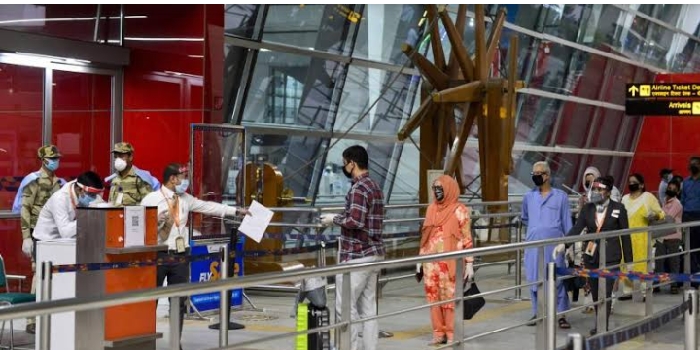
New Delhi, Aug 2: The Ministry of Health and Family Welfare on Sunday issued fresh guidelines for international passengers coming to India amid the COVID-19 pandemic. The new guidelines will be implemented from 12:01 am on August 8.

The ministry has also asked all passengers to submit a self-declaration form online at least 72 hours before travel.

"All travellers should submit self-declaration form on the on the online portal (www.newdelhiairport.in) at least 72hours before the scheduled travel," the guidelines said.

It also said that those coming to India must give an undertaking that they would undergo mandatory quarantine for 14 days as prescribed by the government. "They should also give an undertaking on the portal that they would undergo mandatory quarantine for 14 days i.e. 7 days paid institutional quarantine at their own cost, followed by 7 days isolation at home with self-monitoring of health," it added.

Giving exemptions in some cases, the guidelines mentioned, "Only for compelling reasons/cases of human distress such as pregnancy, death in the family. Serious illness and parent (s) with children of 10 years or below, home quarantine may be permitted for 14 days."

"If they wish to seek such exemption, they shall apply to the online portal at least 72 hours before boarding. The decision taken by the government as communicated on the online portal will be final," it said further.

The guidelines further said that travellers could request for exemption from institutional quarantine by submitting a negative RT-PCR test report on arrival.

"This test should have been conducted within 96 hours prior to undertaking the journey. The test report should be uploaded on the portal for consideration," it added.

Passengers have also been asked to download the Aarogya Setu app on their mobile phones.

Comments

Add new comment

  • Coastaldigest.com reserves the right to delete or block any comments.
  • Coastaldigset.com is not responsible for its readers’ comments.
  • Comments that are abusive, incendiary or irrelevant are strictly prohibited.
  • Please use a genuine email ID and provide your name to avoid reject.
News Network
January 31,2020

New Delhi, Jan 31: The Supreme Court Friday dismissed the plea filed by one of the four death row convicts in the Nirbhaya gang-rape and murder case, Pawan Gupta, seeking review of its order rejecting his juvenility claim.

The review plea filed earlier in the day was taken up for consideration in-chamber by a bench comprising Justices R Banumathi, Ashok Bhushan and A S Bopanna. 

On January 20, the apex court had rejected the plea by Pawan who had challenged the Delhi High Court's order dismissing his juvenility claim.

Advocate A P Singh, who is representing Pawan in the case, said he filed a petition on his behalf seeking review of the top court's January 20 order on Friday.

While dismissing the plea, the top court had said there was no ground to interfere with the high court order that rejected Pawan's plea and his claim was rightly rejected by the trial court as also the high court.

It had said the matter was raised earlier in the review petition before the apex court which rejected plea of juvenility taken by Pawan and another co-accused Vinay Kumar Sharma and that order has attained finality.

Singh had argued that as per his school leaving certificate, he was a minor at the time of the offence and none of the courts, including trial court and high court, ever considered his documents.

Solicitor General Tushar Mehta, appearing for the Delhi Police, had said Pawan's claim of juvenility was considered at each and every judicial forum and it will be a travesty of justice if the convict is allowed to raise the claim of juvenility repeatedly and at this point of time.

The trial court on January 17 issued black warrants for the second time for the execution of all the four convicts in the case -- Mukesh Kumar Singh (32), Pawan (25), Vinay (26) and Akshay (31) -- in Tihar jail at 6 am on February 1. Earlier, on January 7, the court had fixed January 22 as the hanging date.

As of now, only Mukesh has exhausted all his legal remedies including the clemency plea which was dismissed by President Ram Nath Kovind on January 17 and the appeal against the rejection was thrown out by the Supreme Court on January 29.

Convict Akshay's curative petition was dismissed by the top court on January 30. Another death row convict Vinay moved mercy plea before President on January 29, which is pending.

Singh has also approached the trial court seeking stay on the execution scheduled on February 1, saying the legal remedies of some of the convicts are yet to be availed.

A 23-year-old paramedic student, referred to as Nirbhaya, was gang-raped and brutally assaulted on the intervening night of December 16-17, 2012, in a moving bus in south Delhi by six people before she was thrown out on the road.

Comments

Add new comment

  • Coastaldigest.com reserves the right to delete or block any comments.
  • Coastaldigset.com is not responsible for its readers’ comments.
  • Comments that are abusive, incendiary or irrelevant are strictly prohibited.
  • Please use a genuine email ID and provide your name to avoid reject.