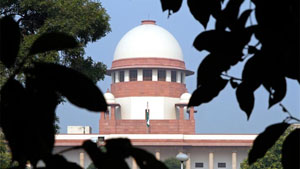
SC forms panel over government advertisements

April 23, 2014

New Delhi, Apr 23: The Supreme Court Wednesday constituted a three member committee to frame guidelines to regulate issuance of advertisements by the government and its departments with an obvious political message.

Government_advertisementsThe apex court bench headed by Chief Justice P. Sathasivam said that the existing DAVP guidelines do not cover such advertisements.

The three member committee would comprise N.R. Madhavan Menon, founder director of Bangalore's National Law University, T.K. Vishwanathan, former Lok Sabha secretary general and senior counsel Ranjit Kumar.

The court said that I&B secretary would be coordinating and assisting the committee. The committee will submits its first report to the apex court in three months time.

Comments

Add new comment

  • Coastaldigest.com reserves the right to delete or block any comments.
  • Coastaldigset.com is not responsible for its readers’ comments.
  • Comments that are abusive, incendiary or irrelevant are strictly prohibited.
  • Please use a genuine email ID and provide your name to avoid reject.
Agencies
June 5,2020

Jodhpur, Jun 5: A video has gone viral on social media showing what could be called Jodhpur's George Floyd moment with a twist, showing cops throwing a person on the ground and pressing his neck with their knees for roaming around without a mask.

However, unlike the unfortunate incident in Minneapolis, Minnesota, the cops in Jodhpur reportedly acted after the person, said to be mentally challenged, turned violent after being confronted by the police.

Dumb TV media is playing the initial part of this video as 'India's George Flyod moment'. Doesn't matter to them that the same video shows the man beating the cops back badly pic.twitter.com/vGSaON6oii

— Swati Goel Sharma (@swati_gs) June 5, 2020

George Floyd, a 46-year-old black man, died after being arrested by the police outside a shop in Minneapolis in the US on May 25. Footage showed a white officer, Derek Chauvin, kneeling on Floyd's neck for several minutes while he was pinned to the floor. He was pronounced dead later in the hospital, triggering widespread protests across the US.

However, in the Jodhpur incident, the man, identifed as Mukesh Kumar Prajapat, did not die but instead started fighting with the policemen.

Jodhpur police officers confirmed that the video was shot in the city on Thursday after the police wanted to issue a challan against the man for roaming on the streets without wearing a mask before he started manhandling the police.

The video shows a cop pressing his neck with his knee while two other cops held the young man's legs. A huge crowd gathered when the scuffle broke out.

Meanwhile, the SHO of Dev Nagar police station, Somkaran, said that the police were issuing a challan to Prajapat when he attacked them and tore their uniform. An FIR has been lodged against Prajapat on a complaint lodged by the Pratap Nagar police station. He will be produced in the court later in the day.

Prajapat is said to be mentally challenged and had damaged his father's eye earlier for which a case was registered against him, the poice said. Action is being initiated against Prajapat under the Epidemic Act, they added.


Comments

Add new comment

  • Coastaldigest.com reserves the right to delete or block any comments.
  • Coastaldigset.com is not responsible for its readers’ comments.
  • Comments that are abusive, incendiary or irrelevant are strictly prohibited.
  • Please use a genuine email ID and provide your name to avoid reject.
News Network
February 18,2020

Ayodhya, Feb 18: A senior Supreme Court lawyer has written to the Ram temple trust on behalf of a group of Muslims in Ayodhya, asking that five acres of land around the demolished Babri Masjid where a graveyard is situated be spared for the sake of 'sanatan dharma'.

The letter, written by advocate M R Shamshad, is addressed to all 10 trustees of Shri Ram Janmabhoomi Teertha Kshetra.

Shamshad said according to Muslims, there is a graveyard known as 'Ganj Shahidan' around the demolished Babri Masjid where 75 Muslims who lost their lives in the 1885 riots in Ayodhya were buried.

"There is a mention of this in Faizabad Gazetteer also," he said.

"The central government has not considered the issue not using the grave-yard of Muslims for constructing the grand temple of Lord Ram. It has violated 'dharma'," the letter stated.

"In view of religious scriptures of 'sanatan dharma', you need to consider whether the temple of Lord Ram can have foundation on the graves of Muslims? This is a decision that the management of the trust has to take," it said.

"With all humility and respect to Lord Ram, I request you, not to use the land of about four to five acres in which the graves of Muslims are there around the demolished mosque," the letter added.

Comments

Add new comment

  • Coastaldigest.com reserves the right to delete or block any comments.
  • Coastaldigset.com is not responsible for its readers’ comments.
  • Comments that are abusive, incendiary or irrelevant are strictly prohibited.
  • Please use a genuine email ID and provide your name to avoid reject.
News Network
January 10,2020

New Delhi, Jan 10: The Supreme Court while hearing petitions challenging restrictions in Jammu and Kashmir on Friday stated that the right to access the internet is a fundamental right under Article 19 of the Constitution of India.

"It is no doubt that freedom of speech is an essential tool in a democratic setup. The freedom of Internet access is a fundamental right under Article 19(1)(a) of the Constitution," a two-judge bench headed by Justice N V Ramana stated while reading out the judgment.

The top court said that Kashmir has seen a lot of violence and that it will try to maintain a balance between human rights and freedoms with the issue of security.

It also directed the Jammu and Kashmir administration to review the restrictive orders imposed in the region within a week. “The citizens should be provided highest security and liberty,” the apex court added.

The top court made observations and issued directions while pronouncing the verdict on a number of petitions challenging the restrictions and internet blockade imposed in Jammu and Kashmir after the abrogation of Article 370 in August last year.

The Supreme Court had on November 27 reserved the judgment on a batch of petitions challenging restrictions imposed on communication, media and telephone services in Jammu and Kashmir pursuant to revocation of Article 370.

The court heard the petitions filed by various petitioners including Congress leader Ghulam Nabi Azad and Kashmir Times editor Anuradha Bhasin.

The petitions were filed after the central government scrapped Article 370 in August and bifurcated Jammu and Kashmir into two Union Territories -- Jammu and Kashmir and Ladakh. Following this, phone lines and the internet were blocked in the region.

The government had, however, contended that it has progressively eased restrictions.

Comments

Add new comment

  • Coastaldigest.com reserves the right to delete or block any comments.
  • Coastaldigset.com is not responsible for its readers’ comments.
  • Comments that are abusive, incendiary or irrelevant are strictly prohibited.
  • Please use a genuine email ID and provide your name to avoid reject.