



SC raps Modi govt, says it'll take 200 years to clean Ganga at this rate

September 3, 2014

New Delhi, Sep 03: The Narendra Modi government's ambitious poll promise to depollute River Ganga came under severe scrutiny on Wednesday in the Supreme Court which said it seems that steps taken so far will not lead to cleaning of the country's holiest river even after 200 years.ganga
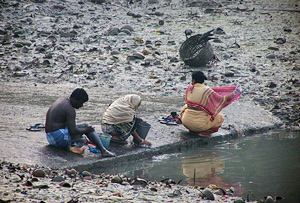
The apex court directed the Centre to come out in three weeks with a "stage-wise plan" to clean the river for "restoring it to its pristine glory".

"After seeing your action plan, it seems Ganga will not be cleaned even after 200 years. Evaluate the dream project You have to take steps to restore Ganga to its pristine glory.

"The dream project is there. Please try that the next generation is able to see the river in its original form. We don't know whether we will see it or not," a bench comprising justices TS Thakur and R Banumathi observed.

It said the "bureaucratic" approach in the action plan would not help in accomplishing Prime Minister's dream project of cleaning the river Ganga and asked the government to come out with "power point presentation" instead of giving vision plan and "artistic view".

The bench said it was not concerned about the financial assistance coming from other countries but was worried how the common people be explained about the proposal for proceeding with project of cleaning the 2,500-km long river stretch.

"We don't want to get into the nitty-gritty of committees etc. But common man expects to know how the cleaning Ganga process will emerge. They should at least know how the government is proceeding.

"You have given a very bureaucratic kind of explanation. We want to see it in a layman's language as to how you are proceeding with the project," the bench told solicitor general Ranjit Kumar after perusing the affidavit filed by Uma Bharti's ministry of water resources, river development and Ganga rejuvenation.

The bench, which asked the solicitor general to file a supplementary affidavit, said power point presentation would help in understanding the stage-wise action plan.

It specifically asked the government to apprise about the steps taken in ecologically sensitive areas from Gangotri to downstream 135km of the river as "no follow up steps have been taken up" after the 2003 notification.

The bench, which posted the matter for hearing on September 24, said in the present affidavit the government has only given the broad parameter on the issue and without the stage-wise plan it would be difficult to clean the river.

It noted in its order that the solicitor general was ready to file supplementary affidavit in which government would give in detail the steps likely to be taken by it in stage-wise manner for cleaning the river.

"We expect government to set out stages for execution of the project," the bench said. During the hearing it also made its intention clear that the apex court would not hesitate in assisting the governement by legal process if industrial units don't comply with laws.

The government has said it is committed to its pre-poll promise of making the river which passes through 29 major cities, 23 small cities and 48 towns, free from pollution.

In its affidavit, the Centre said, "it accords a status of national priority to the rejuvenation of river Ganga and the basic framework to achieve this national priority consists of evolving suitable strategies and action points in several thrust areas."

It said maintaining ecological flow in the river, abatement and mitigation of various types of pollution in it, restoring ecological sanctity, creating awareness about the conservation of river and ensuring people's participation in this process are some of the thrust areas.

"The achievements of these objectives entail multi-institutional, multi-dimensional and multi-sectoral approach," the affidavit said, adding to achieve this, consultative process, involving various ministries concerned has commenced to arrive at common strategy and action plan."

A group of secretaries has been tasked to go into issues connected with realisation of the objectives. Their report is presently under examination.

Comments

Add new comment

  • Coastaldigest.com reserves the right to delete or block any comments.
  • Coastaldigset.com is not responsible for its readers’ comments.
  • Comments that are abusive, incendiary or irrelevant are strictly prohibited.
  • Please use a genuine email ID and provide your name to avoid reject.
Agencies
February 17,2020

New Delhi, Feb 17: The Supreme Court said on Monday that people have a fundamental right to protest against a law but the blocking of public roads is a matter of concern and there has to be a balancing factor.

Hearing pleas over the road blocks due to the ongoing protests at Shaheen Bagh against the Citizenship Amendment Act (CAA), a bench comprising Justices S K Kaul and K M Joseph said its concern is about what will happen if people start protesting on roads.

Democracy works on expressing views but there are lines and boundaries for it, the bench said.

It asked senior advocate Sanjay Hegde and advocate Sadhana Ramachandran to talk to Shaheen Bagh protestors and persuade them to move to an alternative site where no public place is blocked.

The matter has been posted for next hearing on February 24.

People have a fundamental right to protest but the thing which is troubling us is the blocking of public roads, the bench said.

Solicitor General Tushar Mehta said Shaheen Bagh protestors should not be given a message that every institution is on its knees trying to persuade them on this issue.

The apex court said that if nothing works, we will leave it to the authorities to deal with the situation.

Protestors have made their made their point and the protests have gone on for quite some time, it said.

Restrictions have been imposed on the Kalindi Kunj-Shaheen Bagh stretch and the Okhla underpass, which were closed on December 15 last year due to the protests against CAA and Register of Citizens.

The top court had earlier said the anti-CAA protesters at Delhi's Shaheen Bagh cannot block public roads and create inconvenience for others.

The apex court was hearing an appeal filed by advocate Amit Sahni, who had approached the Delhi high court seeking directions to the Delhi Police to ensure smooth traffic flow on the Kalindi Kunj-Shaheen Bagh stretch, which was blocked by anti-CAA protesters on December 15.

While dealing with Sahni's plea, the high court had asked local authorities to deal with the situation keeping in mind law and order.

Separately, former BJP MLA Nand Kishore Garg has filed a petition in the apex court seeking directions to the authorities to remove the protestors from Shaheen Bagh.

One of the pleas has sought laying down of comprehensive and exhaustive guidelines relating to outright restrictions for holding protests or agitations leading to obstruction of public place.

In his plea, Garg has said that law enforcement machinery was being "held hostage to the whims and fancies of the protesters" who have blocked vehicular and pedestrian movement from the road connecting Delhi to Noida.

State has the duty to protect fundamental rights of citizen who were continuously being harassed by the blockage of arterial road, it said.

"It is disappointing that the state machinery is muted and a silent spectator to hooliganism and vandalism of the protesters who are threatening the existential efficacy of the democracy and the rule of law and had already taken the law and order situation in their own hand," the plea had said.

In his appeal, Sahni had sought supervision of the situation in Shaheen Bagh, where several women are sitting on protest, by a retired Supreme Court judge or a sitting judge of the Delhi High Court.

Sahni has said in his plea that protests in Shaheen Bagh has inspired similar demonstrations in other cities and to allow it to continue would set a wrong precedent.

Comments

Add new comment

  • Coastaldigest.com reserves the right to delete or block any comments.
  • Coastaldigset.com is not responsible for its readers’ comments.
  • Comments that are abusive, incendiary or irrelevant are strictly prohibited.
  • Please use a genuine email ID and provide your name to avoid reject.
News Network
June 10,2020

Chennai, Jun 10: DMK MLA J Anbazhagan who had tested positive for coronavirus and was on ventilator support from June 3 passed away at a hospital in Chennai on Wednesday.

Coincidently, today is the 62nd birthday of the MLA.

"Anbazhagan J, who has been fighting for his life with severe COVID 19 pneumonia rapidly deteriorated early this morning. In spite of full medical support including mechanical ventilation at our COVID facility, he succumbed to his illness. He was declared dead at 08:05 hours on the 10th of June 2020," the hospital said in a statement.

In 2001, Anbazhagan was elected from T Nagar Assembly constituency. He served for five years.

Later in 2011, he was elected to Tamil Nadu Assembly from Chepauk-Thiruvallikeni seat. The DMK leader was re-elected from the same constituency in 2016.

Comments

Add new comment

  • Coastaldigest.com reserves the right to delete or block any comments.
  • Coastaldigset.com is not responsible for its readers’ comments.
  • Comments that are abusive, incendiary or irrelevant are strictly prohibited.
  • Please use a genuine email ID and provide your name to avoid reject.
News Network
March 7,2020

Srinagar, Mar 7: Two more accused, including a man who allegedly bought chemicals online for making improvised explosive device (IED) to be used in an attack on a convoy of the Central Reserve Police Force (CRPF) in Jammu and Kashmir's Pulwama last year, were arrested by the National Investigation Agency (NIA) on Friday, an official said.

The terror attack left 40 CRPF personnel dead in south Kashmir's Pulwama last year.

Waiz-ul-Islam, 19, from Srinagar and Mohammad Abbass Rather, 32, from Pulwama were arrested by the NIA, taking the number of those arrested in the case in the past week to five.

"During initial interrogation, Islam disclosed that he used his Amazon online shopping account to procure chemicals for making IEDs, batteries and other accessories on the directions of Pakistani Jaish-e-Mohammed (JeM) terrorists," the official said.

He said Islam personally delivered the items to the JeM terrorists after buying them online as a part of the conspiracy to carry out the attack.

"Rather is an old overground worker of the JeM. He has disclosed that he gave shelter at his home to Jaish terrorist and IED expert Mohd Umar after he came to Kashmir in April-May 2018," the official said.

Rather also sheltered other JeM terrorists - suicide bomber Adil Ahmad Dar, Sameer Ahmed Dar and Kamran, a Pakistani -- at his house before the Pulwama attack, the official said.

"He also facilitated safe shelter for the JeM terrorists, including Adil, at the house of accused Tariq Ahmed Shah and his daughter Insha Jan of Hakripora, who were arrested on March 3," the official said.

He said Islam and Rather will be produced before the NIA special court in Jammu on Saturday, while further investigation in the case continues. The NIA took over the case to probe the conspiracy behind the February 14, 2019, attack in Pulwama.

The last video of Adil, which was released by the JeM from Pakistan after the terror attack, was filmed at the home of Tariq Ahmed Shah. On February 28, the NIA achieved a major breakthrough in the case when it arrested 22-year-old Shakir Bashir Magrey, a furniture shop owner and resident of Pulwama.

Magrey had given shelter and other logistical assistance to suicide bomber Adil. He was introduced to Adil in mid-2018 by Pakistani terrorist Mohammad Umar Farooq and he became a full-time OGW of the JeM.

The explosives used in the attack were determined through forensic probe to be ammonium nitrate, nitro-glycerin and RDX. During investigation into the attack, the identity of the suicide bomber to be Adil Ahmad Dar was confirmed through DNA matching with that of his father.

The other key terrorists involved in the attack have been found to be JeM's south Kashmir divisional head Muddasir Ahmad Khan, killed in an operation by the security forces on March 11 last year; Pakistani terrorists Muhammad Umar Farooq and IED expert Kamran, both killed on March 29 last year; the owner of the car Sajjad Ahmad Bhat, a resident of Anantnag who was killed on June 16 last year, and Qari Yassir, JeM's commander for Kashmir who was killed on January 25 this year.

Comments

Add new comment

  • Coastaldigest.com reserves the right to delete or block any comments.
  • Coastaldigset.com is not responsible for its readers’ comments.
  • Comments that are abusive, incendiary or irrelevant are strictly prohibited.
  • Please use a genuine email ID and provide your name to avoid reject.