


Scholars, KSA’s allies blast Saihat violence

October 18, 2015

Riyadh, Oct 18: Prominent religious scholars, regional allies and world leaders have condemned the terrorist attack on a Shiite gathering in the eastern city of Saihat that killed five people.
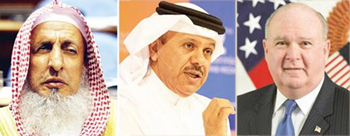
saudiGrand Mufti Abdul Aziz Al-Asheikh condemned the attack in Saihat, describing Daesh’s acts and actions as being against the basic tenets of Islam.

In a press statement, GCC Secretary General Abdullatif Al-Zayani described the incident as a “terrible crime” that runs counter to all moral and humanitarian values.

He affirmed GCC countries’ support for Saudi Arabia in measures taken to maintain the safety and security of its citizens and residents on its soil.

He expressed his trust in the efficiency of Saudi Arabia’s security apparatuses in uncovering the circumstances of this “cowardly and terrorist” act and bringing terrorists and their supporters to justice.

Al-Zayani offered his condolences to the Saudi government and the families of victims, hoping the injured a speedy recovery.

In a statement carried by the Bahraini News Agency (BNA), Manama expressed its “sincere condolences” to Saudi Arabia and emphasized its firm stance and solidarity with the Kingdom “in all its actions to maintain its security and stability.”

US Ambassador Joseph Westphal said in a statement: “The despicable attack in Saihat is a reminder of the scourge of terrorism which we and the Kingdom of Saudi Arabia face together. I express my condolences to the families of those who were killed and my wishes for a rapid recovery of those who were wounded.”

In his remarks on Saturday, the grand mufti also said: “Daesh, the enemy of Islam, has unleashed a reign of terror in the Middle East including the Gulf states, killing thousands of innocent people.”

Al-Asheikh called on all Islamic scholars, institutions, media organizations and civil societies “to stand against terrorism,” while referring to the heinous cowardly crime committed by the gunman in Saihat Friday night.

The grand mufti named Daesh as an enemy of Islam, and said that “the reality is that they are shedding Muslim blood, maligning our name and destroying Islam.”

“Daesh cadres are deviants,” he said during prayers earlier at the Imam Turki bin Abdullah Mosque in Riyadh.

“They are neither an Islamic state nor mujahedeen or Islamic mercenaries. Their faith is falsehood ... their reality is bloodshed and looting,” said Al-Asheikh.

Jordan said it stands firmly with Saudi Arabia and supports all the measures it is undertaking to fight lawlessness.

“Jordan also extends condolences to Kingdom’s government, Saudi people and families of the victims,” the spokesman said.

Condemning the cowardly act committed in Saihat, Saleh Al-Wohaiby, secretary-general of the Riyadh-based World Assembly of Muslim Youth (WAMY), said: “Daesh has been manipulating and misinterpreting the teachings of Islam to further its violent agenda.”

Terror organizations like Daesh are exploiting the power of the Web and the Internet, including social media to create a terrorist threat across the world, he said.

“The terrorists associated with Daesh use messaging and social media services such as Twitter, Facebook and WhatsApp besides other applications,” said WAMY chief.

They have been using media and social media tools to recruit innocent young people for their terror network, which has as its sole agenda to destroy the social fabric, destabilize peaceful countries and eventually to shed blood of human beings.

Referring to the bloodshed and the unrest created by Daesh in the Kingdom and the whole Middle East at large, Sheikh Basel A. Harbi, chief of Rawda Islamic Propagation Center, said that a number of young people have been lured to join the network.

“They are aiming to create problems and spread terrorism in Saudi Arabia, and they wish to create chaos in the country and its neighborhood,” said Harbi, while referring to the growing Daesh presence on social media despite best efforts to block them.

According to a report, efforts are being made by government agencies including NGOs to block terror sites.

Activists on Twitter in Saudi Arabia recently launched an organized campaign to close down all accounts that are accused of promoting Daesh-related ideologies.

The campaign, which included prominent Saudi personalities, was recently able to close down about 300 accounts belonging to Daesh and its supporters.

There are hundreds of thousands of messages being put out every month onto Internet platforms to recruit young minds. Saudi Arabia has so far arrested more than 431 people suspected of belonging to Daesh cells.

These arrests foiled several suicide attacks on public places including mosques, security forces offices and diplomatic missions, the report, quoting the Interior Ministry, said. The report said most of the arrested suspects were Saudi nationals, but also included other nationals from African and Asian countries.

Comments

Add new comment

  • Coastaldigest.com reserves the right to delete or block any comments.
  • Coastaldigset.com is not responsible for its readers’ comments.
  • Comments that are abusive, incendiary or irrelevant are strictly prohibited.
  • Please use a genuine email ID and provide your name to avoid reject.
News Network
April 5,2020

Beirut, Apr 5: The novel coronavirus has put global trade on hold, placed half of the world population in confinement and has the potential to topple governments and reshape diplomatic relations.

The United Nations has appealed for ceasefires in all the major conflicts rocking the planet, with its chief Antonio Guterres on Friday warning "the worst is yet to come". But it remains unclear what the pandemic's impact will be on the multiple wars roiling the Middle East.

Here is an overview of the impact so far on the conflicts in Syria, Yemen, Libya and Iraq:

The COVID-19 outbreak turned into a pandemic just as a ceasefire reached by the two main foreign power brokers in Syria's nine-year-old war -- Russia and Turkey -- was taking effect.

The three million people living in the ceasefire zone, in the country's northwestern region of Idlib, had little hope the deal would hold.

Yet fears the coronavirus could spread like wildfire across the devastated country appear to have given the truce an extended lease of life.

According to the Syrian Observatory for Human Rights, the month of March saw the lowest civilian death toll since the conflict started in 2011, with 103 deaths.

The ability of the multiple administrations in Syria -- the Damascus government, the autonomous Kurdish administration in the northeast and the jihadist-led alliance that runs Idlib -- to manage the coronavirus threat is key to their credibility.

"This epidemic is a way for Damascus to show that the Syrian state is efficient and all territories should be returned under its governance," analyst Fabrice Balanche said.

However the pandemic and the global mobilisation it requires could precipitate the departure of US-led troops from Syria and neighbouring Iraq.

This in turn could create a vacuum in which the Islamic State jihadist group, still reeling from the demise of its "caliphate" a year ago, could seek to step up its attacks.

The Yemeni government and the Huthi rebels initially responded positively to the UN appeal for a ceasefire, as did neighbouring Saudi Arabia, which leads a military coalition in support of the government.

That rare glimmer of hope in the five-year-old conflict was short-lived however and last week Saudi air defences intercepted ballistic missiles over Riyadh and a border city fired by the Iran-backed rebels.

The Saudi-led coalition retaliated by striking Huthi targets in the rebel-held capital Sanaa on Monday.

Talks have repeatedly faltered but the UN envoy Martin Griffiths is holding daily consultations in a bid to clinch a nationwide ceasefire.

More flare-ups in Yemen could compound a humanitarian crisis often described as the worst in the world and invite a coronavirus outbreak of catastrophic proportions.

In a country where the health infrastructure has collapsed, where water is a rare commodity and where 24 million people require humanitarian assistance, the population fears being wiped out if a ceasefire doesn't allow for adequate aid.

"People will end up dying on the streets, bodies will be rotting in the open," said Mohammed Omar, a taxi driver in the Red Sea port city of Hodeida.

Much like Yemen, the main protagonists in the Libyan conflict initially welcomed the UN ceasefire call but swiftly resumed hostilities.

Fierce fighting has rocked the south of the capital Tripoli in recent days, suggesting the risk of a major coronavirus outbreak is not enough to make guns fall silent.

Turkey has recently played a key role in the conflict, throwing its weight behind the UN-recognised Government of National Accord.

Fabrice Balanche predicted that accelerated Western disengagement from Middle East conflicts could limit Turkish support to the GNA.

That could eventually favour forces loyal to eastern-based strongman Khalifa Haftar, who launched an assault on Tripoli one year ago and has the backing of Russia, Egypt and the United Arab Emirates.

Western countries have been hit hardest by the pandemic, which could prompt them to divert both military resources and peace-brokering capacity from foreign conflicts.

A report by the International Crisis Group said European officials had reported that efforts to secure a ceasefire in Libya were no longer receiving high-level attention due to the pandemic.

Iraq is no longer gripped by fully-fledged conflict but it remains vulnerable to an IS resurgence in some regions and its two main foreign backers are at each other's throats.

Iran and the United States are two of the countries most affected by the coronavirus but there has been no sign of any let-up in their battle for influence that has largely played out on Iraqi soil.

With most non-US troops in the coalition now gone and some bases evacuated, American personnel are now regrouped in a handful of locations in Iraq.

Washington has deployed Patriot air defence missiles, prompting fears of a fresh escalation with Tehran, whose proxies it blames for a spate of rocket attacks on bases housing US troops.

Comments

Add new comment

  • Coastaldigest.com reserves the right to delete or block any comments.
  • Coastaldigset.com is not responsible for its readers’ comments.
  • Comments that are abusive, incendiary or irrelevant are strictly prohibited.
  • Please use a genuine email ID and provide your name to avoid reject.
Agencies
April 27,2020

Riyadh, Apr 27: A Saudi Arabia-led coalition said on Monday that all parties need to return to the status that existed before the Southern Transitional Council (STC) in Yemen declared an emergency in Aden, according to a statement published by Spa.

The Coalition to Restore Legitimacy in Yemen, led by Saudi Arabia and the UAE, stresses the need to restore conditions to their previous state following the announcement of a state of emergency by the Southern Transitional Council and the consequential development of affairs in the interim capital (Aden) and some Southern governorates in the Republic of Yemen.

The Coalition urges for an immediate end to any steps contrary to the Riyadh Agreement, and work rapidly toward its implementation, citing the wide support for the agreement by the international community and the United Nations.

The Coalition has and will continue to undertake practical and systematic steps to implement the Riyadh Agreement between the parties to unite Yemeni ranks, restore state institutions and combat the scourge of terrorism. The responsibility rests with the signatories to the Agreement to undertake national steps toward implementing its provisions, which were signed and agreed upon with a time matrix for implementation. The Coalition demands an end to any escalation and calls for return to the Agreement by the participating parties, stressing the immediate need for implementation without delay, and the need to prioritise the Yemeni peoples' interests above all else, as well as working to achieve the stated goals of restoring the state, ending the coup and combatting terrorist organizations.

The Coalition reaffirms its ongoing support to the legitimate Yemeni government, and its support for implementing the Riyadh Agreement, which entails forming a competent government that operate from the interim capital Aden to tackle economic and developmental challenges, in light of natural disasters such as floods, fears of the coronavirus (Covid-19) pandemic outbreak, and work to provide services to the brotherly people of Yemen.

Comments

Add new comment

  • Coastaldigest.com reserves the right to delete or block any comments.
  • Coastaldigset.com is not responsible for its readers’ comments.
  • Comments that are abusive, incendiary or irrelevant are strictly prohibited.
  • Please use a genuine email ID and provide your name to avoid reject.
News Network
July 23,2020

Beirut, Jul 23: The pandemic will exact a heavy toll on Arab countries, causing an economic contraction of 5.7% this year, pushing millions into poverty and compounding the suffering of those affected by armed conflict, a U.N. report said Thursday.

The U.N.'s Economic and Social Commission for Western Asia expects some Arab economies to shrink by up to 13%, amounting to an overall loss for the region of $152 billion.

Another 14.3 million people are expected to be pushed into poverty, raising the total number to 115 million — a quarter of the total Arab population, it said. More than 55 million people in the region relied on humanitarian aid before the COVID-19 crisis, including 26 million who were forcibly displaced.

Arab countries moved quickly to contain the virus in March by imposing stay-at-home orders, restricting travel and banning large gatherings, including religious pilgrimages.

Arab countries as a whole have reported more than 830,000 cases and at least 14,717 deaths. That equates to an infection rate of 1.9 per 1,000 people and 17.6 deaths per 1,000 cases, less than half the global average of 42.6 deaths, according to the U.N.

But the restrictions exacted a heavy economic toll, and authorities have been forced to ease them in recent weeks. That has led to a surge in cases in some countries, including Lebanon, Iraq and the Palestinian territories.

Wealthy Gulf countries were hit by the pandemic at a time of low oil prices, putting added strain on already overstretched budgets. Middle-income countries like Jordan and Egypt have seen tourism vanish overnight and a drop in remittances from citizens working abroad.

War-torn Libya and Syria have thus far reported relatively small outbreaks. But in Yemen, where five years of civil war had already generated the world's worst humanitarian crisis, the virus is running rampant in the government-controlled south while rebels in the north conceal its toll.

Rola Dashti, the head of the U.N. commission, said Arab countries need to “turn this crisis into an opportunity” and address longstanding issues, including weak public institutions, economic inequality and over-reliance on fossil fuels.

“We need to invest in survival, survival of people and survival of businesses,” she said.

Comments

Add new comment

  • Coastaldigest.com reserves the right to delete or block any comments.
  • Coastaldigset.com is not responsible for its readers’ comments.
  • Comments that are abusive, incendiary or irrelevant are strictly prohibited.
  • Please use a genuine email ID and provide your name to avoid reject.