


Aakash 3 may come with SIM slot, more exciting apps

January 1, 2013

New Delhi, Jan 1: The third version of low cost tablet "Aakash" will be a delight for its users as developers are likely to equip it with a SIM slot and more exciting apps, all within the existing price band.

About 50 lakh "Aakash 3" tablets are expected to be rolled out in the next phase, the global tender for which may be floated in February, 2013.

According to committee members engaged in developing the third version of Aakash, the endeavour will be to make the product as indigenous as possible and involve multiple vendors.aakash
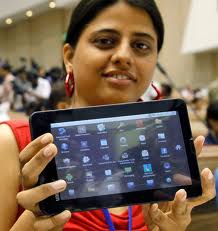
“Our ultimate aim is to imbibe the usage of tablets in the education system and create an ecosystem for this,” said Deepak B. Phatak, committee member and professor in IIT- Bombay"s Department of Computer Science and Engineering.

According to Mr. Phatak, computer giants world over are amazed with the device and there is a keen interest among several vendors to participate in this venture.

Aakash 3 will have a faster processor supporting both Linux and Android operating systems and come with advanced memory, he said.

“It could also have a SIM card slot so that people can use it as a communication device,” Mr. Phatak said.

Apart from Mr. Phatak, Prof Ashok Jhunjhunwala of IIT-Madras along with hundreds of students and other partners are also involved in making the new Aakash 3.

One of the aims of students involved in the project is to develop an application for the tablet that can tell pulse rate among many others.

It will also have a larger distribution and servicing system so that owners can get their tablets repaired locally.

Playing down controversies suggesting that several of the tablet"s components were of Chinese make, Mr. Phatak said emphasis has been placed on adding value to the product with the objective of enhancing its efficacy among students.

He also suggested two models for Aakash 3 — one for schools and the other for colleges.

The most recent version, Aakash 2, developed by IIT-Bombay along with C-DAC (Centre for Development of Advanced Computing), was launched by President Pranab Mukherjee in November.

The tablet is available for students at subsidised rate of Rs. 1,130 while the government purchases it at Rs. 2,263.

Comments

Add new comment

  • Coastaldigest.com reserves the right to delete or block any comments.
  • Coastaldigset.com is not responsible for its readers’ comments.
  • Comments that are abusive, incendiary or irrelevant are strictly prohibited.
  • Please use a genuine email ID and provide your name to avoid reject.
Agencies
June 9,2020

Soon, you may be able to withdraw cash from an ATM without touching any part of the machine. AGS Transact Technologies, a provider of cash and digital payment solutions and automation technology, on Monday said it has successfully developed and tested a touchless ATM solution in light of the COVID-19 pandemic.

The ‘contactless' solution, currently under demo at interested banks, enables a customer to perform all the steps required to withdraw cash from an ATM using the mobile app itself. 

The customer simply has to scan the QR code displayed on the ATM screen and follow the directions on their respective bank's mobile application. 

This includes entering the amount and mPIN required to dispense the cash from the ATM machine. 

According to the company, the QR code feature makes cash withdrawals quicker and more secure, and negates the chances of compromising the ATM Pin or card skimming.

"The new Touchless ATM solution is an extension of the flagship QR Cash solution which ensures safety of the users and will provide a seamless cash withdrawal experience with enhanced security," said Ravi B. Goyal, Chairman and MD, AGS Transact Technologies Ltd.

With minimum investment, the banks can enable this solution for their ATM networks by upgrading the existing software.

AGSTTL has so far installed, maintained and managed a network of over 72,000 ATMs across the country and also provides customised solutions to leading banks. 

The company earlier introduced UPI-QR based Cash withdrawal solution in partnership with Bank of India. 

This is how the solution works.

Open the Bank mobile application on your smartphone and select QR Cash Withdrawal. Enter the amount you wish to withdraw on the mobile app and scan the QR code on the ATM screen.

Next, confirm the amount by clicking on ‘proceed' in the app and enter the mPin to authenticate the transaction. Now collect the cash and receipt and you are done.

"The seamless, cardless and touchless withdrawal method is designed to provide easy transaction flow, without the need to touch the ATM screen or enter the pin," said Mahesh Patel, President and Group Chief Technology Officer, AGS Transact Technologies.

Comments

Add new comment

  • Coastaldigest.com reserves the right to delete or block any comments.
  • Coastaldigset.com is not responsible for its readers’ comments.
  • Comments that are abusive, incendiary or irrelevant are strictly prohibited.
  • Please use a genuine email ID and provide your name to avoid reject.
Agencies
January 4,2020

Washington D.C: One of the greatest spectacles of modern art is still thriving in the Australian outback as confirmed by satellite imagery of NASA. The Marree Man is a massive geoglyph depicting an aboriginal hunter, that spans over 2.6 miles in the Southern Australian region.

Discovered by a pilot in 1998, its origin still remains a mystery even to this date.

The Marree Man was given a new lease of life in 2016 when a group of people from the neighboring town of Marree plowed its lines to avert its fading due to erosion.

After NASA shared the image of the art-work that was taken in June, the efforts of the good samaritans turned out to be a total success, reported CNN Travel.

The restoration team believes that the refurbished Marree Man would last longer than its original version.

According to NASA, "They [the team] created wind grooves, designed to trap water and encourage the growth of vegetation. They hope that eventually, the man will turn green."

In a previous article, CNN reported that an entrepreneur by the name of Dick Smith took upon himself to unravel the geoglyph's mystery in 2016. His team combed through all the available evidence but couldn't find anything conclusive.

In 2018 he even offered a 5,000 Australian dollar reward for anyone who knows the identity of its creator.

Nobody turned up with an answer but it was speculated that unknown artist lives in Alice Springs or even might be an American.

Comments

Add new comment

  • Coastaldigest.com reserves the right to delete or block any comments.
  • Coastaldigset.com is not responsible for its readers’ comments.
  • Comments that are abusive, incendiary or irrelevant are strictly prohibited.
  • Please use a genuine email ID and provide your name to avoid reject.
Agencies
January 7,2020

Washington, Jan 7: Facebook will ban deepfake videos ahead of the US elections but the new policy will still allow heavily edited clips so long as they are parody or satire, the social media giant said Tuesday.

Deepfake videos are hyper-realistic doctored clips made using artificial intelligence or programs that have been designed to accurately fake real human movements.

In a blog published following a Washington Post report, Facebook said it would begin removing clips that were edited--beyond for clarity and quality--in ways that "aren't apparent to an average person" and could mislead people.

Clips would be removed if they were "the product of artificial intelligence or machine learning that merges, replaces or superimposes content onto a video, making it appear to be authentic," the statement from Facebook vice-president Monika Bickert said.

However, the statement added: "This policy does not extend to content that is parody or satire, or video that has been edited solely to omit or change the order of words."

US media noted the new guidelines would not cover videos such as the 2019 viral clip -- which was not a deepfake -- of House Speaker Nancy Pelosi that appeared to show her slurring her words.

Facebook also gave no indication on the number of people assigned to identify and take down the offending videos, but said videos failing to meet its usual guidelines would be removed, and those flagged clips would be reviewed by teams of third-party fact-checkers -- among them AFP.

The news agency has been paid by the social media giant to fact-check posts across 30 countries and 10 languages as part of a program starting in December 2016, and including more than 60 organisations.

Content labeled "false" is not always removed from newsfeeds but is downgraded so fewer people see it -- alongside a warning explaining why the post is misleading.

Comments

Add new comment

  • Coastaldigest.com reserves the right to delete or block any comments.
  • Coastaldigset.com is not responsible for its readers’ comments.
  • Comments that are abusive, incendiary or irrelevant are strictly prohibited.
  • Please use a genuine email ID and provide your name to avoid reject.