


Aakash 3 may come with SIM slot, more exciting apps

January 1, 2013

New Delhi, Jan 1: The third version of low cost tablet "Aakash" will be a delight for its users as developers are likely to equip it with a SIM slot and more exciting apps, all within the existing price band.

About 50 lakh "Aakash 3" tablets are expected to be rolled out in the next phase, the global tender for which may be floated in February, 2013.

According to committee members engaged in developing the third version of Aakash, the endeavour will be to make the product as indigenous as possible and involve multiple vendors.aakash
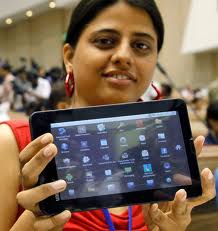
“Our ultimate aim is to imbibe the usage of tablets in the education system and create an ecosystem for this,” said Deepak B. Phatak, committee member and professor in IIT- Bombay"s Department of Computer Science and Engineering.

According to Mr. Phatak, computer giants world over are amazed with the device and there is a keen interest among several vendors to participate in this venture.

Aakash 3 will have a faster processor supporting both Linux and Android operating systems and come with advanced memory, he said.

“It could also have a SIM card slot so that people can use it as a communication device,” Mr. Phatak said.

Apart from Mr. Phatak, Prof Ashok Jhunjhunwala of IIT-Madras along with hundreds of students and other partners are also involved in making the new Aakash 3.

One of the aims of students involved in the project is to develop an application for the tablet that can tell pulse rate among many others.

It will also have a larger distribution and servicing system so that owners can get their tablets repaired locally.

Playing down controversies suggesting that several of the tablet"s components were of Chinese make, Mr. Phatak said emphasis has been placed on adding value to the product with the objective of enhancing its efficacy among students.

He also suggested two models for Aakash 3 — one for schools and the other for colleges.

The most recent version, Aakash 2, developed by IIT-Bombay along with C-DAC (Centre for Development of Advanced Computing), was launched by President Pranab Mukherjee in November.

The tablet is available for students at subsidised rate of Rs. 1,130 while the government purchases it at Rs. 2,263.

Comments

Add new comment

  • Coastaldigest.com reserves the right to delete or block any comments.
  • Coastaldigset.com is not responsible for its readers’ comments.
  • Comments that are abusive, incendiary or irrelevant are strictly prohibited.
  • Please use a genuine email ID and provide your name to avoid reject.
Agencies
January 7,2020

Washington, Jan 7: Facebook will ban deepfake videos ahead of the US elections but the new policy will still allow heavily edited clips so long as they are parody or satire, the social media giant said Tuesday.

Deepfake videos are hyper-realistic doctored clips made using artificial intelligence or programs that have been designed to accurately fake real human movements.

In a blog published following a Washington Post report, Facebook said it would begin removing clips that were edited--beyond for clarity and quality--in ways that "aren't apparent to an average person" and could mislead people.

Clips would be removed if they were "the product of artificial intelligence or machine learning that merges, replaces or superimposes content onto a video, making it appear to be authentic," the statement from Facebook vice-president Monika Bickert said.

However, the statement added: "This policy does not extend to content that is parody or satire, or video that has been edited solely to omit or change the order of words."

US media noted the new guidelines would not cover videos such as the 2019 viral clip -- which was not a deepfake -- of House Speaker Nancy Pelosi that appeared to show her slurring her words.

Facebook also gave no indication on the number of people assigned to identify and take down the offending videos, but said videos failing to meet its usual guidelines would be removed, and those flagged clips would be reviewed by teams of third-party fact-checkers -- among them AFP.

The news agency has been paid by the social media giant to fact-check posts across 30 countries and 10 languages as part of a program starting in December 2016, and including more than 60 organisations.

Content labeled "false" is not always removed from newsfeeds but is downgraded so fewer people see it -- alongside a warning explaining why the post is misleading.

Comments

Add new comment

  • Coastaldigest.com reserves the right to delete or block any comments.
  • Coastaldigset.com is not responsible for its readers’ comments.
  • Comments that are abusive, incendiary or irrelevant are strictly prohibited.
  • Please use a genuine email ID and provide your name to avoid reject.
Agencies
February 26,2020

Unnao, Feb 26: Ever heard of someone wishing a 'bright future' for the dead? In a bizarre incident in Uttar Pradesh's Unnao district, a village head issued a death certificate with the wish for an elderly man who had died last month.

The incident took place in the Sirwariya village in Asoha block where an elderly person Laxmi Shankar died after a prolonged illness on January 22.

His son went to the village head Babulal and requested him to issue a death certificate that he needed for some financial transactions.

Babulal not only issued the death certificate, but also 'wished' 'a bright future for the deceased' on the document.

The village head wrote in the death certificate -- "Main inke ujjwal bhavishya ki kaamna karta hoon (I wish him a bright future)."

The letter went viral on the social media on Monday after which the village head apologised for the error and issued a new death certificate.

Comments

Add new comment

  • Coastaldigest.com reserves the right to delete or block any comments.
  • Coastaldigset.com is not responsible for its readers’ comments.
  • Comments that are abusive, incendiary or irrelevant are strictly prohibited.
  • Please use a genuine email ID and provide your name to avoid reject.
Agencies
May 27,2020

Due to impacts of COVID-19, shipments of total mobile phones are forecast to decline 14.6% in 2020, while smartphone shipments will achieve a slightly slower decline of 13.7 % year over year to total 1.3 billion units this year, according to a Gartner forecast on Tuesday.

"While users have increased the use of their mobile phones to communicate with colleagues, work partners, friends and families during lockdowns, reduced disposable income will result in fewer consumers upgrading their phones," Ranjit Atwal, Senior Research Director at Gartner, said in a statement.

"As a result, phone lifetimes will extend from 2.5 years in 2018 to 2.7 years in 2020," said Atwal.

In 2020, affordable 5G phones were expected to be the catalyst to increase phone replacements, but now it is unlikely to be the case.

5G phones are now forecast to represent only 11% of total mobile phone shipments in 2020.

"The delayed delivery of some 5G flagship phones is an ongoing issue," said Annette Zimmermann, Research Vice President at Gartner.

"Moreover, the lack of 5G geographical coverage along with the increasing cost of the 5G phone contract will impact the choice of a 5G phone."

Overall, spending on 5G phones will be impacted in most regions apart from China, where continued investment in 5G infrastructure is expected, allowing providers in China to effectively market 5G phones.

The combined global shipments PCs, tablets and mobile phones are on pace to decline 13.6% in 2020, according to the forecast.

PC shipments are expected to decline 10.5% this year. Shipments of notebooks, tablets and Chromebooks are forecast to decline slower than the PC market overall in 2020.

"The forecasted decline in the PC market in particular could have been much worse," said Atwal.

"However, government lockdowns due to COVID-19 forced businesses and schools to enable millions of people to work from home and increase spending on new notebooks, Chromebooks and tablets for those workers. Education and government establishments also increased spending on those devices to facilitate e-learning."

Gartner said that 48 per cent of employees will likely work remotely at least part of the time after the COVID-19 pandemic, compared to 30 % pre-pandemic.

Overall, the work from home trend will make IT departments shift to more notebooks, tablets and Chrome devices for work.

"This trend combined with businesses required to create flexible business continuity plans will make business notebooks displace desk based PCs through 2021 and 2022," said Atwal.

Comments

Add new comment

  • Coastaldigest.com reserves the right to delete or block any comments.
  • Coastaldigset.com is not responsible for its readers’ comments.
  • Comments that are abusive, incendiary or irrelevant are strictly prohibited.
  • Please use a genuine email ID and provide your name to avoid reject.