



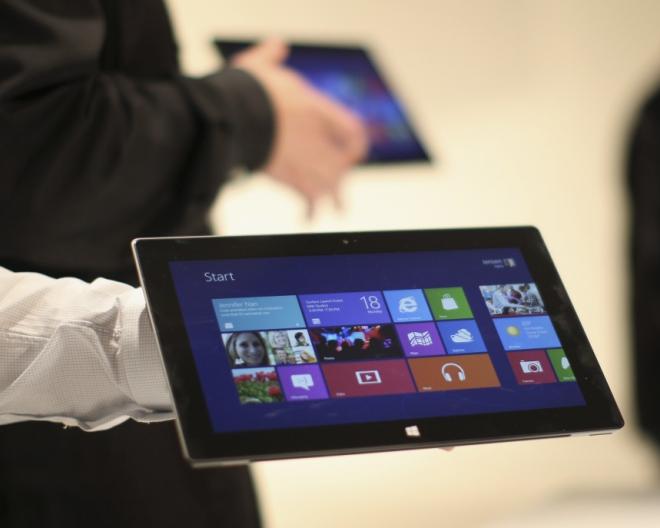
Apple iPad not replacing laptops, Microsoft Surface can: SAP

January 17, 2013

tablet-windows-8

San Francisco, Jan 17: Personal computer makers, trying to beat back a tablet mania that's eating into their sales, are making what may be a last-ditch attempt to sway customers by mimicking the competition.

Many of the laptops to be unveiled around the world in coming months will be hybrids or "convertibles" - morphing easily between portable tablets and full-powered laptops with a keyboard, industry analysts say.

The wave of hybrids comes as Intel and Microsoft, long the twin leaders of the PC industry, prepare to report results this week and next. Wall Street is predicting flat to sluggish quarterly revenue growth for both, underscoring the plight of an industry that has struggled to innovate.

In 2013, some are hoping that will change.

With the release of Microsoft's touch-centric, re-imagined Windows 8 platform in October and more power-efficient chips from Intel, PC makers are trying to spark growth by focusing on creating slim laptops with touchscreens that convert to tablets and vice versa.

Microsoft, expanding beyond its traditional business of selling software, is expected this month to roll out a "Surface Pro" tablet compatible with legacy PC software developed over decades.

That's a major selling point for corporate customers like German business software maker SAP, which plans to buy Surface Pros for employees that want it, said SAP Chief Information Officer Oliver Bussmann.

"The hybrid model is very compelling for a lot of users," Bussmann told Reuters last week. "The iPad is not replacing the laptop. It's hard to create content. That's the niche that Microsoft is going after. The Surface can fill that gap."

Apple's iPad began chipping away at demand for laptops in 2010, an assault that accelerated with the launch of Amazon.com's Kindle Fire and other Google Android devices like Samsung Electronics' Note.

With sales of PCs falling last year for the first time since 2001, this year may usher in a renaissance in design and innovation from manufacturers who previously focused on reducing costs instead of adding new features to entice consumers.

"People used to be able to just show up at the party and do well just because the market was going up," Lisa Su, a senior vice president at Advanced Micro Devices, which competes against Intel. "It's harder now. You can't just show up at the party. You have to innovate and have something special."

At last week's Consumer Electronics Show in Las Vegas, devices on display from Intel and others underscored the PC industry's plan to bet more on convertible laptops.

Lenovo's North America President Gerry Smith told Reuters last week that over the holidays he sold out of the company's "Yoga", a laptop with a screen that flips back behind its keyboard, and the "ThinkPad Twist", another lightweight laptop with a swiveling screen.

Intel itself showed off a hybrid prototype laptop dubbed "North Cape", housed in a thin tablet screen that attaches magnetically to a low-profile keyboard. And Asus showed a hefty 18-inch, all-in-one Windows 8 PC that converts to a tablet running Google's Android operating system.

Lenovo and Asus, which have both won positive reviews for their devices in recent months, increased their PC shipments by 14 per cent and 17 per cent respectively last year, according to Gartner.

"The number of unique systems that our partners have developed for Windows has almost doubled since launch. That gives an indication of how much innovation is going into the PC market," Tami Reller, chief financial officer of Microsoft's Windows unit, told Reuters.

Finger-pointing

To be sure, hybrids with detachable or twistable screens do not yet account for a significant proportion of global PC sales, and consumers still need to be sold on their benefits.

Previous attempts by PC makers to reinvigorate the market have had limited success. Pushed by Intel, manufacturers launched a series of slimmed down laptops early last year with features popular on tablets, like solid-state memory.

They were too expensive, often at more than $1,000 apiece, and failed to arrest the PC decline.

Microsoft's Windows 8 launch in October brought touchscreen features but failed to spark a resurgence in PC sales many manufacturers had hoped for. A round of finger-pointing ensued, with PC and chip executives blaming a shortage of touchscreen components and others saying it was the manufacturers that sharply underestimated consumer demand for touch devices.

Regardless, the entire PC ecosystem is onboard for 2013. Almost half of the Windows laptops rolled out this year may have touchscreens. Of those, most will be in convertible form, according to IDC analyst David Daoud.

Further blurring the distinction between kinds of devices, about a quarter of upcoming Windows 8 gadgets will be tablets that can easily act as laptops with the help of keyboard accessories, he added.

But buyers may have to wait until the second half of the year to see many of them.

"The most likely scenario today is for the industry to have these products ready for the back-to-school season," Daoud said.

Comments

Add new comment

  • Coastaldigest.com reserves the right to delete or block any comments.
  • Coastaldigset.com is not responsible for its readers’ comments.
  • Comments that are abusive, incendiary or irrelevant are strictly prohibited.
  • Please use a genuine email ID and provide your name to avoid reject.
Agencies
March 15,2020

Cybercriminals continue to exploit public fear of rising coronavirus cases through malware and phishing emails in the guise of content coming from the Centers for Disease Control and Prevention (CDC) in the US and World Health Organisation (WHO), says cybersecurity firm Kaspersky.

In the APAC region, Kaspersky has detected 93 coronavirus-related malware in Bangladesh, 53 in the Philippines, 40 in China, 23 in Vietnam, 22 in India and 20 in Malaysia. 

Single-digit detections were monitored in Singapore, Japan, Indonesia, Hong Kong, Myanmar, and Thailand. 

Along with the consistent increase of 2019 coronavirus cases comes the incessant techniques cybercriminals are using to prey on public panic amidst the global epidemic, the company said in a statement. 

Kaspersky also detected emails offering products such as masks, and then the topic became more commonly used in Nigerian spam emails. Researchers also found scam emails with phishing links and malicious attachments.

One of the latest spam campaigns mimics the World Health Organisation (WHO), showing how cybercriminals recognise and are capitalising on the important role WHO has in providing trustworthy information about the coronavirus.

"We would encourage companies to be particularly vigilant at this time, and ensure employees who are working at home exercise caution. 

"Businesses should communicate clearly with workers to ensure they are aware of the risks, and do everything they can to secure remote access for those self-isolating or working from home," commented David Emm, principal security researcher.

Some malicious files are spread via email. 

For example, an Excel file distributed via email under the guise of a list of coronavirus victims allegedly sent from the World Health Organisation (WHO) was, in fact, a Trojan-Downloader, which secretly downloads and installs another malicious file. 

This second file was a Trojan-Spy designed to gather various data, including passwords, from the infected device and send it to the attacker.

Comments

Add new comment

  • Coastaldigest.com reserves the right to delete or block any comments.
  • Coastaldigset.com is not responsible for its readers’ comments.
  • Comments that are abusive, incendiary or irrelevant are strictly prohibited.
  • Please use a genuine email ID and provide your name to avoid reject.
News Network
June 18,2020

Beijing, Jun 18:  Besides washing hands and wearing masks, it is also important to close the toilet lid before flushing to contain the spread of COVID-19, as per a new study.

According to a new study cited by The Washington Post, scientists who simulated toilet water and airflows, have found that flushing a toilet can generate a plume of virus-containing aerosol particles that is widespread and can linger in the air long enough to be inhaled by others. The novel coronavirus has been found in the faeces of COVID-19 patients, but it remains unknown whether such clouds could contain enough virus to infect a person.

"Flushing will lift the virus up from the toilet bowl," co-author Ji-Xiang Wang, who researches fluids at Yangzhou University in Yangzhou, China, said in an email. Wang stressed that bathroom users "need to close the lid first and then trigger the flushing process" and wash hands properly if the closure is not possible. As one flushes the toilet with the lids open, bits of faecal matter swish around so violently that they can be propelled into the air, become aerosolised and then settle on the surroundings.

Experts call it the "toilet plume".Age-old studies have been made to understand the potential for airborne transmission of infectious disease via sewage, and the toilet plume's role. Scientists who have seeded toilet bowls with bacteria and viruses have found contamination of seats, flush handles, bathroom floors and nearby surfaces. This is one reason we are told to wash our hands after visiting the toilet. Public bathrooms are well known to contribute to the spread of viruses that transmit via ingestion, such as the noroviruses that haunt cruise ships. However, their role in the transmission of respiratory viruses has not been established, said Charles P Gerba, a microbiologist at the University of Arizona."The risk is not zero, but how great a risk it is, we do not know. The big unknown is how much virus is infectious in the toilet when you flush it ... and how much virus does it take to cause an infection," said Gerba, who has studied the intersection of toilets and infectious disease for 45 years.

A study published in March in the journal Gastroenterology found significant amounts of coronavirus in the stool of patients and determined that viral RNA lasted in faeces even after the virus cleared from the patients` respiratory tracts. While another study in the journal Lancet found coronavirus in faeces up to a month after the illness had passed.

Scientists around the world are now studying sewage to track the spread of the virus. According to the researchers, the presence of the virus in excrement and the gastrointestinal tract raises the prospect of transmission via toilets, because many COVID-19 patients experience diarrhoea or vomiting.

A study of air samples in two hospitals in Wuhan, China found that although coronavirus aerosols in isolation wards and ventilated patient rooms were very low, "it was higher in the toilet areas used by the patients".The Centers for Disease Control and Prevention (CDC) says it remains "unclear whether the virus found in faeces may be capable of causing COVID-19," and "there has not been any confirmed report of the virus spreading from faeces to a person".For now, the CDC characterises the risk as low based on observations from previous outbreaks of other coronaviruses such as severe acute respiratory syndrome (SARS) and the Middle East respiratory syndrome (MERS). Wang decided to use computer models to simulate toilet plumes while isolating at home, as per Chinese government orders and thinking about how a fluids researcher "could contribute to the global fight against the virus".

Published in the journal Physics of Fluids, the study found that flushing of both single-inlet toilets, which push water into the bowl from one port, and annular-inlet toilets, which pour water into the bowl from the rim's surrounding edge with even greater energy, results in "massive upward transport of virus".

Particles can reach heights of more than three feet and float in the air for more than a minute, it found. The paper recommends not just lid-closing and hand-washing, it urges manufacturers to produce toilets that close and self-clean automatically. It also suggests that toilet-users should wipe down the seat. Gerba, however, said seats should not be a major concern.

Research has found that public and household toilet seats are typically the cleanest surfaces in restrooms, he said, probably because so many people already wipe them off before using them. Also, he said of SARS-CoV-2, the virus that causes COVID-19, "I don't think it's butt-borne, so I don`t think you have to worry."Gerba, who has been studying coronavirus transmission for two decades to investigate the role of a toilet flushing in a SARS outbreak stresses "flush and run" when using a public toilet without a lid. Gerba also said that people should wash hands well post-flushing and use hand sanitiser after leaving the restroom. "Choose well-ventilated bathrooms if possible and do not hang around the restroom in any case," added Gerba.

Comments

Add new comment

  • Coastaldigest.com reserves the right to delete or block any comments.
  • Coastaldigset.com is not responsible for its readers’ comments.
  • Comments that are abusive, incendiary or irrelevant are strictly prohibited.
  • Please use a genuine email ID and provide your name to avoid reject.
Agencies
July 15,2020

New Delhi, Jul 15: The employees union of state-run telecom operator BSNL will stage protests across the country on Thursday on a host of issues including the cancellation of its 4G tender and non-payment of salaries.

All major unions are organising ‘lunch-hour black-flag' demonstrations throughout the country under the banner of All Unions and Association of BSNL (AUAB), said a statement by AUAB. These demonstrations will be organised, by maintaining social distancing and by taking other precautions, like wearing of masks. The BSNL employees will also wear black-badges the whole day on July 16.

The employees body would demand that BSNL should immediately be allowed to roll out its 4G services and the tender should be issued immediately. Further, they want that in the matter of procuring new equipment and upgradation, there should not be any discrimination between BSNL and other private telecom service providers.

Recently, the Centre cancelled the 4G upgradation tender for BSNL as it had decided to come up with fresh specifications for the upgrade process, in a move to keep Chinese technology companies at bay as the border tussle escalated with the northern neighbour.

The Department of Telecommunications (DoT) would issue a fresh tender for the same, and people in the know said that Chinese companies may not be allowed to participate.

"The agitational programme is being organised to express the deep anguish and resentment of the employees against cancellation of BSNL's 4G tender, cancellation of BSNL's proposal for upgradation of its 49,300 BTSs to 4G, abnormal delay in issuing ‘Add on Order' for 4G equipments, inordinate delay in the implementation of BSNL's Revival Package and against the non-settlement of the burning problems of the employees," said the statement.

The umbrella body of BSNL's employees' unions noted that rolling out of 4G services is the backbone for the revival of this telecom PSU, but the recent cancellation of the tender floated by BSNL for procuring 4G equipment at a cost of Rs 9,300 crore, has brought the company back to square one.

It said that BSNL is already having 49,300 base transceiver stations (BTS), which are 4G compatible and through minor upgradation, all these equipment can be converted into 4G BTSs with an investment of about Rs 1,500 crore.

In addition to this, BSNL could have added another 15,000 BTSs, by placing an Add on Order to the existing mobile tender, it added.

Noting that in October 2019, the PSU could have rolled out pan-India 4G services, AUAB said: "Being the sole owner of the company, the Government of India also cannot shirk its responsibility in this matter."

"Adding insult to injury, the tender floated by BSNL to procure 4G equipment, has been cancelled by the government, based on a complaint from the Telecom Equipments and Services Promotional Council (TEPC)," it said.

AUAB said that BSNL is already lagging four years behind the private operators, in terms of 4G and the cancellation of the tender is going to inordinately delay the company's 4G launch.

Saying that TEPC's contention has been to bar foreign companies from participating in BSNL's tender, AUAB statement pointed out that when private operators are procuring equipment from multinationals, "why BSNL alone should be compelled to procure 4G equipments from domestic vendors, whose 4G technology is not tested or proven so far."

It alleged a conspiracy to destabilise BSNL by disrupting its rolling out of 4G services.

AUAB further said that even after the lapse of nine months, the implementation of the much publicised BSNL's Revival Package is moving at a snail's pace.

"Except the swift retrenchment of 79,000 BSNL employees under VRS, all other assurances given in BSNL's Revival Package have been put in cold storage."

The management should ensure that the salary payment of the employees is made on the last working day of every month. Deductions made from employees' salary, on account of "society dues", should immediately be remitted, it said.

Regarding the monetisation of the company's assets under the revival package, the organisation said that the land asset should not be handed over to corporates, at "throwaway" prices.

"These lands should be sold in a transparent manner and at the prevailing market rates. They should not be sold at book value or at circle rates. The AUAB will strictly monitor these dealings," it said.

Comments

Add new comment

  • Coastaldigest.com reserves the right to delete or block any comments.
  • Coastaldigset.com is not responsible for its readers’ comments.
  • Comments that are abusive, incendiary or irrelevant are strictly prohibited.
  • Please use a genuine email ID and provide your name to avoid reject.