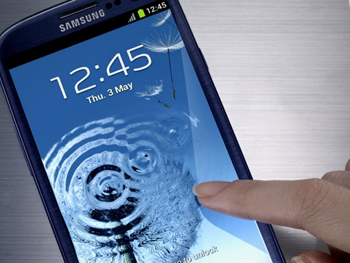
Samsung Galaxy S III bug lets anyone bypass password-protected lockscreen

[email protected] (Anupam Saxena)
March 8, 2013

Samsung_Galaxy_S_III

A user has discovered a security flaw in the Samsung Galaxy S III that allows anyone to bypass the lock screen of the phone by following a few simple steps.

Sean McMillan has posted a method to access the lock screen of the Galaxy S II on a mailing list. According to him the bug can be reproduced by following these steps:

1) On the code entry screen (of the lock screen) press Emergency Call

2) Then press Emergency Contacts

3) Press the Home button once

4) Just after pressing the Home button, press the power button quickly

5) If successful, pressing the power button again will bring you to the S3's home screen

McMillan mentions that it might take a few attempts to get the hack working and that sometimes the method works in one go while at others, it can take more than 20 attempts. He also adds that the method seems to work better when the mobile has auto rotation turned on. McMillan claims to have tested the method on three Galaxy S III devices.

We tried unlocking the screen of a Samsung Galaxy S III(GT-I9300 running Android 4.1.2) using the same method but weren't successful.

However, ZDNET says they were able to replicate the hack after a few attempts. The site states that the timing to replicate the issue is very small and that it is difficult to replicate it in the first attempt. But after bypassing the screen once, the bug stays on the device even when the phone's screen is turned back off and the phone stops asking the user for their PIN, password or pattern.

Just a few days back, another user, Terence Eden, had discovered a security flaw in the Samsung Galaxy Note II that allowed anyone to bypass the lock screen and take a look at the home screen app icons by following similar steps. But the hack didn't allow the hacker to use any of the apps.

Last month, a similar vulnerability was discovered in Apple iOS 6.1, allowing users to bypass the lock screen, following which Apple had acknowledged the issue and promised a fix.

Comments

Add new comment

  • Coastaldigest.com reserves the right to delete or block any comments.
  • Coastaldigset.com is not responsible for its readers’ comments.
  • Comments that are abusive, incendiary or irrelevant are strictly prohibited.
  • Please use a genuine email ID and provide your name to avoid reject.
Agencies
June 16,2020

Paris, Jun 16: Increasing numbers of readers are paying for online news around the world even if the level of trust in the media, in general, remains very low, according to a report published Tuesday.

Around 20 percent of Americans questioned said they subscribed to an online news provider (up to four points over the previous year) and 42 percent of Norwegians (up eight points), along with 13 percent of the Dutch (up to three points), compared with 10 percent in France and Germany.

But between a third and a half of all news subscriptions go to just a few major media organisations, such as the New York Times, according to the annual Digital News Report by the Reuters Institute.

Some readers, however, are also beginning to take out more than one subscription, paying for a local or specialist title in addition to a national news source, the study's authors said.

But a large proportion of internet users say nothing could convince them to pay for online news, around 40 percent in the United States and 50 percent in Britain.

YouGov conducted the online surveys of 40 countries for the Reuters Institute in January, with 2,000 respondents in each.

Further surveys were carried out in six countries in April to analyse the initial effects of COVID-19.

The health crisis brought a revival of interest in television news -- with the audience rising five percent on average -- establishing itself as the main source of information along with online media.

Conversely, newspaper circulation was hard-hit by coronavirus lockdown measures.

The survey found trust in the news had fallen to its lowest level since the first report in 2012, with just 38 percent saying they trusted most news most of the time.

However, confidence in the news media varied considerably by country, ranging from 56 percent in Finland and Portugal to 23 percent in France and 21 percent in South Korea.

In Hong Kong, which has been hit by months of sometimes violent street protests against an extradition law, trust in the news fell 16 points to 30 percent over the year.

Chile, which has had regular demonstrations against inequality, saw trust in the media fall 15 percent while in Britain, where society has been polarised by issues such as Brexit, it was down 12 points.

Comments

Add new comment

  • Coastaldigest.com reserves the right to delete or block any comments.
  • Coastaldigset.com is not responsible for its readers’ comments.
  • Comments that are abusive, incendiary or irrelevant are strictly prohibited.
  • Please use a genuine email ID and provide your name to avoid reject.
Agencies
June 7,2020

New Delhi, Jun 7: The Government of India (GoI) must strengthen the laws to protect animals, said People for the Ethical Treatment of Animals (PETA) India CEO Dr Manilal Valliyate on Sunday, following an elephant's death in Kerala and cow injured due to ingestion of explosives in Himachal Pradesh.

"Such incidents are not just restricted to certain regions but are happening all across the country. PETA receives more than 100 similar cases every day. People send in their complaints to us, not just for cows and elephants but for so many other animals as well," he said.

The PETA chief urged the GoI to strengthen the laws established to protect animals.

"As per the current laws set out against animal cruelty, the perpetrator would only be charged Rs 50,000 as a fine. That is equivalent to no punishment at all," added PETA India CEO.

He expressed his anguish against municipal agencies as well, saying that they are not doing "serious" work. He also highlighted how cows are left on the roads to wander, after milking them, to feed on garbage, in several parts of the country.

"These injustices against animals through explosives has been going on for quite a while. But for the first time, it has received such public attention," he said.

After a pregnant elephant was fed cracker-filled pineapple and her eventual death on May 27 in Kerala's Palakkad district, a pregnant cow sustained fatal injuries on May 25 due to accidental ingestion of explosives in Dadh village of Bilaspur district of Himachal Pradesh.

One person has been arrested in the Dadh village for allegedly hurting the cow.

Comments

Add new comment

  • Coastaldigest.com reserves the right to delete or block any comments.
  • Coastaldigset.com is not responsible for its readers’ comments.
  • Comments that are abusive, incendiary or irrelevant are strictly prohibited.
  • Please use a genuine email ID and provide your name to avoid reject.
News Network
April 17,2020

Paris, Apr 17: Even as virologists zero in on the virus that causes COVID-19, a very basic question remains unanswered: do those who recover from the disease have immunity?

There is no clear answer to this question, experts say, even if many have assumed that contracting the potentially deadly disease confers immunity, at least for a while.

"Being immunised means that you have developed an immune response against a virus such that you can repulse it," explained Eric Vivier, a professor of immunology in the public hospital system in Marseilles.

"Our immune systems remember, which normally prevents you from being infected by the same virus later on."

For some viral diseases such a measles, overcoming the sickness confers immunity for life.

But for RNA-based viruses such as Sars-Cov-2 -- the scientific name for the bug that causes the COVID-19 disease -- it takes about three weeks to build up a sufficient quantity of antibodies, and even then they may provide protection for only a few months, Vivier told AFP.

At least that is the theory. In reality, the new coronavirus has thrown up one surprise after another, to the point where virologists and epidemiologists are sure of very little.

"We do not have the answers to that -- it's an unknown," Michael Ryan, executive director of the World Health Organization's Emergencies Programme said in a press conference this week when asked how long a recovered COVID-19 patient would have immunity.

"We would expect that to be a reasonable period of protection, but it is very difficult to say with a new virus -- we can only extrapolate from other coronaviruses, and even that data is quite limited."

For SARS, which killed about 800 people across the world in 2002 and 2003, recovered patients remained protected "for about three years, on average," Francois Balloux director of the Genetics Institute at University College London, said.

"One can certainly get reinfected, but after how much time? We'll only know retroactively."

A recent study from China that has not gone through peer review reported on rhesus monkeys that recovered from Sars-Cov-2 and did not get reinfected when exposed once again to the virus.

"But that doesn't really reveal anything," said Pasteur Institute researcher Frederic Tangy, noting that the experiment unfolded over only a month.

Indeed,several cases from South Korea -- one of the first countries hit by the new coronavirus -- found that patients who recovered from COVID-19 later tested positive for the virus.

But there are several ways to explain that outcome, scientists cautioned.

While it is not impossible that these individuals became infected a second time, there is little evidence this is what happened.

More likely, said Balloux, is that the virus never completely disappeared in the first place and remains -- dormant and asymptomatic -- as a "chronic infection", like herpes.

As tests for live virus and antibodies have not yet been perfected, it is also possible that these patients at some point tested "false negative" when in fact they had not rid themselves of the pathogen.

"That suggests that people remain infected for a long time -- several weeks," Balloux added. "That is not ideal."

Another pre-publication study that looked at 175 recovered patients in Shanghai showed different concentrations of protective antibodies 10 to 15 days after the onset of symptoms.

"But whether that antibody response actually means immunity is a separate question," commented Maria Van Kerhove, Technical Lead of the WHO Emergencies Programme.

"That's something we really need to better understand -- what does that antibody response look like in terms of immunity."

Indeed, a host of questions remain.

"We are at the stage of asking whether someone who has overcome COVID-19 is really that protected," said Jean-Francois Delfraissy, president of France's official science advisory board.

For Tangy, an even grimmer reality cannot be excluded.

"It is possible that the antibodies that someone develops against the virus could actually increase the risk of the disease becoming worse," he said, noting that the most serious symptoms come later, after the patient had formed antibodies.

For the moment, it is also unclear whose antibodies are more potent in beating back the disease: someone who nearly died, or someone with only light symptoms or even no symptoms at all. And does age make a difference?

Faced with all these uncertainties, some experts have doubts about the wisdom of persuing a "herd immunity" strategy such that the virus -- unable to find new victims -- peters out by itself when a majority of the population is immune.

"The only real solution for now is a vaccine," Archie Clements, a professor at Curtin University in Perth Australia, told AFP.

At the same time, laboratories are developing a slew of antibody tests to see what proportion of the population in different countries and regions have been contaminated.

Such an approach has been favoured in Britain and Finland, while in Germany some experts have floated the idea of an "immunity passport" that would allow people to go back to work.

"It's too premature at this point," said Saad Omer, a professor of infectious diseases at the Yale School of Medicine.

"We should be able to get clearer data very quickly -- in a couple of months -- when there will be reliable antibody tests with sensitivity and specificity."

One concern is "false positives" caused by the tests detecting antibodies unrelated to COVID-19.

The idea of immunity passports or certificates also raises ethical questions, researchers say.

"People who absolutely need to work -- to feed their families, for example -- could try to get infected," Balloux.


Comments

Add new comment

  • Coastaldigest.com reserves the right to delete or block any comments.
  • Coastaldigset.com is not responsible for its readers’ comments.
  • Comments that are abusive, incendiary or irrelevant are strictly prohibited.
  • Please use a genuine email ID and provide your name to avoid reject.