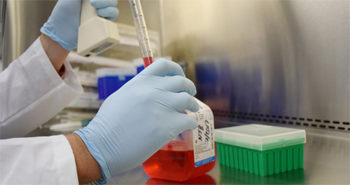
Scientists Develop Oral Vaccine Against Salmonella Infection

December 20, 2016

Houston, Dec 20: Scientists, including one of Indian origin, have developed an oral vaccine against Salmonella - the deadly bacteria responsible for one of the most common food-borne illnesses in the world.

5-teamdevelopsOral vaccination is simplest and least invasive way to protect people against salmonella infection, researchers said.

Taking this vaccine by mouth also has the added advantage of using the same pathway that salmonella uses to wreak havoc on the digestive system, they said.

"In the current study, we analysed the immune responses of mice that received the vaccination by mouth as well as how they responded to a lethal dose of salmonella," said Ashok Chopra, professor at The University of Texas Medical Branch at Galveston (UTMB) in the US.

"We found that the orally administered vaccines produced strong immunity against salmonella, showing their potential for future use in people," said Mr Chopra.

There is no vaccine currently available for salmonella poisoning. Antibiotics are the first choice in treating salmonella infections, but the fact that some strains of salmonella are quickly developing antibiotic resistance is a serious concern.

"Another dangerous aspect of salmonella is that it can be used as a bioweapon - this happened in Oregon when a religious cult intentionally contaminated restaurant salad bars and sickened 1,000 people," researchers said.

Salmonella is responsible for one of the most common food-borne illnesses in the world. In the US alone, the Centres for Disease Control and Prevention estimates that there are about 1.4 million cases with 15,000 hospitalisations and 400 deaths each year.

It is thought that for every reported case, there are about 39 undiagnosed infections. Overall, the number of salmonella cases in the US has not changed since 1996.

Salmonella infection in people with compromised immune systems and children under the age of three are at increased risk of invasive non-typhoidal salmonellosis, which causes systemic infection. There are about one million cases globally per year, with a 25 per cent fatality rate.

In earlier studies, the UTMB researchers developed potential vaccines from three genetically mutated versions of the salmonella bacteria, that is Salmonella Typhimurium, that were shown to protect mice against a lethal dose of salmonella. In these studies, the vaccines were given as an injection.

The findings were published in the journal Frontiers in Cellular and Infection Microbiology.

Comments

Add new comment

  • Coastaldigest.com reserves the right to delete or block any comments.
  • Coastaldigset.com is not responsible for its readers’ comments.
  • Comments that are abusive, incendiary or irrelevant are strictly prohibited.
  • Please use a genuine email ID and provide your name to avoid reject.
Agencies
February 24,2020

Singapore, Feb 24: Last week Singapore's Ministry of Trade and Industry revised their 2020 GDP growth projections downwards to -0.5 to 1.5 per cent, confirming fears of economic fallout from the coronavirus COVID-19. Just three days earlier, while visiting Changi Airport, the Prime Minister told the media that the country is bracing for a significant hit on the economy and the possibility of a recession.

In the budget announcement on February 18, various measures to help affected companies were announced.

This included a jobs support scheme to help companies retain workers that will see the government offset 8 per cent of wages up to SGD3,600(USD2,600) per worker, per month, for a three-month period. Companies will also get a 25 per cent rebate on their taxes for the year capped at SGD15,000 (USD10,800) per company.

There will be additional support for sectors directly affected by the virus outbreak such as tourism, aviation and retail. Qualifying companies will be given property tax rebates and can apply for temporary bridging loans to ease cash flow. Rebates will be offered on aircraft landing and parking charges as well as rental rebates for shops and cargo agents at Changi Airport.

Overall, the economic package will cost Singapore some USD 4.6 billion, well in excess of the USD 500 million some analysts had predicted. The resulting spending plan including the virus economic package will see a budget deficit of SGD 10.9 billion or 2.1 per cent of GDP, the highest since the Asian financial crisis of 1997.

It is hoped that with financial support, companies in Singapore will not only be able to ride through the current rough patch but be able to position themselves better to take off once the economic crisis brought upon by the contagion is over.

Which then are the Singapore companies that can potentially ride out the current storm and emerge stronger?

Aviation and hospitality firms are among those most impacted by the virus outbreak and Singapore Airlines (SIA) comes to mind. SIA is a well-run company but has seen its share price fall about 5.2 percent since the beginning of the year. In the short term, revenue and profits will no doubt be affected but it will recover in the long run.

Hospitality sector companies like Ascott Residence whose main sponsor is Capitaland, Southeast Asia's largest landlord, and CDL Hospitality, have seen 1.5 and 5.5 percent (respectively) shaved off their share prices since the start of the year.

In reporting financial results for the quarter which ended in December on February 14, Alibaba CEO Daniel Zhang said that due to the virus, they are seeing large changes in buying patterns. With widespread home confinement, there is a growing demand for delivery services including online food and grocery delivery, as well as office apps and streaming entertainment.

Similarly, in Singapore, with more people staying and working from home, the three main food delivery services, Grab Food, Foodpanda and Deliveroo, are doing roaring business. All three are privately held.

In late January, as the scale of the outbreak became more apparent, investors began pouring money into health-product firms in Asia that they think will benefit from the virus outbreak.

Bloomberg reported that when Chinese pharmaceutical companies like Da An Gene Co, Xilong Scientific and Shanghai Kehua Bio-Engineering said they have developed kits for detecting the virus, their stocks soared to hit the 10 per cent daily limit. Firms manufacturing protection gear and air-cleaning equipment climbed more than 10 per cent in Japan, while Malaysian rubber gloves producers climbed at least 5 per cent.

Naturally, many would view that pharmaceutical companies that have the technology and expertise to develop drugs to treat patients with the virus or are able to develop a vaccine, would stand to benefit from the coronavirus outbreak.

Firms like and Johnson & Johnson, Pfizer, MSD, GlaxoSmithKline (GSK) and Sanofi are the pharmaceutical behemoths that dominate the global vaccine market.

However, industry experts speaking to the BBC warned that a pot of gold is not necessarily waiting for any company that successfully develops a vaccine. Although the global vaccine market is expected to grow to USD60 billion this year, it is costly and time-consuming to develop and pass it through for use by the general public.

It is also unclear if Indian pharmaceutical firms will be able to benefit from the demand for medicines that can treat or prevent the virus.

India is the world's largest manufacturer of generic drugs and it supplies 20 percent of the world's drugs by volume. However, it sources 70 percent of its raw material from China. If supplies are disrupted beyond a month to a month and a half, they may see a slow-down in production. According to a CNN report, the companies that are most impacted by material shortages are GSK India, Pfizer (PFE) and Cipla. Other companies like Aurobindo Pharma, Cadila Healthcare and Sun Pharma are said to be carefully monitoring the situation.


Comments

Add new comment

  • Coastaldigest.com reserves the right to delete or block any comments.
  • Coastaldigset.com is not responsible for its readers’ comments.
  • Comments that are abusive, incendiary or irrelevant are strictly prohibited.
  • Please use a genuine email ID and provide your name to avoid reject.
Agencies
February 10,2020

Washington D.C, Feb 10: Children's vulnerability towards depression, anxiety, impulsive behaviour, and poor cognitive performance could be determined by considering the hours of sleep they manage to get.

Sleep states are active processes that support the reorganisation of brain circuitry. This makes sleep especially important for children, whose brains are developing and reorganising rapidly.

In a study by researchers from the University of Warwick -- recently published in the journal Molecular Psychiatry -- cases of 11,000 children aged between 9 and 11 years from the Adolescent Brain Cognitive Development dataset were analyzed to find out the relationship between sleep duration and brain structure.

The study was carried out by researchers Professor Jianfeng Feng, Professor Edmund Rolls, Dr. Wei Cheng and colleagues from the University of Warwick's Department of Computer Science and Fudan University.

Measures of depression, anxiety, impulsive behaviour and poor cognitive performance in the children were associated with shorter sleep duration. Moreover, the depressive problems were associated with short sleep duration one year later.

The reduced brain volume of areas such as orbitofrontal cortex, prefrontal, and temporal cortex, precuneus, and supramarginal gyrus was found to be associated with the shorter sleep duration.

Professor Jianfeng Feng, from the University of Warwick's Department of Computer Science, comments: "The recommended amount of sleep for children 6 to 12 years of age is 9-12 hours. However, sleep disturbances are common among children and adolescents around the world due to the increasing demand on their time from school, increased screen time use, and sports and social activities."

A previous study showed that about 60 per cent of adolescents in the United States receive less than eight hours of sleep on school nights.

Professor Jianfeng Feng further added: "Our findings showed that the total score for behavior problems in children with less than 7 hours sleep was 53 per cent higher on average and the cognitive total score was 7.8 per cent lower on average than for children with 9-11 hours of sleep. It highlights the importance of enough sleep in both cognition and mental health in children."

Professor Edmund Rolls from the University of Warwick's Department of Computer Science also commented: "These are important associations that have been identified between sleep duration in children, brain structure, and cognitive and mental health measures, but further research is needed to discover the underlying reasons for these relationships."

Comments

Add new comment

  • Coastaldigest.com reserves the right to delete or block any comments.
  • Coastaldigset.com is not responsible for its readers’ comments.
  • Comments that are abusive, incendiary or irrelevant are strictly prohibited.
  • Please use a genuine email ID and provide your name to avoid reject.
Agencies
May 2,2020

Clinician-scientists have found that Irish patients admitted to hospital with severe coronavirus (COVID-19) infection are experiencing abnormal blood clotting that contributes to death in some patients.

The research team from the Royal College of Surgeons in Ireland found that abnormal blood clotting occurs in Irish patients with severe COVID-19 infection, causing micro-clots within the lungs.

According to the study, they also found that Irish patients with higher levels of blood clotting activity had a significantly worse prognosis and were more likely to require ICU admission.

"Our novel findings demonstrate that COVID-19 is associated with a unique type of blood clotting disorder that is primarily focussed within the lungs and which undoubtedly contributes to the high levels of mortality being seen in patients with COVID-19," said Professor James O'Donnell from St James's Hospital in Ireland.

In addition to pneumonia affecting the small air sacs within the lungs, the research team has also hundreds of small blood clots throughout the lungs.

This scenario is not seen with other types of lung infection and explains why blood oxygen levels fall dramatically in severe COVID-19 infection, the study, published in the British Journal of Haematology said.

"Understanding how these micro-clots are being formed within the lung is critical so that we can develop more effective treatments for our patients, particularly those in high-risk groups," O'Donnell said.

"Further studies will be required to investigate whether different blood-thinning treatments may have a role in selected high-risk patients in order to reduce the risk of clot formation," Professor O'Donnell added.

According to the study, emerging evidence also shows that the abnormal blood-clotting problem in COVID-19 results in a significantly increased risk of heart attacks and strokes.

As of Friday morning, the cases increased to 20,612 cases in Ireland, with 1,232 deaths so far, according to the Johns Hopkins University.

Comments

Add new comment

  • Coastaldigest.com reserves the right to delete or block any comments.
  • Coastaldigset.com is not responsible for its readers’ comments.
  • Comments that are abusive, incendiary or irrelevant are strictly prohibited.
  • Please use a genuine email ID and provide your name to avoid reject.