



Scientists find compound to fight virus behind MERS and SARS

June 1, 2014

Geneva, Jun 1: An international team of scientists say they have identified a compound that can fight coronaviruses, responsible for the SARS and MERS outbreaks, which currently have no cure.
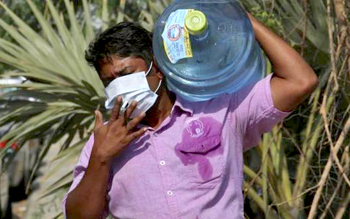
MERS and SARSCoronaviruses affected the upper and lower respiratory tracts in humans.

They are the reason for up to a third of common colds.

A more severe strain of the virus, thought to have come from bats, triggered the global SARS (Severe Acute Respiratory Syndrome) epidemic in 2002 that killed nearly 800 people.

The Middle East Respiratory Syndrome (MERS) is a new strain discovered in Saudi Arabia in 2012 and thought to have originated in camels. More deadly but less contageous, it has so far killed 193 people across 636 confirmed cases.

But now a team of scientists led by Edward Trybala from the University of Gothenburg in Sweden, and Volker Thiel from the University of Bern have discovered a compound called K22, which appears to block the ability of the virus to spread in humans.

They first noticed that K22 was able to combat a weak form of coronavirus that causes mild cold-like symptoms, and went on to show that it can fight more serious strains, including SARS and MERS.

In an article for specialist journal "PLOS Pathogens", the scientists explained that the virus reproduces in the cells that line the human respiratory system.

The virus takes over the membranes that separate different parts of human cells, reshaping them into a sort of armour around itself in order to start its production cycle.

But K22 acts at an early stage in this process, preventing the virus from taking control of the cell membranes.

"The results confirm that the use of the membrane of the host cell is a crucial step in the life-cycle of the virus," the researchers wrote.

Their work shows that "the process is highly sensitive and can be influenced by anti-viral medications."

They said the recent SARS epidemic and MERS outbreak mean there should be urgent investment in testing K22 outside the laboratory and developing medicines.

Earlier this month, experts gathered in Geneva by the World Health Organisation confirmed that MERS was spreading but had yet to reach the level of global emergency.

Most of the MERS cases and deaths so far have been in Saudi Arabia, but the virus has been imported to more than a dozen other countries.

All of those cases have involved people who became ill while in the Middle East.

Iran registered its first death from MERS on Thursday, and has registered six cases of the infection.

Comments

Add new comment

  • Coastaldigest.com reserves the right to delete or block any comments.
  • Coastaldigset.com is not responsible for its readers’ comments.
  • Comments that are abusive, incendiary or irrelevant are strictly prohibited.
  • Please use a genuine email ID and provide your name to avoid reject.
News Network
February 5,2020

The Organisation of Islamic Cooperation (OIC) has said it rejects US President  Donald Trump 's recently unveiled Middle East plan.

The 57-member body, which held a summit on Monday  to discuss the plan in Saudi Arabia's Jeddah, said in a statement that it "calls on all member states not to engage with this plan or to cooperate with the US administration in implementing it in any form".

Requested by the Palestinian leadership, the meeting of the body came two days after the Arab League rejected Trump's so-called "deal of the century", saying: "It does not meet the minimum rights and aspirations of Palestinian people."

Addressing a pro-Israel audience at the White House with Israeli Prime Minister Benjamin Netanyahu by his side, Trump on Tuesday described his long-delayed plan for resolving the Israeli-Palestinian conflict as a "win-win solution" for both sides.

The US president said his proposed deal would ensure the establishment of a two-state solution, promising Palestinians a state of their own with a new capital in Abu Dis, a suburb just outside Jerusalem. Trump also said Jerusalem would be the "undivided capital" of Israel. The Palestinians want both occupied East Jerusalem and the West Bank to be part of a future state.

Palestinian leaders, who were absent during the announcement and had rejected the proposal even before its release, denounced the plan as "a new Balfour Declaration" that heavily favoured Israel and would deny them a viable independent state.

The OIC said in a statement on Twitter on Sunday that its "open-ended executive committee meeting" at the level of foreign ministers would "discuss the organisation's position after the US administration announced its peace plan".

With member states from four continents, the OIC is the second-largest intergovernmental organisation in the world after the United Nations, with a collective population reaching more than 1.8 billion.

The majority of its member states are Muslim-majority countries, while others have significant Muslim populations, including several African and South American countries. While the 22 members of the Arab League are also part of the OIC, the organisation has several significant non-Arab member states, including Turkey, Iran and Pakistan. It also has five observer members, including Russia and Thailand.

Iran 'barred'

Meanwhile, Iran on Monday accused its regional rival Saudi Arabia of blocking its officials from attending the OIC meeting.

"The government of Saudi Arabia has prevented the participation of the Iranian delegation in the meeting to examine the 'deal of the century' plan at the headquarters of the Organization of Islamic Cooperation," Fars news agency quoted Abbas Mousavi, spokesman for Iran's foreign ministry, as saying.

Mousavi said Iran - one of the countries to strongly condemn Trump's plan - had filed a complaint with the OIC and accused its regional rival of misusing its position as the host for the organisation's headquarters.

There was no immediate comment from Saudi officials.

Following the unveiling of Trump's plan, the Saudi foreign ministry expressed appreciation for Trump's efforts and support for direct peace negotiations under Washington's auspices, while state media reported that King Salman had called Palestinian President Mahmoud Abbas to reassure him of Riyadh's unwavering commitment to the Palestinian cause.

The announcement of Trump's plan drew mixed responses from Arab states.

Observers said the reaction was indicative of the division among Arab countries and their inability to prioritise the Palestinian people's plight over domestic economic agendas and political calculations in relation to the Trump administration.

Comments

Add new comment

  • Coastaldigest.com reserves the right to delete or block any comments.
  • Coastaldigset.com is not responsible for its readers’ comments.
  • Comments that are abusive, incendiary or irrelevant are strictly prohibited.
  • Please use a genuine email ID and provide your name to avoid reject.
Agencies
February 27,2020

Riyadh, Feb 27: Saudi Arabia on Thursday halted travel to the holiest sites in Islam over fears about a new viral epidemic just months ahead of the annual hajj pilgrimage, a move coming as the Mideast has over 220 confirmed cases of the illness.

The extraordinary decision by Saudi Arabia stops foreigners from reaching the holy city of Mecca and the Kaaba, the cube-shaped structure the world's 1.8 billion Muslims pray toward five times a day. It also said travel was suspended to Prophet Muhammad's mosque in Medina.

The decision showed the worry about the outbreak potentially spreading into Saudi Arabia, whose oil-rich monarchy stakes its legitimacy on protecting Islam's holy sites. The epicenter in the Mideast's most-affected country, Iran, appears to be in the holy Shiite city of Qom, where a shrine there sees the faithful reach out to kiss and touch it in reverence.

"Saudi Arabia renews its support for all international measures to limit the spread of this virus, and urges its citizens to exercise caution before traveling to countries experiencing coronavirus outbreaks," the Saudi Foreign Ministry said in a statement announcing the decision.

"We ask God Almighty to spare all humanity from all harm." Disease outbreaks always have been a concern surrounding the hajj, required of all able-bodied Muslims once in their life, especially as pilgrims come from all over the world.

The earliest recorded outbreak came in 632 as pilgrims fought off malaria. A cholera outbreak in 1821, for instance, killed an estimated 20,000 pilgrims. Another cholera outbreak in 1865 killed 15,000 pilgrims and then spread worldwide.

More recently, Saudi Arabia faced a danger from a related coronavirus that caused Middle East respiratory syndrome, or MERS. The kingdom increased its public health measures in 2012 and 2013, though no outbreak occurred.

While millions attend the 10-day hajj, this year set for late July into early August, millions more come during the rest of the year to the holy sites in the kingdom.

"It is unprecedented, at least in recent times, but given the worldwide spread of the virus and the global nature of the umrah, it makes sense from a public health and safety point of view," said Kristian Ulrichsen, a research fellow at the James A Baker III Institute for Public Policy at Rice University. "Especially since the Iranian example illustrates how a religious crossroads can so quickly amplify the spread and reach of the virus." The virus that causes the illness named COVID-19 has infected more than 80,000 people globally, mainly in China. The hardest-hit nation in the Mideast is Iran, where Health Ministry spokesman Kianoush Jahanpour said 19 people have died among 139 confirmed cases.

Experts are concerned Iran may be underreporting cases and deaths, given the illness's rapid spread from Iran across the Persian Gulf. For example, Iran still has not confirmed any cases in Mashhad, even though a number of cases reported in Kuwait are linked to the Iranian city.

In Bahrain, which confirmed 33 cases as of Thursday morning, authorities halted all flights to Iraq and Lebanon. It separately extended a 48-hour ban overflights from Dubai and Sharjah in the United Arab Emirates, through which infected travellers reached the island kingdom off the coast of Saudi Arabia.

Iranian President Hassan Rouhani said there were no immediate plans to quarantine cities but acknowledged it may take "one, two or three weeks” to get control of the virus in Iran.

As Iran's 80 million people find themselves increasingly isolated in the region by the outbreak, the country's sanctions-battered economy saw its currency slump to its lowest level against the US dollar in a year on Wednesday.

Comments

Add new comment

  • Coastaldigest.com reserves the right to delete or block any comments.
  • Coastaldigset.com is not responsible for its readers’ comments.
  • Comments that are abusive, incendiary or irrelevant are strictly prohibited.
  • Please use a genuine email ID and provide your name to avoid reject.
Agencies
June 9,2020

Dubai, Jun 9: Dubai's Emirates airline has begun laying off employees to reduce cost and save cash as the carrier looks to rightsize its workforce.

"We at Emirates have been doing everything possible to retain the talented people that make up our workforce for as long as we can. However, given the significant impact that the pandemic has had on our business, we simply cannot sustain excess resources and have to rightsize our workforce in line with our reduced operations. After reviewing all scenarios and options, we deeply regret that we have to let some of our people go," the spokesperson said in the statement.

Citing sources, Reuters and Bloomberg earlier reported that a majority of those being made redundant are cabin crew workers as well as a minority of its engineers and pilots, including those flew the Airbus A380.

"This was a very difficult decision and not one that we took lightly. The company is doing everything possible to protect the workforce wherever we can. Where we are forced to take tough decisions we will treat people with fairness and respect. We will work with impacted employees to provide them with all possible support," said the statement.

The spokesperson, however, didn't disclose how many employees are being made redundant in this latest round of rightsizing the workforce.

Emirates on Sunday confirmed that it extended the period of reduced pay for its staff for another three months till September. It had previously reduced basic wages by 25 to 50 per cent for three months from April, with junior employees exempted.

The airline had employed around 60,000 people at the end of its 2019-20 financial year.

Saj Ahmad, chief analyst at StrategicAero Research, said the announced job cuts at Emirates will likely not be the last given the unprecedented damage that Covid-19 has had not just on air travel, but on the entire aviation industry as a whole.

"Emirates' massive international network means that job reductions were always a last resort option as the company staves off cash burn and expenses at a time when revenues are dried up. While Emirates SkyCargo is enjoying a resurgence in activities, the reality is that this income will never offset the lost money from passenger operations," he added.

"Whilst some salary reduction schemes have prevented bigger job cuts for now, the absence of a cure or medicinal suppressant of Covid-19 means that air travel is unlikely to even reach pre-9/11 levels within 3-5 years, let alone pre-Covid-19 levels in that same time period. For that reason, Emirates' reduction in headcount is necessary to stay competitive, agile and be ready for when air travel can resume with a degree of normalcy that we have been accustomed to for decades," said Ahmad.

Comments

Add new comment

  • Coastaldigest.com reserves the right to delete or block any comments.
  • Coastaldigset.com is not responsible for its readers’ comments.
  • Comments that are abusive, incendiary or irrelevant are strictly prohibited.
  • Please use a genuine email ID and provide your name to avoid reject.