


Search for Malaysian plane may extend to Indian Ocean: US

March 14, 2014

Malaysian_plane_mysteryKuala Lumpur/Washington, Mar 14: A new search area for Malaysia Airlines Flight 370 may be opened in the Indian Ocean, the White House said, significantly broadening the potential location of the plane, which disappeared nearly a week ago with 239 people on board.

Expanding the search area to the Indian Ocean would be consistent with the theory that the Boeing 777 may have detoured to the west about an hour after take-off from the Malaysian capital Kuala Lumpur en route to Beijing.

"It's my understanding that based on some new information that's not necessarily conclusive — but new information — an additional search area may be opened in the Indian Ocean," White House spokesman Jay Carney told reporters in Washington.

Carney did not specify the nature of the new information and Malaysian officials were not immediately available to comment.

The disappearance of the Malaysia Airlines plane is one of the most baffling mysteries in the history of modern aviation. There has been no trace of the plane nor any sign of wreckage despite a search by the navies and military aircraft of more than a dozen countries across Southeast Asia.

Satellites picked up faint electronic pulses from the aircraft after it went missing on Saturday, but the signals gave no information about where the jet was heading and little else about its fate, two sources close to the investigation said on Thursday.

But the "pings" indicated its maintenance troubleshooting systems were switched on and ready to communicate with satellites, showing the aircraft was at least capable of communicating after losing touch with air traffic controllers.

The system transmits such pings about once an hour, according to the sources, who said five or six were heard. However, the pings alone are not proof that the plane was in the air or on the ground, the sources said.

Malaysian authorities have said the last civilian contact occurred as the Boeing 777-200ER flew north into the Gulf of Thailand. They said military radar sightings indicated it may have turned sharply to the west and crossed the Malay Peninsula toward the Andaman Sea.

The new information about signals heard by satellites shed little light on the mystery of what happened to the plane, whether it was a technical failure, a hijacking or another kind of incident on board.

While the troubleshooting systems were functioning, no data links were opened, the sources said, because the companies involved had not subscribed to that level of service from the satellite operator, the sources said.

Boeing and Rolls-Royce, which supplied its Trent engines, declined to comment.

Earlier Malaysian officials denied reports that the aircraft had continued to send technical data and said there was no evidence that it flew for hours after losing contact with air traffic controllers early last Saturday.

"It's extraordinary that with all the technology that we've got that an aircraft can disappear like this," Tony Tyler, the head of the International Air Transport Association that links over 90 percent of the world's airlines, told reporters in London.

MILITARY DEPLOYMENT GROWS

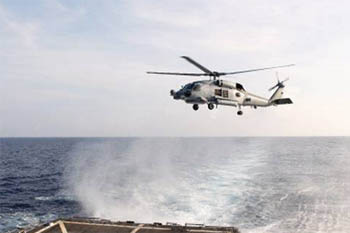
Ships and aircraft are now combing a vast area that had already been widened to cover both sides of the Malay Peninsula and the Andaman Sea.

The US Navy was sending an advanced P-8A Poseidon plane to help search the Strait of Malacca, separating the Malay Peninsula from the Indonesian island of Sumatra. It had already deployed a Navy P-3 Orion aircraft to those waters.

US defense officials told Reuters that the US Navy guided-missile destroyer, USS Kidd, was heading to the Strait of Malacca, answering a request from the Malaysian government. The Kidd had been searching the areas south of the Gulf of Thailand, along with the destroyer USS Pinckney.

India's defence ministry has ordered the deployment of ships, aircraft and helicopters from the remote Andaman and Nicobar Islands, at the juncture of the Bay of Bengal and the Andaman Sea. An Indian P8I Poseidon surveillance plane was sent to the Andaman islands on Thursday.

China, which had more than 150 citizens on board the missing plane, has deployed four warships, four coastguard vessels, eight aircraft and trained 10 satellites on a wide search area. Chinese media have described the ship deployment as the largest Chinese rescue fleet ever assembled.

WRONG IMAGES

On the sixth day of the search, planes scanned an area of sea where Chinese satellite images had shown what could be debris but found no sign of the airliner.

Malaysian transport minister Hishammuddin Hussein told a news conference the images were provided accidentally, saying the Chinese government neither authorized nor endorsed putting them on a website. "The image is not confirmed to be connected to the plane," he said.

It was the latest in a series of contradictory reports, adding to the confusion and agony of the relatives of the passengers.

As frustration mounted over the failure to find any trace of the plane, China heaped pressure on Malaysia to improve coordination in the search.

Premier Li Keqiang, speaking at a news conference in Beijing, demanded that the "relevant party" step up coordination while China's civil aviation chief said he wanted a "smoother" flow of information from Malaysia, which has come under heavy criticism for its handling of the disaster.

Malaysian police have said they were investigating whether any passengers or crew on the plane had personal or psychological problems that might shed light on the mystery, along with the possibility of a hijacking, sabotage or mechanical failure.

The Boeing 777 has one of the best safety records of any commercial aircraft in service. Its only previous fatal crash came on July 6 last year when Asiana Airlines Flight 214 struck a seawall with its undercarriage on landing in San Francisco, killing three people.

Comments

Add new comment

  • Coastaldigest.com reserves the right to delete or block any comments.
  • Coastaldigset.com is not responsible for its readers’ comments.
  • Comments that are abusive, incendiary or irrelevant are strictly prohibited.
  • Please use a genuine email ID and provide your name to avoid reject.
News Network
April 11,2020

Apr 11: The number of global coronavirus deaths has increased to 102,753, while the total number of cases worldwide has surpassed 1.6 million, according to the latest update by the Washington-based Johns Hopkins University.

As of Saturday morning, the overall number of infections increased to 1,698,416, while the tally of those who recovered from the deadly disease stood at 376,677, according to the varsity's Center for Systems Science and Engineering (CSSE).

In terms of cases, the US had the highest in the world at 501,301, followed by Spain 158,273, Italy 147,577 and France 125,931.

Italy accounted for the highest death toll at 18,849, with the US in the second place with 18,769 fatalities.

Other countries with more than 10,000 deaths include Spain (16,081) and France (13,197).

Although the pandemic originated in China last December, it now only accounts for 3,343 deaths with 83,003 confirmed cases.

Comments

Add new comment

  • Coastaldigest.com reserves the right to delete or block any comments.
  • Coastaldigset.com is not responsible for its readers’ comments.
  • Comments that are abusive, incendiary or irrelevant are strictly prohibited.
  • Please use a genuine email ID and provide your name to avoid reject.
News Network
June 20,2020

Sao Paulo, June 20: Brazil’s government confirmed on Friday that the country has risen above 1 million confirmed coronavirus cases, second only to the United States.

The country’s health ministry said that the total now stood at 10,32,913, up more than 50,000 from Thursday. The ministry said the sharp increase was due to corrections of previous days’ underreported numbers.

Brazilian President Jair Bolsonaro still downplays the risks of the virus after nearly 50,000 deaths from COVID-19 in three months, saying the impact of social isolation measures on the economy could be worse than the disease itself.

Specialists believe the actual number of cases in Brazil could be up to seven times higher than the official statistic. Johns Hopkins University says Brazil is performing an average of 14 tests per 1,00,000 people each day, and health experts say that number is up to 20 times less than needed to track the virus.

Official data show a downward trend of the virus in Brazil’s north, including the hard-hit region of the Amazon, a plateau in cases and deaths in the countries’ biggest cities near the Atlantic coast, but a rising curve in the south.

In the Brazilian countryside, which is much less prepared to handle a crisis, the pandemic is clearly growing. Many smaller cities have weaker health care systems and basic sanitation that’s insufficient to prevent contagion.

“There is a lot of regional inequality in our public health system and a shortage of professionals in the interior,” said Miguel Lago, executive director of Brazil’s Institute for Health Policy Studies, which advises public health officials.

That creates many health care deserts, with people going long distances to get attention. When they leave the hospital, the virus can go with them.

The cattle-producing state of Mato Grosso was barely touched by the virus when it hit the nation’s biggest cities in March. Sitting far from the coast, between the Bolivian border and Brazil’s capital of Brasilia, its 33 lakh residents led a mostly normal life until May. But now its people live under lockdown and meat producers have dozens of infected workers.

In Tangará da Serra, a city of 1,03,000 people in Mato Grosso, the mayor decided Friday to forbid the sale of alcoholic drinks for two weeks as an incentive for people to stay home.

Fᢩo Junqueira said the measure was needed after a spike in COVID-19 cases that filled 80% of the city’s 54 intensive care beds. The city has had nearly 300 cases of the disease, plus three fatalities.

In Rondonópolis, only 300 miles away from Tangará da Serra and home to a thriving economy, health authorities closed the local meatpacking industry after 92 cases were confirmed there. The city of 1,44,000 inhabitants counted 21 deaths from the virus and more than 600 cases. The mayor has also decided to limit sales of alcoholic beverages.

Even regions once considered examples of successful efforts against the virus are now struggling.

Porto Alegre, home to about 14 lakh people, had success in slowing the virus’ spread over the last three months. But now its mayor is considering increasing social isolation measures after ICU occupancy in the city jumped to 80% this month.

We were already making projections for schools to come back, Mayor Nelson Marchezan Jr. told The Associated Press. Now the trend is to impose more restrictions. Outside Sao Paulo city, five regions of the state’s countryside will have to close shops starting Monday due to a rise in coronavirus cases. Governor João Doria announced the decision Friday.

Dr. Mike Ryan, the World Health Organization’s executive director, said at a news conference that Brazil needs to increase its efforts to stop the spread of infections.

“The epidemic is still quite severe in Brazil. I believe health workers are working extremely hard and under pressure to be able to deal with the number of cases that they see on a daily basis,” Dr. Ryan said.

“Certainly the rise is not as exponential as it was previously, so there are some signs that the situation is stabilising. But we’ve seen this before in other epidemics in other countries.”

Margareth Dalcolmo, a clinical researcher and professor of respiratory medicine at the state-funded Oswaldo Cruz Foundation in Rio de Janeiro, believes the reopening in major cities and the virus traveling by road into Brazil’s heartland will keep the pressure on the country’s health system.

“The risk in the interior now is very big,” she said. “Our health system just can’t solve the most serious cases of COVID in many places of the countryside.”

Comments

Add new comment

  • Coastaldigest.com reserves the right to delete or block any comments.
  • Coastaldigset.com is not responsible for its readers’ comments.
  • Comments that are abusive, incendiary or irrelevant are strictly prohibited.
  • Please use a genuine email ID and provide your name to avoid reject.
News Network
January 27,2020

Kabul, Jan 27: A passenger plane crashed on Monday in a Taliban-held area of Afghanistan's Ghazni province, local officials said.

Arif Noori, spokesman for the provincial governor, said the plane went down around 1:10 p.m. local time in Deh Yak district, which is held by the Taliban. Two provincial council members also confirmed the crash.

The number of people on board and their fate was not immediately known, nor was the cause of the crash.

Ariana Airlines, Afghanistan's national carrier, dismissed the claim that one of their planes had crashed in a statement on their website, saying all their aircraft were operational and safe.

The mountainous Ghazni province sits in the foothills of the Hindu Kush mountains and is bitterly cold in winter.

The last major commercial air crash in Afghanistan occurred in 2005 when a Kam Air flight from western Herat to the capital Kabul crashed into the mountains as it tried to land in snowy weather.

The war however has seen a number of deadly crashes of military aircraft. One of the most spectacular occurred in 2013 when an American Boeing 747 cargo jet crashed shortly after takeoff from Bagram air base north of Kabul en route to Dubai in the United Arab Emirates. All seven crew member were killed.

Afghanistan's aviation industry suffered desperately during the rule of the Taliban when its only airline Ariana was subject to punishing sanctions and allowed to fly only to Saudi Arabia for Hajj flights.

Since the overthrow of the religious regime smaller private airlines have emerged but the industry is still a nascent one.

Comments

Add new comment

  • Coastaldigest.com reserves the right to delete or block any comments.
  • Coastaldigset.com is not responsible for its readers’ comments.
  • Comments that are abusive, incendiary or irrelevant are strictly prohibited.
  • Please use a genuine email ID and provide your name to avoid reject.