


Search for Malaysian plane may extend to Indian Ocean: US

March 14, 2014

Malaysian_plane_mysteryKuala Lumpur/Washington, Mar 14: A new search area for Malaysia Airlines Flight 370 may be opened in the Indian Ocean, the White House said, significantly broadening the potential location of the plane, which disappeared nearly a week ago with 239 people on board.

Expanding the search area to the Indian Ocean would be consistent with the theory that the Boeing 777 may have detoured to the west about an hour after take-off from the Malaysian capital Kuala Lumpur en route to Beijing.

"It's my understanding that based on some new information that's not necessarily conclusive — but new information — an additional search area may be opened in the Indian Ocean," White House spokesman Jay Carney told reporters in Washington.

Carney did not specify the nature of the new information and Malaysian officials were not immediately available to comment.

The disappearance of the Malaysia Airlines plane is one of the most baffling mysteries in the history of modern aviation. There has been no trace of the plane nor any sign of wreckage despite a search by the navies and military aircraft of more than a dozen countries across Southeast Asia.

Satellites picked up faint electronic pulses from the aircraft after it went missing on Saturday, but the signals gave no information about where the jet was heading and little else about its fate, two sources close to the investigation said on Thursday.

But the "pings" indicated its maintenance troubleshooting systems were switched on and ready to communicate with satellites, showing the aircraft was at least capable of communicating after losing touch with air traffic controllers.

The system transmits such pings about once an hour, according to the sources, who said five or six were heard. However, the pings alone are not proof that the plane was in the air or on the ground, the sources said.

Malaysian authorities have said the last civilian contact occurred as the Boeing 777-200ER flew north into the Gulf of Thailand. They said military radar sightings indicated it may have turned sharply to the west and crossed the Malay Peninsula toward the Andaman Sea.

The new information about signals heard by satellites shed little light on the mystery of what happened to the plane, whether it was a technical failure, a hijacking or another kind of incident on board.

While the troubleshooting systems were functioning, no data links were opened, the sources said, because the companies involved had not subscribed to that level of service from the satellite operator, the sources said.

Boeing and Rolls-Royce, which supplied its Trent engines, declined to comment.

Earlier Malaysian officials denied reports that the aircraft had continued to send technical data and said there was no evidence that it flew for hours after losing contact with air traffic controllers early last Saturday.

"It's extraordinary that with all the technology that we've got that an aircraft can disappear like this," Tony Tyler, the head of the International Air Transport Association that links over 90 percent of the world's airlines, told reporters in London.

MILITARY DEPLOYMENT GROWS

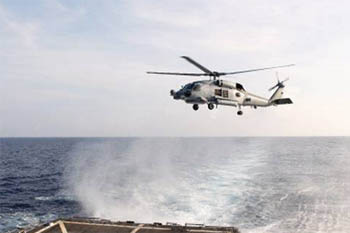
Ships and aircraft are now combing a vast area that had already been widened to cover both sides of the Malay Peninsula and the Andaman Sea.

The US Navy was sending an advanced P-8A Poseidon plane to help search the Strait of Malacca, separating the Malay Peninsula from the Indonesian island of Sumatra. It had already deployed a Navy P-3 Orion aircraft to those waters.

US defense officials told Reuters that the US Navy guided-missile destroyer, USS Kidd, was heading to the Strait of Malacca, answering a request from the Malaysian government. The Kidd had been searching the areas south of the Gulf of Thailand, along with the destroyer USS Pinckney.

India's defence ministry has ordered the deployment of ships, aircraft and helicopters from the remote Andaman and Nicobar Islands, at the juncture of the Bay of Bengal and the Andaman Sea. An Indian P8I Poseidon surveillance plane was sent to the Andaman islands on Thursday.

China, which had more than 150 citizens on board the missing plane, has deployed four warships, four coastguard vessels, eight aircraft and trained 10 satellites on a wide search area. Chinese media have described the ship deployment as the largest Chinese rescue fleet ever assembled.

WRONG IMAGES

On the sixth day of the search, planes scanned an area of sea where Chinese satellite images had shown what could be debris but found no sign of the airliner.

Malaysian transport minister Hishammuddin Hussein told a news conference the images were provided accidentally, saying the Chinese government neither authorized nor endorsed putting them on a website. "The image is not confirmed to be connected to the plane," he said.

It was the latest in a series of contradictory reports, adding to the confusion and agony of the relatives of the passengers.

As frustration mounted over the failure to find any trace of the plane, China heaped pressure on Malaysia to improve coordination in the search.

Premier Li Keqiang, speaking at a news conference in Beijing, demanded that the "relevant party" step up coordination while China's civil aviation chief said he wanted a "smoother" flow of information from Malaysia, which has come under heavy criticism for its handling of the disaster.

Malaysian police have said they were investigating whether any passengers or crew on the plane had personal or psychological problems that might shed light on the mystery, along with the possibility of a hijacking, sabotage or mechanical failure.

The Boeing 777 has one of the best safety records of any commercial aircraft in service. Its only previous fatal crash came on July 6 last year when Asiana Airlines Flight 214 struck a seawall with its undercarriage on landing in San Francisco, killing three people.

Comments

Add new comment

  • Coastaldigest.com reserves the right to delete or block any comments.
  • Coastaldigset.com is not responsible for its readers’ comments.
  • Comments that are abusive, incendiary or irrelevant are strictly prohibited.
  • Please use a genuine email ID and provide your name to avoid reject.
News Network
April 26,2020

Apr 26: The remarkable story of an airman who overcame prejudice to become one of only a handful of Indian fighter pilots in the First World War has emerged in newly-released archive files by the UK's Commonwealth War Graves Commission (CWGC).

Lieutenant Shri Krishna Chanda Welinkar is one of the thousands of moving stories from the war preserved in family correspondence and being brought alive as part of a digitisation project.

The never-before-published files contain thousands of letters, pictures and other papers sent between the Commission and the next of the kin of First World War dead.

Among them is the story of Welinkar, who hailed from Bombay in colonial India. After much hardship and discrimination, he eventually became a pilot and went missing while on patrol over the skies above the Western Front in June 1918.

His family had to wait nearly three years before they finally knew for certain that he had died, and his grave was located.

“For everyone who died in the First World War, there was inevitably a partner, parent or child back home who had questions. The heartbreaking letters in CWGC's archive give us an insight into what it was like for those families trying to come to terms with their loss,” said Andrew Fetherston, chief archivist for CWGC.

“They are stories that show desperate searches for closure, former enemies uniting and, on many occasions, the sad realisation that a missing loved one would always remain so. We are pleased to be able to make this invaluable piece of World War history accessible to a new generation and help deepen our understanding of how the First World War impacted those who were left behind,” he said.

Welinkar was one of the 1.3 million Indians who answered the call to fight for the British Empire. Nearly 74,000 never saw their homeland again and are remembered today in cemeteries and memorials throughout the world, including France, Belgium, the Middle East and Africa.

Welinkar was a well-educated man studying at Cambridge University. He trained to become an aviator in Middlesex and wished to join the Royal Flying Corps, later known as the Royal Air Force.

Upon attempting to enlist, Welinkar encountered the same prejudices as his other fellow Indian airmen and was encouraged to become an air mechanic instead.

He was eventually given a commission in the Royal Flying Corps as an Officer. In 1918, he was posted to France and patrolled the skies above the Western Front.

In June 1918, Lieutenant Welinkar embarked on what would be his final patrol; he did not return and was reported missing. His fate remained unknown for many months afterwards.

The newly-released e-files chronicle the remarkable discovery of Welinkar and his final resting place long after the war had ended. Colonel Barton, who knew Welinkar, acted on behalf of his mother and helped find her missing son. They spoke to former enemies and honed their search to the grave of an unidentified man, buried by the Germans as “Oberleutnant S.C. Wumkar” in a grave in Rouvroy, Belgium.

The body was later moved and reinterred in Hangard Communal Cemetery Extension but it wasn't until the vital clue, found in the original German burial records in February 1921, that it was confirmed beyond doubt this grave was of Welinkar's.

In May 1921, Colonel Barton, on behalf of Welinkar's mother, requested that a Commission headstone be placed on the grave with the following personal inscription: “To the Honoured Memory of One of the Empire's Bravest Sons”.

This records – known as Enquiry Files – are part of a collection of nearly 3,000 files which have never been made available to the public before. Nearly half have been digitised so far, alongside a previously unreleased collection of more than 16,000 photographs held in negatives in the Commission's archive.

The files, internally referred to simply as E-Files, contain correspondence between the CWGC and the next of kin of the war dead. They often contain letters, typed memos between Commission staff and on occasion photos, maps and diagrams.

CWGC only holds an enquiry file for a small proportion of the 1.7 million people it commemorates from the Commonwealth. Today it is only possible to release those surviving records from the First World War because correspondence with families of Second World War casualties often involves people still alive today and cannot be made public for many years, due to the UK's data protection rules.

To date, more than 1,300 of the surviving 3,000 First World War enquiry files have been digitised.

The CWGC commemorates the 1.7 million Commonwealth servicemen and women who died during the two World Wars. It also holds and updates an extensive and accessible records archive, while operating over 23,000 locations in more than 150 countries and territories.

Comments

Add new comment

  • Coastaldigest.com reserves the right to delete or block any comments.
  • Coastaldigset.com is not responsible for its readers’ comments.
  • Comments that are abusive, incendiary or irrelevant are strictly prohibited.
  • Please use a genuine email ID and provide your name to avoid reject.
News Network
April 13,2020

Manila, Apr 13: The Asian Development Bank (ADB) on Monday tripled the size of its response to novel coronavirus disease (COVID-19) pandemic to 20 billion dollars and approved measures to streamline its operations for quicker and more flexible delivery of assistance.

The package expands ADB's 6.5 billion dollars initial response announced on March 18, adding 13.5 billion dollars in resources to help ADB's developing member countries counter the severe macroeconomic and health impacts caused by COVID-19.

The 20 billion dollar package includes about 2.5 billion dollars in concessional and grant resources.

"This pandemic threatens to severely set back economic, social, and development gains in Asia and the Pacific, reverse progress on poverty reduction and throw economies into recession," said ADB President Masatsugu Asakawa.

"Our expanded and comprehensive package of assistance, made possible with the strong support of our board, will be delivered more quickly, flexibly and forcefully to the governments and the private sector in our developing member countries to help them address the urgent challenges in tackling the pandemic and economic downturn," he said in a statement.

ADB's most recent assessment released on April 3 estimates the global impact of the pandemic at between 2.3 and 4.8 per cent of gross domestic product. Regional growth is forecast to decline from 5.2 per cent last year to 2.2 per cent in 2020.

The new package includes the establishment of a COVID-19 pandemic response option under ADB's countercyclical support facility.

Up to 13 billion dollars will be provided through this new option to help governments of developing member countries implement effective countercyclical expenditure programs to mitigate impacts of the COVID-19 pandemic, with a particular focus on the poor and the vulnerable.

Grant resources will continue to be deployed quickly for providing medical and personal protective equipment and supplies from expanded procurement sources.

Some 2 billion dollars from the 20 billion dollar package will be made available for the private sector. Loans and guarantees will be provided to financial institutions to rejuvenate trade and supply chains.

Enhanced microfinance loan and guarantee support and a facility to help liquidity-starved small and medium-sized enterprises, including those run by female entrepreneurs, will be implemented alongside direct financing of companies responding to or impacted by COVID-19.

The response package includes a number of adjustments to policies and business processes that will allow ADB to respond more rapidly and flexibly to the crisis. These include measures to streamline internal business processes, widen the eligibility and scope of various support facilities and make the terms and conditions of lending more tailored.

All support under the expanded package will be provided in close collaboration with international organisations, including the International Monetary Fund, World Bank Group, World Health Organisation, UNICEF, other UN agencies and the broader global community.

Comments

Add new comment

  • Coastaldigest.com reserves the right to delete or block any comments.
  • Coastaldigset.com is not responsible for its readers’ comments.
  • Comments that are abusive, incendiary or irrelevant are strictly prohibited.
  • Please use a genuine email ID and provide your name to avoid reject.
Agencies
March 15,2020

Tehran, Mar 15: Two hundred and thirty-four Indians stranded in coronavirus-hit Iran have arrived in India, External Affairs Minister S Jaishankar said on Sunday.

The batch comprises 131 students and 103 pilgrims, he said.

“234 Indians stranded in Iran have arrived in India; including 131 students and 103 pilgrims. Thank you Ambassador Dhamu Gaddam and @India_in_Iran team for your efforts. Thank Iranian authorities,” Jaishankar tweeted.

The third batch of Indians from Iran arrived early Sunday. A second batch of 44 Indian pilgrims had arrived from Iran on Friday.

Iran is one of the worst-affected countries by the coronavirus outbreak and the government has been working on plans to bring back Indians stranded there.

The first batch of 58 Indian pilgrims were brought back from Iran on Tuesday.

Comments

Add new comment

  • Coastaldigest.com reserves the right to delete or block any comments.
  • Coastaldigset.com is not responsible for its readers’ comments.
  • Comments that are abusive, incendiary or irrelevant are strictly prohibited.
  • Please use a genuine email ID and provide your name to avoid reject.