


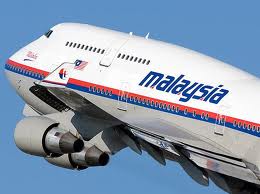
Search resumes for missing Malaysian jetliner

March 9, 2014
Kuala Lumpur, Mar 9: Planes and ships from across Asia resumed the hunt on Sunday for the Malaysian jetliner missing with 239 people on board for more than 24 hours, while Malaysian aviation authorities investigated how two passengers were apparently able to get on the aircraft using stolen passports.

airlines

There was still no confirmed sighting of wreckage from the Boeing 777 in the seas between Malaysia and Vietnam where it vanished from screens early Saturday morning en route to Beijing from Kuala Lumpur. The weather was fine, the plane was already cruising and the pilots had no time to send a distress signal in unusual circumstances for a modern jetliner to crash.

Li Jiaxiang, administrator of the Civil Aviation Administration of China, said some debris had been spotted, but it was unclear whether it came from the plane. Vietnamese authorities said they had seen nothing close to two large oil slicks they saw Saturday and said might be from the missing plane.

Malaysia's civil aviation chief Azaharuddin Abdul Rahman said his country had expanded its area of operation to the west coast of peninsular Malaysia, on the other side of the country from where the plane disappeared. “This is standard procedure. If we can't find it here, we go to other places,” he said.

Finding traces of an aircraft that crashes over sea can take days or longer, even with a sustained search effort. Depending on the circumstances of the crash, wreckage can be scattered over many square kilometers (miles). If the plane enters the water before breaking up, there can be relatively little debris.

Investigators will need access to the flight data recorders to determine what happened. Terrorism is always considered a possibility, but the sudden disappearance of Flight MH370 has given extra emphasis to speculation a bomb might have been on board.

On Saturday, foreign ministries in Italy and Austria said the names of two citizens listed on the flight's manifest matched the names on two passports reported stolen in Thailand. It's unclear how common it is for people to get on flights with fake passports, but the news added to fears of terrorism.

Azaharuddin said Sunday that authorities were “aware of the situation and we are doing an investigation at the moment.”

Just 9 percent of fatal accidents happen when a plane is at cruising altitude, according to a statistical summary of commercial jet accidents done by Boeing. Malaysia Airlines CEO Ahmad Jauhari Yahya said Saturday there was no indication the pilots had sent a distress signal.

The lack of a radio call “suggests something very sudden and very violent happened,” said William Waldock, who teaches accident investigation at Embry-Riddle Aeronautical University in Prescott, Ariz.

The plane was last inspected 10 days ago and found to be “in proper condition,” Ignatius Ong, CEO of Malaysia Airlines subsidiary Firefly airlines, said at a news conference.

Two-thirds of the jet's passengers were from China. The rest were from elsewhere in Asia, North America and Europe.

Asked whether terrorism was suspected, Malaysian Prime Minister Najib Razak said authorities were “looking at all possibilities, but it is too early to make any conclusive remarks.”

The South China Sea is a tense region with competing territorial claims that have led to several low-level conflicts, particularly between China and the Philippines. That antipathy briefly faded Saturday as China, the Philippines, Vietnam, Singapore and Malaysia all sent ships and planes to the region.

Malaysia had dispatched 15 planes and nine ships to the area. The U.S. Navy was sending a warship and a surveillance plane, while Singapore said it would send a submarine and a plane. China and Vietnam also sent aircraft to help in the search.

Malaysia Airlines has a good safety record, as does the 777, which had not had a fatal crash in

its 19—year history until an Asiana Airlines plane crashed last July in San Francisco, killing three passengers, all teenagers from China.

Comments

Add new comment

  • Coastaldigest.com reserves the right to delete or block any comments.
  • Coastaldigset.com is not responsible for its readers’ comments.
  • Comments that are abusive, incendiary or irrelevant are strictly prohibited.
  • Please use a genuine email ID and provide your name to avoid reject.
News Network
February 9,2020

Beijing, Feb 9: After making sure everyone's face mask is on and sanitizer is to hand, the Qiao family heads out to Jingshan Park, a former royal sanctuary beside the Forbidden City in China's capital Beijing.

Snow has fallen for a second day, a rare event in the city of 21.5 million that would normally bring hundreds of thousands of people out to take photos and play. But the streets are empty and the parks are so quiet the only sound is of birds chirping.

It's not just Beijing. Shanghai, China's financial hub, and other cities in the world's most populous nation have turned into ghost towns after the government extended a holiday and asked residents not to go out because of the coronavirus.

"We know the situation of the coronavirus is severe. But the epicentre is far away, so we think it should be fine here ... It's a God-given chance to enjoy this family moment with snow and without work," said Mr Qiao, who has an 11-year-old daughter.

The epidemic has killed 722 people and infected nearly 32,000 in China as of February 8. More than three-quarters of the cases are in the central Hubei province where the virus originated - more than 1,000 km (620 miles) from Beijing.

Only a few people are brave enough to come out. A security guard at Jingshan Park said there were less than a third of the number of tourists than usual, even with the rare snowfall.

Even at one of the best spots for snapping photos of snowy Beijing just outside the Forbidden City, there's barely a crowd, while the usual tour buses and groups of people speaking different dialects are nowhere to be seen.

"Last year when it snowed, I took a few hours off work to come down here to take a picture and the crowd was several layers deep," said a man in his 30s who gave his surname as Yang. "But this year, I am not at all worried about finding a space to take a photo. The virus is keeping people indoors."

Security guards along Wangfujing street, a popular pedestrianised shopping area in downtown Beijing, said it was normally so crowded during the holiday period that it was hard to move around.

"Look at it now, there are more security guards and street cleaners than tourists!" said one of the guards.

Businesses, including shops, bars and restaurants, have been severely hit by the epidemic as the government has banned mass gatherings and even group meals in an effort to curb the spread of the coronavirus.

"You would have to wait outside for a table on a normal day," said a waitress at a restaurant with more than 50 tables. Just five were taken at the peak lunch hour.

Only a handful of the more than 100 restaurants along Beijing's famous food street, Guijie, were open, and the remaining outlets were wondering how long they can hold out.

Comments

Add new comment

  • Coastaldigest.com reserves the right to delete or block any comments.
  • Coastaldigset.com is not responsible for its readers’ comments.
  • Comments that are abusive, incendiary or irrelevant are strictly prohibited.
  • Please use a genuine email ID and provide your name to avoid reject.
News Network
May 6,2020

Washington, May 6: At a time when the coronavirus pandemic has squeezed them, multi-national companies in America are laying off workers while paying cash dividends to their shareholders. Thus making the workers bear the brunt of the sacrifices while the shareholders continue to collect.

The Washington Post said in one of its reports that five big American companies have paid a combined USD 700 million to shareholders while cutting jobs, closing plants and leaving thousands of their workers filing for unemployment benefits.

Since the pandemic was declared an emergency, Caterpillar has suspended operations at two plants and a foundry, Levi Strauss has closed stores, and toolmaker Stanley Black & Decker has been planning layoffs and furloughs.

Steelcase, an office furniture manufacturer, and World Wrestling Entertainment have also shed employees.

Executives of those companies told the Post that the layoffs support the long-term health of their companies, and often the executives are giving up a piece of their salaries. Furloughed workers can apply for unemployment benefits.

But distributing millions of dollars to shareholders while leaving many workers without a paycheck is unfair, critics argue, and belies the repeated statements from executives about their concern for employees' welfare during the coronavirus crisis.

Caterpillar, for example, announced a USD 500 million distribution to shareholders April 8, about two weeks after indicating that operations at some plants would stop. The company however declined to divulge how many workers are affected.

"We are taking a variety of actions globally, but we aren't going to discuss the number of impacted people," spokeswoman of the company, Kate Kenny, said in a reply to an email by the Post.

This spate of dividends is also likely to revive long-standing debates about economic rewards.

"There are no hard-and-fast rules about this," said Amy Borrus, deputy director of the Council of Institutional Investors, a group that argues for shareholder rights and represents pension funds and other long-term investors.

Many large US companies choose to issue a regular, quarterly dividend to shareholders, often increasing it, and they boast about these payments because they help keep the share price higher than it might otherwise be. Those companies might be reluctant to announce that they are cutting or suspending their dividend during a crisis, Borrus was further quoted as saying.

But "companies have to be mindful of the optics of paying dividends if they're laying off thousands of workers," she added.

On March 26, Caterpillar had announced that because of the pandemic, it was "temporarily suspending operations at certain facilities." Two plants, in East Peoria, Ill., and Lafayette, Ind., were coming to a halt, as well as a foundry in Mapleton, Ill., according to news reports.

"We are taking a variety of actions at our global facilities to reduce production due to weaker customer demand, potential supply constraints and the spread of the covid-19 pandemic and related government actions," Kenny said via email.

"These actions include temporary facility shutdowns, indefinite or temporary layoffs," she added.

Similarly, Levi Strauss announced April 7 that the company would stop paying store workers, and about 4,000 are now on furlough. On the same day, the company announced that it was returning USD 32 million to shareholders.

"As this human and economic tragedy unfolds globally over the coming months, we are taking swift and decisive action that will ensure we remain a winner in our industry," Chip Bergh, president and chief executive of the company, also told the Post.

Stanley Black & Decker announced on April 2 that it was planning furloughs and layoffs because of the pandemic. Two weeks later, it issued a dividend to shareholders of about USD 106 million.

The notion that a company's primary purpose is to serve shareholders gained prominence in the 1980s but has come under attack in recent years, even from business executives, the newspaper reported.

Corporate decisions to suspend dividends and buybacks are complex, however, and it is difficult to know whether these suspensions of dividend and buyback programs were motivated by a desire to conserve cash in anticipation of bad times, and how much they are prompted by a sense of obligation to employees.

Over recent decades, the mandate to "maximize shareholder value" has become orthodoxy, for many, and it is often unclear what motivates companies to pare dividends or buybacks for shareholders, said William Lazonick, an emeritus economics professor at the University of Massachusetts at Lowell, who has been one of the leading critics of companies that distribute cash to shareholders through stock buybacks and dividends rather than reinvesting the profits into employees, innovation and production.

Comments

Add new comment

  • Coastaldigest.com reserves the right to delete or block any comments.
  • Coastaldigset.com is not responsible for its readers’ comments.
  • Comments that are abusive, incendiary or irrelevant are strictly prohibited.
  • Please use a genuine email ID and provide your name to avoid reject.
News Network
June 12,2020

Washington, Jun 12: US President Donald Trump is considering suspending a number of employment visas including the H-1B, most sought-after among Indian IT professionals, in view of the massive unemployment in America due to the coronavirus pandemic, according to a media report.

The proposed suspension could extend into the government’s new fiscal year beginning October 1, when many new visas are issued, The Wall Street Journal reported on Thursday, quoting unnamed administration officials.

“That could bar any new H-1B holder outside the country from coming to work until the suspension is lifted, though visa holders already in the country are unlikely to be affected,” the daily reported.

H-1B is the most coveted foreign work visas for technology professionals from India.

Such a decision by the Trump administration is likely to have an adverse impact on thousands of Indian IT professionals. Already a large number of Indians on the H-1B visas have lost their jobs and are headed back home during the coronavirus pandemic.

The White House, however, said that no final decision has been made and the administration is considering various proposals.

“The administration is currently evaluating a wide range of options, formulated by career experts, to protect American workers and job seekers especially disadvantaged and underserved citizens — but no decisions of any kind have been made,” White House spokesman Hogan Gidley said in a statement.

In addition to the H-1B visas, the suspension could apply to the H-2B visa for short-term seasonal workers, the J-1 visa for short-term workers including camp counselors and au pairs and the L-1 visa for internal company transfers, the financial daily reported.

Meanwhile, the US Chambers of Commerce CEO Thomas Donohue on Thursday wrote a letter to Trump, expressing concern over his reported move on temporary work visas.

“As the economy rebounds, American businesses will need assurances that they can meet all their workforce needs. To that end, it is crucial that they have access to talent both domestically and from around the world,” Donohue wrote in a letter to Trump.

According to The Hill newspaper, Donohue said that American businesses need L-1 visa holders, who have a work visa valid for a relatively short amount of time, for necessary expertise.

He noted the importance of H-1B visa holders, who have a work visa valid for multiple years, for various industries, including technology, accounting and manufacturers, the newspaper said.

“Policies that would, for example, impose wide-ranging bans on the entry of nonimmigrant workers or impose burdensome new regulatory requirements on businesses that employ foreign nationals would undermine that access to talent and in the process, undercut our economy’s ability to grow and create jobs,” Donohue added.

Comments

Add new comment

  • Coastaldigest.com reserves the right to delete or block any comments.
  • Coastaldigset.com is not responsible for its readers’ comments.
  • Comments that are abusive, incendiary or irrelevant are strictly prohibited.
  • Please use a genuine email ID and provide your name to avoid reject.