


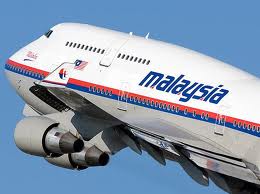
Search resumes for missing Malaysian jetliner

March 9, 2014
Kuala Lumpur, Mar 9: Planes and ships from across Asia resumed the hunt on Sunday for the Malaysian jetliner missing with 239 people on board for more than 24 hours, while Malaysian aviation authorities investigated how two passengers were apparently able to get on the aircraft using stolen passports.

airlines

There was still no confirmed sighting of wreckage from the Boeing 777 in the seas between Malaysia and Vietnam where it vanished from screens early Saturday morning en route to Beijing from Kuala Lumpur. The weather was fine, the plane was already cruising and the pilots had no time to send a distress signal in unusual circumstances for a modern jetliner to crash.

Li Jiaxiang, administrator of the Civil Aviation Administration of China, said some debris had been spotted, but it was unclear whether it came from the plane. Vietnamese authorities said they had seen nothing close to two large oil slicks they saw Saturday and said might be from the missing plane.

Malaysia's civil aviation chief Azaharuddin Abdul Rahman said his country had expanded its area of operation to the west coast of peninsular Malaysia, on the other side of the country from where the plane disappeared. “This is standard procedure. If we can't find it here, we go to other places,” he said.

Finding traces of an aircraft that crashes over sea can take days or longer, even with a sustained search effort. Depending on the circumstances of the crash, wreckage can be scattered over many square kilometers (miles). If the plane enters the water before breaking up, there can be relatively little debris.

Investigators will need access to the flight data recorders to determine what happened. Terrorism is always considered a possibility, but the sudden disappearance of Flight MH370 has given extra emphasis to speculation a bomb might have been on board.

On Saturday, foreign ministries in Italy and Austria said the names of two citizens listed on the flight's manifest matched the names on two passports reported stolen in Thailand. It's unclear how common it is for people to get on flights with fake passports, but the news added to fears of terrorism.

Azaharuddin said Sunday that authorities were “aware of the situation and we are doing an investigation at the moment.”

Just 9 percent of fatal accidents happen when a plane is at cruising altitude, according to a statistical summary of commercial jet accidents done by Boeing. Malaysia Airlines CEO Ahmad Jauhari Yahya said Saturday there was no indication the pilots had sent a distress signal.

The lack of a radio call “suggests something very sudden and very violent happened,” said William Waldock, who teaches accident investigation at Embry-Riddle Aeronautical University in Prescott, Ariz.

The plane was last inspected 10 days ago and found to be “in proper condition,” Ignatius Ong, CEO of Malaysia Airlines subsidiary Firefly airlines, said at a news conference.

Two-thirds of the jet's passengers were from China. The rest were from elsewhere in Asia, North America and Europe.

Asked whether terrorism was suspected, Malaysian Prime Minister Najib Razak said authorities were “looking at all possibilities, but it is too early to make any conclusive remarks.”

The South China Sea is a tense region with competing territorial claims that have led to several low-level conflicts, particularly between China and the Philippines. That antipathy briefly faded Saturday as China, the Philippines, Vietnam, Singapore and Malaysia all sent ships and planes to the region.

Malaysia had dispatched 15 planes and nine ships to the area. The U.S. Navy was sending a warship and a surveillance plane, while Singapore said it would send a submarine and a plane. China and Vietnam also sent aircraft to help in the search.

Malaysia Airlines has a good safety record, as does the 777, which had not had a fatal crash in

its 19—year history until an Asiana Airlines plane crashed last July in San Francisco, killing three passengers, all teenagers from China.

Comments

Add new comment

  • Coastaldigest.com reserves the right to delete or block any comments.
  • Coastaldigset.com is not responsible for its readers’ comments.
  • Comments that are abusive, incendiary or irrelevant are strictly prohibited.
  • Please use a genuine email ID and provide your name to avoid reject.
News Network
February 16,2020

Munich, Feb 16: Iran's foreign minister said Saturday that US President Donald Trump is receiving bad advice if he believes an American "maximum pressure" campaign against his country will cause the government in Tehran to collapse.

Foreign Minister Mohammad Javad Zarif told a group of top defense officials and diplomats at the Munich Security Conference that the information provided to the president has dissuaded Trump from accepting offers from other leaders to mediate between Washington and Tehran.

"President Trump has been convinced that we are about to collapse so he doesn't want to talk to a collapsing regime," Zarif said.

To support his argument, the Iranian minister cited Trump's decision to pull out unilaterally in 2018 from Iran's nuclear deal with the US and other world powers. Trump said the landmark 2015 accord didn't address Iran's ballistic missile program or regional activities and needed to be renegotiated.

Since then, the Trump administration's re-imposition of US sanctions in a campaign of so-called "maximum pressure" have taken a severe toll on the Iranian economy and sent Iran's currency plunging.

"I believe President Trump, unfortunately, does not have good advisers," Zarif said. "He's been wanting for Iran to collapse since he withdrew from the nuclear deal." Zarif also said the killing of Iranian Gen. Qassem Soleimani in a US drone strike in Iraq on January 3 was a miscalculation by Washington that has galvanized support for Iran instead of increasing pressure on the regime.

The Iran nuclear deal, known as the Joint Comprehensive Plan of Action or JCPOA, promised Iran economic incentives in exchange for curbs on its nuclear program. It was intended to prevent Tehran from developing a nuclear bomb, which Iran insists it does not want to do.

Since the US withdrawal, the deal's other signatories - Germany, France, Britain, Russia and China - have unsuccessfully struggled to come up with ways to offset the effects of the new American sanctions.

Washington has pressured the other countries - so far without success - to abandon the deal entirely US Secretary of State Mike Pompeo said at the Munich Security Conference earlier Saturday that while there may be disagreements on what to do with the JCPOA, "when I talk to my counterparts here in Europe, everybody gets it."

"Everyone understands that these are folks who continue to build out their nuclear program," Pompeo said. "So there's a common understanding about the threat; we have tactical differences on how to proceed."

In recent months, Iran has steadily violated the limitations the deal placed on the amount of enriched uranium and heavy water it can stockpile, the number and type of centrifuges it can operate, and the purity of the uranium it enriches.

Iranian officials insist the moves are intended only to put pressure on the countries that remain part of the deal to provide economic help to Iran and that all the measures taken are fully reversible.

Zarif rejected Trump's suggestion of negotiating a new deal, saying the one negotiated during the Obama administration was the only vehicle for talks on Iran's nuclear program.

"There is no point in talking over something you already talked about. You don't buy a horse twice," he said.

"It's not about opening talks with the United States. It's about bringing the United States to the negotiating table that's already there," Zarif said.

Comments

Add new comment

  • Coastaldigest.com reserves the right to delete or block any comments.
  • Coastaldigset.com is not responsible for its readers’ comments.
  • Comments that are abusive, incendiary or irrelevant are strictly prohibited.
  • Please use a genuine email ID and provide your name to avoid reject.
Agencies
May 8,2020

United Nations, May 8: UN Secretary-General Antonio Guterres said Friday the coronavirus pandemic keeps unleashing a tsunami of hate and xenophobia, scapegoating and scare-mongering. 

The UN chief said anti-foreigner sentiment has surged online and in the streets, anti-Semitic conspiracy theories have spread, and COVID-19-related anti-Muslim attacks have occurred. 

Guterres said migrants and refugees have been vilified as a source of the virus -- and then denied access to medical treatment. 

With older persons among the most vulnerable, contemptible memes have emerged suggesting they are also the most expendable, he said. 

And journalists, whistleblowers, health professionals, aid workers and human rights defenders are being targeted simply for doing their jobs. 

Guterres appealed for an all-out effort to end hate speech globally. The secretary-general called on political leaders to show solidarity with all people, on educational institutions to focus on digital literacy at a time when extremists are seeking to prey on captive and potentially despairing audiences. 

He called on the media, especially social media, to remove racist, misogynist and other harmful content, on civil society to strengthen their outreach to vulnerable people, and on religious figures to serve as models of mutual respect. 

And I ask everyone, everywhere, to stand up against hate, treat each other with dignity and take every opportunity to spread kindness, Guterres said.

The secretary-general stressed that COVID-19 does not care who we are, where we live, what we believe or about any other distinction. His global appeal to address and counter COVID-19-related hate speech follows his April 23 message calling the coronarivus pandemic a human crisis that is fast becoming a human rights crisis. 

Guterres said then that the pandemic has seen disproportionate effects on certain communities, the rise of hate speech, the targeting of vulnerable groups, and the risks of heavy-handed security responses undermining the health response. 

With rising ethno-nationalism, populism, authoritarianism and a push back against human rights in some countries, the crisis can provide a pretext to adopt repressive measures for purposes unrelated to the pandemic, he warned.

In February, Guterres issued a call to action to countries, businesses and people to help renew and revive human rights across the globe, laying out a seven-point plan amid concerns about climate change, conflict and repression.

Comments

Add new comment

  • Coastaldigest.com reserves the right to delete or block any comments.
  • Coastaldigset.com is not responsible for its readers’ comments.
  • Comments that are abusive, incendiary or irrelevant are strictly prohibited.
  • Please use a genuine email ID and provide your name to avoid reject.
News Network
July 5,2020

Washington, Jul 5: US President Donald Trump on Saturday thanked Prime Minister Narendra Modi for his wishes on America's 244th Independence Day.

On Saturday, PM Modi tweeted: "I congratulate @POTUS @realDonaldTrump and the people of the USA on the 244th Independence Day of the USA. As the world's largest democracies, we cherish freedom and human enterprise that this day celebrates. @WhiteHouse"

While replying to PM Modi's wishes, Mr Trump tweeted: "Thank you my friend. America loves India!"

The US President also attended the July 4 American Independence Day celebrations in South Dakota.

Comments

Add new comment

  • Coastaldigest.com reserves the right to delete or block any comments.
  • Coastaldigset.com is not responsible for its readers’ comments.
  • Comments that are abusive, incendiary or irrelevant are strictly prohibited.
  • Please use a genuine email ID and provide your name to avoid reject.