


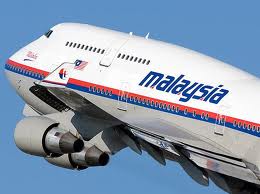
Search resumes for missing Malaysian jetliner

March 9, 2014
Kuala Lumpur, Mar 9: Planes and ships from across Asia resumed the hunt on Sunday for the Malaysian jetliner missing with 239 people on board for more than 24 hours, while Malaysian aviation authorities investigated how two passengers were apparently able to get on the aircraft using stolen passports.

airlines

There was still no confirmed sighting of wreckage from the Boeing 777 in the seas between Malaysia and Vietnam where it vanished from screens early Saturday morning en route to Beijing from Kuala Lumpur. The weather was fine, the plane was already cruising and the pilots had no time to send a distress signal in unusual circumstances for a modern jetliner to crash.

Li Jiaxiang, administrator of the Civil Aviation Administration of China, said some debris had been spotted, but it was unclear whether it came from the plane. Vietnamese authorities said they had seen nothing close to two large oil slicks they saw Saturday and said might be from the missing plane.

Malaysia's civil aviation chief Azaharuddin Abdul Rahman said his country had expanded its area of operation to the west coast of peninsular Malaysia, on the other side of the country from where the plane disappeared. “This is standard procedure. If we can't find it here, we go to other places,” he said.

Finding traces of an aircraft that crashes over sea can take days or longer, even with a sustained search effort. Depending on the circumstances of the crash, wreckage can be scattered over many square kilometers (miles). If the plane enters the water before breaking up, there can be relatively little debris.

Investigators will need access to the flight data recorders to determine what happened. Terrorism is always considered a possibility, but the sudden disappearance of Flight MH370 has given extra emphasis to speculation a bomb might have been on board.

On Saturday, foreign ministries in Italy and Austria said the names of two citizens listed on the flight's manifest matched the names on two passports reported stolen in Thailand. It's unclear how common it is for people to get on flights with fake passports, but the news added to fears of terrorism.

Azaharuddin said Sunday that authorities were “aware of the situation and we are doing an investigation at the moment.”

Just 9 percent of fatal accidents happen when a plane is at cruising altitude, according to a statistical summary of commercial jet accidents done by Boeing. Malaysia Airlines CEO Ahmad Jauhari Yahya said Saturday there was no indication the pilots had sent a distress signal.

The lack of a radio call “suggests something very sudden and very violent happened,” said William Waldock, who teaches accident investigation at Embry-Riddle Aeronautical University in Prescott, Ariz.

The plane was last inspected 10 days ago and found to be “in proper condition,” Ignatius Ong, CEO of Malaysia Airlines subsidiary Firefly airlines, said at a news conference.

Two-thirds of the jet's passengers were from China. The rest were from elsewhere in Asia, North America and Europe.

Asked whether terrorism was suspected, Malaysian Prime Minister Najib Razak said authorities were “looking at all possibilities, but it is too early to make any conclusive remarks.”

The South China Sea is a tense region with competing territorial claims that have led to several low-level conflicts, particularly between China and the Philippines. That antipathy briefly faded Saturday as China, the Philippines, Vietnam, Singapore and Malaysia all sent ships and planes to the region.

Malaysia had dispatched 15 planes and nine ships to the area. The U.S. Navy was sending a warship and a surveillance plane, while Singapore said it would send a submarine and a plane. China and Vietnam also sent aircraft to help in the search.

Malaysia Airlines has a good safety record, as does the 777, which had not had a fatal crash in

its 19—year history until an Asiana Airlines plane crashed last July in San Francisco, killing three passengers, all teenagers from China.

Comments

Add new comment

  • Coastaldigest.com reserves the right to delete or block any comments.
  • Coastaldigset.com is not responsible for its readers’ comments.
  • Comments that are abusive, incendiary or irrelevant are strictly prohibited.
  • Please use a genuine email ID and provide your name to avoid reject.
News Network
February 14,2020

London, Feb 14: Five years ago Britain’s new finance minister Rishi Sunak wasn’t even a member of parliament and now he is running the world's fifth largest economy.

The 39-year-old former Goldman Sachs banker was appointed in dramatic fashion on Thursday when incumbent Sajid Javid unexpectedly quit — in a row over advisers — during what Downing Street had cast as a routine ministerial reshuffle.

Sunak is married to the daughter of Infosys co-founder NR Narayana Murthy, and was hand-picked to take over an ultra-safe seat in northern England, previously represented by former Conservative Party leader William Hague. The Murthy family was not reachable for comment.

In July, when he was promoted chief secretary to the Treasury, Murthy had said: “Our advice to our children, including Rishi, has been to work hard, be honest, and do good for society…We wish him well.”

After Thursday’s announcement, Sunak said: “Delighted to be appointed... Lots to get on with.”

Tipped for Promotion

As Boris Johnson moves to increase control of the finance ministry, one of the youngest chancellors in history will face a prime minister who wants to increase government spending on everything from infrastructure and police to health and education.

Sunak, seen as a rising star in the ruling Conservative Party since he entered Parliament in 2015, had been tipped for promotion to a senior post in the ministerial rejig as Johnson put together his post-Brexit cabinet.

But, despite an already rapid ascent through the ranks of government, few expected the Oxford University Politics, Philosophy and Economics graduate to ascend to one of the highest offices in the land.

Sunak had been serving as Javid’s deputy in the finance ministry since Johnson promoted him upon taking office in July 2019. Prior to that he had served as a junior housing minister.

“From working in my mum’s tiny chemist shop to my experience building large businesses, I have seen first-hand how politicians should support free enterprise and innovation to ensure our future prosperity,” Sunak says on his website.

Smooth and loyal

Seen as a smooth media performer and ultra-loyal member of the Conservative Party, Sunak has been used by the government to present and defend their policies in television interviews — a sign of trust from Johnson, who has a fraught relationship with Britain’s media.

Sunak takes control at a critical juncture for Britain’s $2.7 trillion economy. He will have to steer the economy through the turbulence of leaving the European Union and the forging of new trade links that will define Britain’s new relationship with the world.

However, the power struggle that forced his predecessor Javid to quit hints at a more diminished role for what is the second most powerful position in the government — with Johnson’s office wanting to centralise control and minimise dissent.

Sunak is one of the three ministers of Indian origin in Johnson’s cabinet, the other two being Priti Patel and Alok Sharma. Patel remains the interior minister after the cabinet reshuffle while Sharma, a former minister for international development, was appointed the new minister for business. Sunak’s father was a doctor and his mother ran a chemist shop. Before entering politics he worked for Goldman Sachs and a hedge fund, then co-founded an investment firm. He also has an MBA from Stanford University.

Comments

Add new comment

  • Coastaldigest.com reserves the right to delete or block any comments.
  • Coastaldigset.com is not responsible for its readers’ comments.
  • Comments that are abusive, incendiary or irrelevant are strictly prohibited.
  • Please use a genuine email ID and provide your name to avoid reject.
News Network
February 9,2020

Nakhon Ratchasima, Feb 9: The Thai soldier who killed at least 20 people and holed up in a mall overnight was shot dead Sunday morning by commandos, ending a near-17-hour ordeal which left dozens wounded and stunned the country.

It was unclear how many people remained trapped inside the Terminal 21 mall in Nakhon Ratchasima -- also known as Korat -- where the gunman held out through the night, armed with assault weapons stolen from his barracks.

Volleys of gunfire rang out as the siege ran into dawn, hours after Thai security services stormed the ground floor and freed scores of stunned, terrified shoppers from a bloody rampage that the gunman -- a junior army officer identified as Sergeant-Major Jakrapanth Thomma -- had relayed via Facebook posts.

"He was shot dead thirty minutes ago" (0200 GMT), chief of the Crime Suppression Division Jirabhob Bhuridej told AFP.

Commandos from elite Thai police units killed the gunman, a police spokesman added, after an operation involving hundreds of security personnel.

"The official death toll is 20 and wounded 42... nine are in surgery," Narinrat Pitchayakamin, a Korat doctor told reporters, revising down an initial death toll of 21.

But it was unclear if there were more victims inside the multi-level complex which was packed with Saturday shoppers when the gunman stormed in.

A fleet of ambulances left the front of the complex and forensic police poured into the grim crime scene, shortly before the gunman's death was confirmed.

The night was peppered with heavy exchanges of gunfire and sporadic evacuations.

A police officer who took part in a raid to flush out the gunman died, according to deputy prime minister Anutin Charnvirakul. "He had been hit and unfortunately, he couldn't make it," said Anutin.

Shocked evacuees recounted how an ordinary Saturday shopping day at the busy mall descended into horror as the gunman entered.

"It was like a dream... I'm grateful I survived," Sottiyanee Unchalee, 48, told AFP, explaining she hid in the toilet of a gym inside the mall as she heard the gunfire.

"I'm so sorry for those who died... (and) the people still trapped inside."

Stolen weapons

Jakrapanth relayed his shooting spree through Facebook posts which charted the attack from the army barracks in the city to the mall, where an unknown number of shoppers remained trapped.

A volunteer rescue worker recounted a bloody scene of horror after his team carried four corpses to the hospital.

"I've never seen anything like this," Peerapong Chatadee told AFP.

"I just feel so sad. He is a soldier, he should not have fired at unarmed people."

The bloodshed began Saturday afternoon when Jakrapanth shot three people -- among them at least one soldier -- at a senior officer's house and then at the nearby army barracks, before driving an army vehicle to the town centre.

There the gunman used weapons stolen from the military arsenal to unleash carnage in the town centre.

He "used a machine gun and shot innocent victims resulting in many injured and dead", said police spokesman Krissana Pattanacharoen.

Throughout the day, Jakrapanth posted images of himself and wrote several posts on his Facebook page as the attack unfolded.

In one Facebook video -- since deleted -- the assailant, wearing an army helmet, filmed from an open-top jeep, saying, "I'm tired... I can't pull my finger anymore" as he made a trigger symbol with his hand.

There were also photos of a man in a ski mask holding up a pistol.

A Facebook spokesperson said: "We have removed the gunman's accounts from our services and will work around the clock to remove any violating content related to this attack as soon as we become aware of it."

The city is home to one of the largest barracks in Thailand, a country where the military is enmeshed in politics and society.

The nation also has one of the highest rates of gun ownership in the world, and several shootings at courthouses last year renewed concern about gun violence.

Comments

Add new comment

  • Coastaldigest.com reserves the right to delete or block any comments.
  • Coastaldigset.com is not responsible for its readers’ comments.
  • Comments that are abusive, incendiary or irrelevant are strictly prohibited.
  • Please use a genuine email ID and provide your name to avoid reject.
News Network
March 29,2020

Beijing, Mar 29: In a rare display of public anger in China, dozens of people in central Hubei province, the epicentre of the coronavirus outbreak till recently, attacked official vehicles after they were stopped from crossing a bridge and travel to neighbouring Jiangxi after the lifting of the lockdown.
Hubei province with over 56 million people was kept under lockdown from January 23 as part of aggressive measures to bring down COVID-19 cases which rapidly spread in the area.

Videos on Chinese social media on Friday showed unprecedented scenes of police from Hubei and Jiangxi clashing on the bridge connecting the two provinces over barricades erected from stopping Hubei people from moving out over fears of coronavirus spreading.

Policemen from both sides argued over how to verify if people were allowed to enter Jiangxi, according to local media reports.

It was a major relief for millions of people in Hubei province, when the Chinese government which kept it under lockdown lifted the restrictions on travel.

The government will permit people from the province to travel if they hold a green health code, meaning no contact with any infected or suspected COVID-19 cases.

But people of Hubei to their shock on Friday found roadblocks on the 1st Yangtze River Bridge that separates Huangmei county in Hubei erected by Huangmei county of Jiangxi province.

In local media reports, witnesses were quoted as saying that Huangmei police in Jiujiang erected roadblocks on the bridge to stop people from Hubei from crossing it, a move they alleged stigmatised them.

Video footage shared online showed rows of police armed with riot shields holding back the crowds, while members of the public could be seen damaging and even overturning police vehicles.

In a clip published by the Huanggang city government, which administers Huangmei, the county's Communist Party chief Ma Yanzhou could be heard speaking to the people through a loud hailer, warning them that by gathering in a large group they were increasing their chances of contracting the virus, Hong Kong-based South China Morning Post reported.

While it is unclear exactly how the clash started, police from the two sides published separate official statements online, which were quickly deleted, it said.

The incident underlines the problems China faces as it seeks a return to normalcy after months of lockdown, the Post said.

After the incident, the governments of Huangmei and Jiujiang on Friday issued a joint statement saying they had agreed to remove the barriers set up to restrict travel during the lockdown, and also to recognise each other's health screening codes to make it easier for people in good health to get to where they needed to be, the Post report said.

An article by the ruling Communist Party of China (CPC) mouthpiece, People''s Daily acknowledged the problems in getting the country back on its feet.

"In the past few days, all walks of life have called for governments to accept workers from Hubei," it said.

"However, it is undeniable that some places, intentionally or not, have set up obstacles for Hubei migrant workers to return to their posts and hold prejudices against them."

Comments

Add new comment

  • Coastaldigest.com reserves the right to delete or block any comments.
  • Coastaldigset.com is not responsible for its readers’ comments.
  • Comments that are abusive, incendiary or irrelevant are strictly prohibited.
  • Please use a genuine email ID and provide your name to avoid reject.