



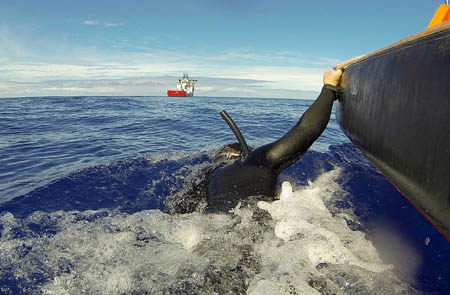
Searchers fail to find any confirmed clues about missing plane

April 13, 2014

Missing_planePerth, Apr 13: Searchers hunting for the missing Malaysian plane in the Indian Ocean today failed to find any confirmed clues about the black boxes of the aircraft, as no new signals have been detected over the past 48 hours.

"Up to 11 military aircraft, one civil aircraft and 14 ships will assist in today's search," the Joint Agency Coordination Centre (JACC) said in a statement, adding the centre of the search areas was set approximately 2,200 km north west of Perth.

It said the Australian Maritime Safety Authority had planned a visual search area, totalling 57,506 sq km compared to 41,393 sq km yesterday.

No new signals have been detected over the past 48 hours, as the search for the missing jet entered into 37th day. The last of the four other signals was detected on Tuesday night.

In an effort to narrow the underwater search area in which the autonomous underwater vehicle is deployed, JACC said the Australian defence vessel, Ocean Shield, continued more focused sweeps with the towed pinger locator to try and locate further signals related to the black box.

Last Wednesday, JACC chief coordinator Angus Houston said the autonomous underwater vehicle would be deployed once signals could no longer be detected.

Finding black the black box is crucial to know what happened on March 8 before the Beijing-bound Malaysia Airlines jet with 239 people, including five Indians, an Indo-Canadian and 154 Chinese nationals, mysteriously vanished after taking off from Kuala Lumpur.

The batteries powering the black box are certified to be working for 30 days, but can still provide weak signals for some more days. Stored in a plane's tail, they are designed to begin sending off distinct, high-pitched signals as soon as they come in contact with water.

China's vessels have been searching in an area of about 25,000 square kilometers, which is in the western part of the search region designated by the Australian authorities, said Zhuo Li, an official with the China Maritime Search and Rescue Center.

In the eastern region of about 15,000 square kilometers, vessels from other countries, including Australia, the UK, the US and Malaysia, have been in search, Zhuo added.

By midday today, the center had mobilized 63 merchant ships for assistance in the search, covering about 167,135 square kilometers in total, he said.

The mystery of the missing plane continued to baffle aviation and security authorities who have so far not succeeded in tracking the aircraft despite deploying hi-tech radar and other gadgets even after searching for 37 days.

Australian Prime Minister Tony Abbott yesterday said signals possibly from the black box of the ill-fated Malaysian jet were "rapidly fading" and the ongoing massive search for the plane was likely to continue "for a long time".

Comments

Add new comment

  • Coastaldigest.com reserves the right to delete or block any comments.
  • Coastaldigset.com is not responsible for its readers’ comments.
  • Comments that are abusive, incendiary or irrelevant are strictly prohibited.
  • Please use a genuine email ID and provide your name to avoid reject.
Agencies
July 2,2020

Moscow, Jul 2: Russian voters approved changes to the constitution that will allow President Vladimir Putin to hold power until 2036, but the weeklong plebiscite that concluded Wednesday was tarnished by widespread reports of pressure on voters and other irregularities.

With most of the nation's polls closed and 20% of precincts counted, 72% voted for the constitutional amendments, according to election officials.

For the first time in Russia, polls were kept open for a week to bolster turnout without increasing crowds casting ballots amid the coronavirus pandemic a provision that Kremlin critics denounced as an extra tool to manipulate the outcome.

A massive propaganda campaign and the opposition's failure to mount a coordinated challenge helped Putin get the result he wanted, but the plebiscite could end up eroding his position because of the unconventional methods used to boost participation and the dubious legal basis for the balloting.

By the time polls closed in Moscow and most other parts of Western Russia, the overall turnout was at 65%, according to election officials. In some regions, almost 90% of eligible voters cast ballots.

On Russia's easternmost Chukchi Peninsula, nine hours ahead of Moscow, officials quickly announced full preliminary results showing 80% of voters supported the amendments, and in other parts of the Far East, they said over 70% of voters backed the changes.

Kremlin critics and independent election observers questioned the turnout figures.

We look at neighboring regions, and anomalies are obvious there are regions where the turnout is artificially (boosted), there are regions where it is more or less real, Grigory Melkonyants, co-chair of the independent election monitoring group Golos, told The Associated Press.

Putin voted at a Moscow polling station, dutifully showing his passport to the election worker. His face was uncovered, unlike most of the other voters who were offered free masks at the entrance.

The vote completes a convoluted saga that began in January, when Putin first proposed the constitutional changes.

He offered to broaden the powers of parliament and redistribute authority among the branches of government, stoking speculation he might seek to become parliamentary speaker or chairman of the State Council when his presidential term ends in 2024.

His intentions became clear only hours before a vote in parliament, when legislator Valentina Tereshkova, a Soviet-era cosmonaut who was the first woman in space in 1963, proposed letting him run two more times.

The amendments, which also emphasize the primacy of Russian law over international norms, outlaw same-sex marriages and mention a belief in God as a core value, were quickly passed by the Kremlin-controlled legislature.

Putin, who has been in power for more than two decades longer than any other Kremlin leader since Soviet dictator Josef Stalin said he would decide later whether to run again in 2024.

He argued that resetting the term count was necessary to keep his lieutenants focused on their work instead of darting their eyes in search for possible successors.

Analyst Gleb Pavlovsky, a former Kremlin political consultant, said Putin's push to hold the vote despite the fact that Russia has thousands of new coronavirus infections each day reflected his potential vulnerabilities.

Putin lacks confidence in his inner circle and he's worried about the future, Pavlovsky said.

He wants an irrefutable proof of public support.

Even though the parliament's approval was enough to make it law, the 67-year-old Russian president put his constitutional plan to voters to showcase his broad support and add a democratic veneer to the changes.

But then the coronavirus pandemic engulfed Russia, forcing him to postpone the April 22 plebiscite.

The delay made Putin's campaign blitz lose momentum and left his constitutional reform plan hanging as the damage from the virus mounted and public discontent grew.

Plummeting incomes and rising unemployment during the outbreak have dented his approval ratings, which sank to 59%, the lowest level since he came to power, according to the Levada Center, Russia's top independent pollster.

Moscow-based political analyst Ekaterina Schulmann said the Kremlin had faced a difficult dilemma: Holding the vote sooner would have brought accusations of jeopardizing public health for political ends, while delaying it raised the risks of defeat.

Holding it in the autumn would have been too risky, she said.

In Moscow, several activists briefly lay on Red Square, forming the number 2036 with their bodies in protest before police stopped them.

Some others in Moscow and St. Petersburg staged one-person pickets and police didn't intervene.

Several hundred opposition supporters rallied in central Moscow to protest the changes, defying a ban on public gatherings imposed for the coronavirus outbreak. Police didn't intervene and even handed masks to the participants.

Authorities mounted a sweeping effort to persuade teachers, doctors, workers at public sector enterprises and others who are paid by the state to cast ballots. Reports surfaced from across the vast country of managers coercing people to vote.

The Kremlin has used other tactics to boost turnout and support for the amendments.

Comments

Add new comment

  • Coastaldigest.com reserves the right to delete or block any comments.
  • Coastaldigset.com is not responsible for its readers’ comments.
  • Comments that are abusive, incendiary or irrelevant are strictly prohibited.
  • Please use a genuine email ID and provide your name to avoid reject.
News Network
April 10,2020

Paris, Apr 10: French pharma major Sanofi said on Friday it has decided to donate 100 million doses of hydroxychloroquine, the anti-malaria drug which could be a potential weapon against novel coronavirus, across 50 countries.

The company has already doubled its incremental production capacity on top of the usual production for current indications across its eight hydroxychloroquine manufacturing sites worldwide and is on track to quadruple it by the summer.

"In this global health emergency, Sanofi stands ready to assist as many countries as possible, starting with countries where its medicine is registered for current approved indications as well as countries where there are no hydroxychloroquine suppliers or countries with underserved populations," it said in a statement.

Sanofi called for coordination among the entire hydroxychloroquine chain worldwide to ensure the continued supply of the medicine if proven to be a well-tolerated and effective treatment in COVID-19 patients.

"The COVID-19 pandemic is an unprecedented health and economic crisis which is shaking some of the very fundamentals of international solidarity and cooperation among countries," said Chief Executive Officer Paul Hudson. "This virus does not care about the concept of borders, so we should not either," he added.

"It is critical that international authorities, local governments, manufacturers and all other players involved in the hydroxychloroquine chain work together in a coordinated manner to ensure all patients who may benefit from this potential treatment can access it. If the trials prove positive, we hope our donation will play a critical role for patients," said Hudson.

While hydroxychloroquine is generating a lot of hope for patients around the world, said Sanofi, it should be remembered that there are no results from ongoing studies and the results may be positive or negative.

To date, there is insufficient clinical evidence to draw any conclusion over the safety and efficacy of hydroxychloroquine in the management of COVID-19 patients.

It is one of several medicines being investigated by the World Health Organisation (WHO) in its international clinical trial seeking a treatment solution for COVID-19. "Sanofi is supporting ongoing trials by providing the medicine to some participating investigator sites and other independent research centres," it said.

Comments

Add new comment

  • Coastaldigest.com reserves the right to delete or block any comments.
  • Coastaldigset.com is not responsible for its readers’ comments.
  • Comments that are abusive, incendiary or irrelevant are strictly prohibited.
  • Please use a genuine email ID and provide your name to avoid reject.
News Network
May 30,2020

Washington, May 30: The United States will end its relationship with the World Health Organization over the body’s handling of the coronavirus pandemic, U.S. President Donald Trump said on Friday, accusing the U.N. agency of becoming a puppet of China.

The move to quit the Geneva-based body, which the United States formally joined in 1948, comes amid growing tensions between Washington and Beijing over the coronavirus outbreak. The virus first emerged in China’s Wuhan city late last year.

Speaking in the White House Rose Garden, Trump said Chinese officials “ignored their reporting obligations” to the WHO about the virus - that has killed hundreds of thousands of people globally - and pressured the agency to “mislead the world.”

“China has total control over the World Health Organization despite only paying $40 million per year compared to what the United States has been paying which is approximately $450 million a year,” he said.

Trump’s decision follows a pledge last week by Chinese President Xi Jinping to give $2 billion to the WHO over the next two years to help combat the coronavirus. The amount almost matches the WHO’s entire annual program budget for last year.

Trump last month halted funding for the 194-member organization, then in a May 18 letter gave the WHO 30 days to commit to reforms.

“Because they have failed to make the requested and greatly needed reforms, we will be today terminating our relationship with the World Health Organization and redirecting those funds to other worldwide and deserving urgent global public health needs,” Trump said on Friday.

It was not immediately clear when his decision would come into effect. A 1948 joint resolution of Congress on U.S. membership of the WHO said the country “reserves its right to withdraw from the organization on a one-year notice.”

The World Health Organization did not immediately respond to a request for comment on Trump’s announcement. It has previously denied Trump’s assertions that it promoted Chinese “disinformation” about the virus.

“It’s important to remember that the WHO is a platform for cooperation among countries,” said Donna McKay, executive director of Physicians for Human Rights. “Walking away from this critical institution in the midst of an historic pandemic will hurt people both in the United States and around the world.”

‘ABSOLUTELY CRITICAL’

The United States currently owes the WHO more than $200 million in assessed contributions, according to the WHO website. Washington also gives several hundred million dollars annually in voluntary funding tied to specific WHO programs such as polio eradication, HIV, hepatitis and tuberculosis.

Amesh A. Adalja, a senior scholar at Johns Hopkins Center for Health Security, said that in practice Trump’s decision was unlikely to change the operations of the WHO.

“From a symbolic or moral standpoint it’s the wrong type of action to be taking in the middle of a pandemic and seems to deflect responsibility for what we in the U.S. failed to do and blame the WHO,” said Adalja.

When Trump halted funding to the WHO last month, two Western diplomats said the U.S. suspension was more harmful politically to the WHO than to the agency’s current programs, which are funded for now.

The WHO is an independent international body that works with the United Nations. U.N. Secretary-General Antonio Guterres said last month that the WHO is “absolutely critical to the world’s efforts to win the war against COVID-19.”

When asked about Trump’s decision, a U.N. spokesman said: “We have consistently called for all states to support WHO.”

Trump has long scorned multilateralism as he focuses on an “America First” agenda. Since taking office, he has quit the U.N. Human Rights Council, the U.N. cultural agency, a global accord to tackle climate change and the Iran nuclear deal. He has also cut funding for the U.N. population fund and the U.N. agency that aids Palestinian refugees.

“The WHO is the world’s early warning system for infectious diseases,” said U.S. Representative Nita Lowey, a Democrat who chairs the House Committee on Appropriations. “Now, during a global pandemic that has cost over 100,000 American lives, is not the time to put the country further at risk.”

Comments

Add new comment

  • Coastaldigest.com reserves the right to delete or block any comments.
  • Coastaldigset.com is not responsible for its readers’ comments.
  • Comments that are abusive, incendiary or irrelevant are strictly prohibited.
  • Please use a genuine email ID and provide your name to avoid reject.