



Searchers resume hunt for bodies from AirAsia jet

December 31, 2014

Pangkalan bun, Dec 31: A massive hunt for the 162 victims of AirAsia Flight 8501 resumed in the Java Sea on Wednesday. The search will focus on the area of the aqua-colored waters where the first bodies and debris were located a day earlier. But wind, strong currents and high surf hampered recovery efforts as distraught family members anxiously waited to identify their loved ones.
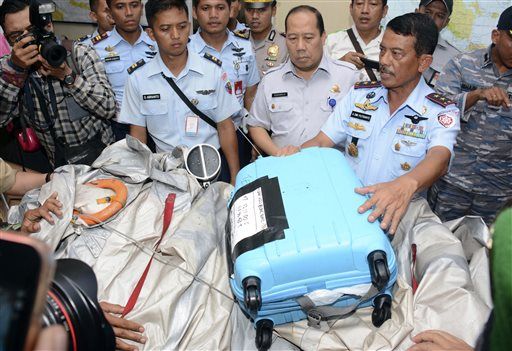
AirAsia jet

The first proof of the jet's fate emerged on Tuesday in an area not far from where it dropped off radar screens. Searchers found as many as six bodies and debris that included a life jacket, an emergency exit door and a suitcase about 10 miles from the plane's last known coordinates.

The airliner's disappearance halfway through a two-hour flight between Surabaya, Indonesia, and Singapore triggered an international search for the aircraft involving dozens of planes, ships and helicopters. It is still unclear what brought the plane down.

The plane needs to be located and its cockpit voice and flight data recorders, or black boxes, recovered before officials can start determining what caused the crash.

Images of the debris and a bloated body shown on Indonesian television sent a spasm of anguish through the room at the Surabaya airport where relatives awaited news.

The first sign of the jet turned up about 10 miles (16 kilometres) from its last known coordinates. Parts of the interior, including the oxygen tank, were brought to the nearest town, Pangkalan Bun. Another find included a bright blue plastic suitcase, completely unscratched.

“I know the plane has crashed, but I cannot believe my brother and his family are dead,” said Ifan Joko, who lost seven family members, three of them children, as they travelled to Singapore to ring in the new year. “We still pray they are alive.”

First Adm. Sigit Setiayanta, commander of the Naval Aviation Centre at Surabaya Air Force base, told reporters six corpses were spotted about 160 kilometres (100 miles) from Central Kalimantan province.

Rescue workers descended on ropes from a hovering helicopter to retrieve bodies. Efforts were hindered by 2-meter (6-foot) waves and strong winds, National Search and Rescue Director SB Supriyadi said.

The first body was later picked up by a navy ship. Officials said as many as six others followed, but they disagreed about the exact number.

Mr. Supriyadi was on the aircraft and saw what appeared to be more wreckage under the water, which was clear and a relatively shallow 20 to 30 meters (65 to 100 feet).

When TV broadcast an image of a half-naked man floating in the water, a shirt partially covering his head, many of the family members screamed and wailed uncontrollably. One middle-aged man collapsed and had to be carried out on a stretcher.

Their horror was captured by cameras on the other side of windows into the waiting room. Officials later blacked out the glass.

About 125 family members were planning to travel on Wednesday to Pangkalan Bun to start identifying their loved ones. Body bags and coffins have been prepared at three hospitals there. Dozens of elite military divers also joined the search.

Malaysia-based AirAsia's loss comes on top of the still-unsolved disappearance of Malaysia Airlines Flight 370 in March with 239 people aboard, and the downing of Malaysia Airlines Flight 17 in July over Ukraine, which killed all 298 passengers and crew.

Nearly all the passengers and crew were Indonesians, who are frequent visitors to Singapore, particularly on holidays.

AirAsia group CEO Tony Fernandes, the airline's founder and public face and a constant presence in Indonesia since the tragedy started unfolding, said he planned to travel to the recovery site on Wednesday.

“I have apologised profusely for what they are going through,” he said of his contact with relatives. “I am the leader of this company, and I have to take responsibility. That is why I'm here. I'm not running away from my obligations.”

The jet's last communication indicated the pilots were worried about bad weather. They sought permission to climb above threatening clouds but were denied because of heavy air traffic. Four minutes later, the jet disappeared from the radar without issuing a distress signal.

Several countries rushed to Indonesia to help with search and recovery efforts.

The United States said it was sending the USS Sampson destroyer, joining at least 30 ships, 15 aircraft and seven helicopters in the search for the jet.

A Chinese frigate was on the way. Singapore said it was sending two underwater beacon detectors to try to pick up pings from the plane's all-important cockpit voice and flight-data recorders. Malaysia, Australia and Thailand are also involved in the search.

Comments

Add new comment

  • Coastaldigest.com reserves the right to delete or block any comments.
  • Coastaldigset.com is not responsible for its readers’ comments.
  • Comments that are abusive, incendiary or irrelevant are strictly prohibited.
  • Please use a genuine email ID and provide your name to avoid reject.
News Network
July 4,2020

Geneva, Jul 4: The World Health Organization has updated its account of the early stages of the COVID crisis to say it was alerted by its own office in China, and not by China itself, to the first pneumonia cases in Wuhan.

The UN health body has been accused by US President Donald Trump of failing to provide the information needed to stem the pandemic and of being complacent towards Beijing, charges it denies.

On April 9, WHO published an initial timeline of its communications, partly in response to criticism of its early response to the outbreak that has now claimed more than 521,000 lives worldwide.

In that chronology, WHO had said only that the Wuhan municipal health commission in the province of Hubei had on December 31 reported cases of pneumonia. The UN health agency did not however specify who had notified it.

WHO director Tedros Adhanom Ghebreyesus told a press conference on April 20 the first report had come from China, without specifying whether the report had been sent by Chinese authorities or another source.

But a new chronology, published this week by the Geneva-based institution, offers a more detailed version of events.

It indicates that it was the WHO office in China that on December 31 notified its regional point of contact of a case of "viral pneumonia" after having found a declaration for the media on a Wuhan health commission website on the issue.

The same day, WHO's epidemic information service picked up another news report transmitted by the international epidemiological surveillance network ProMed -- based in the United States -- about the same group of cases of pneumonia from unknown causes in Wuhan.

After which, WHO asked the Chinese authorities on two occasions, on January 1 and January 2, for information about these cases, which they provided on January 3.

WHO emergencies director Michael Ryan told a press conference on Friday that countries have 24-48 hours to officially verify an event and provide the agency with additional information about the nature or cause of an event.

Ryan added that the Chinese authorities immediately contacted WHO's as soon as the agency asked to verify the report.

US President Donald Trump has announced that his country, the main financial contributor to WHO, will cut its bridges with the institution, which he accuses of being too close to China and of having poorly managed the pandemic.

The WHO denies any complacency toward China.

Comments

Add new comment

  • Coastaldigest.com reserves the right to delete or block any comments.
  • Coastaldigset.com is not responsible for its readers’ comments.
  • Comments that are abusive, incendiary or irrelevant are strictly prohibited.
  • Please use a genuine email ID and provide your name to avoid reject.
News Network
July 20,2020

Paris, Jul 20: Two coronavirus vaccine candidates have proven safe for humans and produced strong immune reactions among patients involved in separate clinical trials, doctors said on Monday.

The first trial among more than 1,000 adults in Britain found that the vaccine induced "strong antibody and T cell immune responses" against the novel coronavirus.

A separate trial in China involving more than 500 people showed most had developed widespread antibody immune response.

The studies, published in The Lancet medical journal, constitute a major step on the road towards a COVID-19 vaccine that is effective and safe for widespread use.

The authors of the studies said that they encountered few adverse side-effects from the vaccine candidates.

However, they cautioned that more research was needed, particularly among older adults, who are disproportionately at risk of dying of COVID-19.

Co-author Sarah Gilbert from the University of Oxford said the results "hold promise".

"If our vaccine is effective, it is a promising option as these types of vaccine can be manufactured at large scale."

Comments

Add new comment

  • Coastaldigest.com reserves the right to delete or block any comments.
  • Coastaldigset.com is not responsible for its readers’ comments.
  • Comments that are abusive, incendiary or irrelevant are strictly prohibited.
  • Please use a genuine email ID and provide your name to avoid reject.
News Network
May 24,2020

Beijing, May 24: The Chinese virology institute in the city where COVID-19 first emerged has three live strains of bat coronavirus on-site, but none match the new contagion wreaking chaos across the world, its director has said.

Scientists think COVID-19 -- which first emerged in Wuhan and has killed some 340,000 people worldwide -- originated in bats and could have been transmitted to people via another mammal.

But the director of the Wuhan Institute of Virology told state broadcaster CGTN that claims made by US President Donald Trump and others that the virus could have leaked from the facility were "pure fabrication".

"Now we have three strains of live viruses... But their highest similarity to SARS-CoV-2 only reaches 79.8 percent," she said, referring to the coronavirus strain that causes COVID-19.

US demands immediate start to WHO review

The United States called on the World Health Organisation on Friday to begin working immediately on investigating the source of the novel coronavirus, as well as its handling of the response to the pandemic.

One of their research teams, led by Professor Shi Zhengli, has been researching bat coronaviruses since 2004 and focused on the "source tracing of SARS", the strain behind another virus outbreak nearly two decades ago.

"We know that the whole genome of SARS-CoV-2 is only 80 percent similar to that of SARS. It's an obvious difference," she said.

"So, in Professor Shi's past research, they didn't pay attention to such viruses which are less similar to the SARS virus."

Conspiracy rumours that the biosafety lab was involved in the outbreak swirled online for months before Trump and US Secretary of State Mike Pompeo brought the theory into the mainstream by claiming that there is evidence the pathogen came from the institute.

The lab has said it received samples of the then-unknown virus on December 30, determined the viral genome sequence on January 2 and submitted information on the pathogen to the WHO on January 11.

Wang said in the interview that before it received samples in December, their team had never "encountered, researched or kept the virus."

"In fact, like everyone else, we didn't even know the virus existed," she said. "How could it have leaked from our lab when we never had it?"

The World Health Organization said Washington had offered no evidence to support the "speculative" claims.

In an interview with Scientific American, Shi said the SARS-CoV-2 genome sequence did not match any of the bat coronaviruses her laboratory had previously collected and studied.

Comments

Add new comment

  • Coastaldigest.com reserves the right to delete or block any comments.
  • Coastaldigset.com is not responsible for its readers’ comments.
  • Comments that are abusive, incendiary or irrelevant are strictly prohibited.
  • Please use a genuine email ID and provide your name to avoid reject.