



The secrets of Udupi's Madhwa Brahmin kitchen leaked!

[email protected] (News Network | KM Acharya)
August 26, 2015

Udupi, Aug 26: What connects Bisi Bele Hulianna, Saaru, Modaka, Huggi, Majjige Palidya and Drakshi Gojju? These are some of the famed dishes of the Madhwa Brahmin community of Udupi, a coastal town in Karnataka where the Krishna temple acts as a pivot in people's lives.
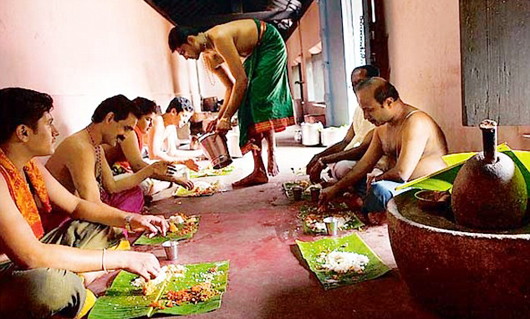
brahmin

Laying out the geographical expanse and scientific logic to the regions Madhwa Brahmins vegetarian food habits, culinary expert Malati Srinivasan and arts and crafts connoisseur Geetha Rao showcase the hitherto unknown vegetarian recipes from Udupi in their book "The Udupi Kitchen."

The authors straddle the traditional and modern and list what was once easily cooked in Udupi households - spice powders, salads and chutneys, savoury snacks, desserts - and elaborate on several recipes which are all-time favourites like Bisi Bele Hulianna, Saaru, Masal Dose and Modaka.

While Bisi Bele Hulianna is a dish of spicy red gram, rice and vegetables, Saaru is spicy red gram soup, Huggi is rice and green gram with black pepper and cumin and Modaka is dumplings with coconut and jiggery filling.

Majjige Palidya is ash gourd with coconut and cumin in sour yoghurt and Drakshi Gojju is raisins in sweet, sour and spicy gravy.

Split into 12 sections, the Udupi Kitchen, published by Westland Ltd, celebrates vegetarian food with aplomb from a town where food is religion as well as a complete mouth-watering experience.

At the core of Udupi cuisine is the use of indigenous vegetables and fruits, cereals and pulses special to the Parashurama Kshetra and traditional Brahmins ate only vegetarian fare without onion and garlic.

According to the authors, Udupi cuisine has a vast variety and is not limited to tiffins or snacks.

"As I began working on this project, I realised how vast and varied our family’s repertoire of Udupi (Madhwa) cuisine was. I wrote down 175 recipes, but have used about a 100 of them in the book," says Srinivasan.

"Writing a cook book for both Indian and non-Indian readers required that a comprehensive multi-lingual glossary be compiled. It also meant using internationally accepted terminology: 'henchu' or 'tava' became griddle, bandle or 'kadhai' became wok, 'tappele' or 'bartan' became saucepan," says Rao.

She says for some kitchen tools like 'eelgemane' and 'ogarane chamcha', which had no "internationally understood" words, substitute words like curved knife blade and tempering-ladle had to be coined.

The story of Udupi cuisine is the story of how a temple-based, Brahmanical culinary tradition got modernised and became a global phenomenon. Food is religion in Udupi.

Fourteen varieties of food are cooked daily and offered to the deity at different times of the day. The food offered to god is 'naivediya', and the food eaten by human beings is 'prasada', food that is blessed.

In Udupi, meals are served on banana leaves in a particular order. Many recipes and foods have also proven health benefits. For example, dishes made from the inner banana stem prevent kidney stones, pepper rasam helps with the lactation of new mothers, jackfruit seeds have high protein content and so on.

The authors also say that the original of the masal dose or the famous masala dosa is attributed to Udupi.

Before it was invented, plain dosa was served with potato playa, without onions, in a separate cup. With changing food tastes, the Udupi chefs began to saute the mashed potatoes with onions and spices.

"As onions were considered taboo food for orthodox Brahmins, it is said that the doses were stuffed with onion-laced playa, instead of served in a separate cup, so that the onion could be 'hidden'," the authors say.

Comments

Usha moorthy
 - 
Wednesday, 8 Jun 2016

I'm extremely pleased that I now have a book to refer to for genuine udupi food!!! Thanks to the authors for painstakingly bringing together these wonderful recipes!!;

Add new comment

  • Coastaldigest.com reserves the right to delete or block any comments.
  • Coastaldigset.com is not responsible for its readers’ comments.
  • Comments that are abusive, incendiary or irrelevant are strictly prohibited.
  • Please use a genuine email ID and provide your name to avoid reject.
News Network
June 5,2020

Bengaluru, Jun 5: The much awaited Southwest Monsoon entered Karnataka with widespread rain in coastal and central regions of the southern state, an official said on Friday. Rain and thundershowers are likely to occur at most places over coastal areas and at a few places over the interior parts over the next 24-48 hours.

"The southwest monsoon entered the state on Thursday as predicted from Kerala and the Arabian Sea, with moderate to heavy rainfall in the coastal districts and central or Malnad region of the state," Karnataka State Natural Disaster Monitoring Centre Director Srinivas Reddy told media here.

Though the monsoon has set in on time in the state, Reddy said its progress was likely to be slow in the next three days, as cyclone Nisarga induced high-speed winds took away rain-bearing clouds from the southern peninsula.

According to the regional meteorological office, Karwar in Uttar Kannada district received a whopping 15cm rainfall on Thursday, followed by 11cm each at Kundapur in Udupi district and Shivamogga in Malnad region.

Kadra and Gersoppa in Uttara Kannada and Kottigehara in Chikkamagaluru district had 10cm rainfall, followed by 8cm at Virajpet in Kodagu district and 7cm each at Shirali and Gokarana in Uttara Kannda.

Isolated to scattered rainfall also occurred in many places across the north and south interior regions of the state.

"The monsoon will advance in the state to south and north interior areas after June 8 as there is lull in its movement due to lack of rain-bearing clouds and winds to carry them," said Reddy.

Noting that the four-month monsoon from June to September, crucial to the rain-dependent state would be normal this year, Reddy said its progress and spread, however, would depend on various factors like cloud formations and wind movements.

"Conditions are likely to become favourable for monsoon advancement in the state over the next 2-3 days," asserted Reddy.

Comments

Add new comment

  • Coastaldigest.com reserves the right to delete or block any comments.
  • Coastaldigset.com is not responsible for its readers’ comments.
  • Comments that are abusive, incendiary or irrelevant are strictly prohibited.
  • Please use a genuine email ID and provide your name to avoid reject.
News Network
March 30,2020

Bengaluru, Mar 30: The coronavirus scare has taken a toll on the poultry industry in Karnataka with many poultry farm owners culling the birds, insiders in the poultry industry said.

At least one lakh birds have been culled in the last one week, the sources said.

Ever since the news spread about novel coronavirus spreading rapidly, the poultry industry started feeling the heat.

The lockdown spelt further trouble for the industry with reduced business compelling farm owners to go in for the culling.

According to Muddukrishna of C N Nischchith Enterprises, a live chicken dealer in Bengaluru, the culling had taken place in Shivamogga, Kolar and other places.

"There is a drastic decline in business. There are neither customers nor enough supply of birds for sale. We are badly hit. There are many poultry farm owners who have incurred tremendous loss due to the lockdown," Muddukrishna told news agency.

Another major poultry industry owner, having his farms in Channapatna, Ramanagar, Anekal and surrounding places, said he had to get rid of at least 4,000 birds in each of these farms.

"This is not restricted to me alone. There are about 64 major poultry industries who have gone for the drastic measure of culling," said the farm owner.

He said in the last one week, at least one lakh birds have been culled as it was hard for them to maintain them.

"Each bird needs at least a kilogram of grains in three days to eat whereas each kg of poultry food costs about Rs 32. We have about two lakh birds in our farm. How can we maintain if there is no business," rued the poultry farm owner.

The industry has suffered a double whammy.

People gave up eating chicken following rumours that the novel coronavirus COVID-19 is similar to SARS, another virus.

Further, the lockdown has blocked the transportation of these birds, he added.

According to the farm owner, in the last one month, he had suffered a loss of around Rs 15 lakh and if the situation continues for the next three months, his condition would be beyond imagination.

Muddukrishna said the poultry farm association had given a memorandum to the animal husbandry and fisheries department seeking direction on the transportation of these birds.

Accordingly, the secretary in the department of Animal Husbandry and Fisheries A B Ibrahim issued a circular to all the city police commissioners, deputy commissioners of the district, superintendent of police and the CEO of Zilla Panchayath on Friday that the animal husbandry services have been declared as essential services.

Ibrahim said in his circular that the production of chicken birds, sheep, goat, pigs, etc in the farm and their transportation, manufacturing feed, liquid nitrogen meant for veterinary use and other items related to the Animal Husbandry should be permitted.

"Despite the order, our vehicles are stopped and drivers are harassed," alleged Muddukrishna.

Comments

Add new comment

  • Coastaldigest.com reserves the right to delete or block any comments.
  • Coastaldigset.com is not responsible for its readers’ comments.
  • Comments that are abusive, incendiary or irrelevant are strictly prohibited.
  • Please use a genuine email ID and provide your name to avoid reject.
News Network
January 10,2020

Bengaluru, Jan 10: The National Commission for Scheduled Tribes (NCST), which met with officials of the Social Welfare Department Thursday, has urged the state government to increase the reservation provided to the ST community.

The Commission's suggestion comes even as a committee headed by Justice Nagamohan Das is currently studying a demand for increase of reservation for the community from the existing 3% to 7.5%.

Addressing mediapersons on Thursday, Commission Chairperson Nand Kumar Sai, said the Commission had discussed the issue with the Social Welfare Department, Karnataka, asking officials to expedite the process.

In response to this suggestion, Social Welfare Department Principal Secretary G Kumar Naik said the government would take a call based on the Nagamohan Das Committee's report.

A meeting was held between members of the National ST Commission and the Social Welfare Department Thursday with regard to various projects taken up by the department.

In June last year, the then Kumaraswamy-led coalition government constituted the Justice Nagamohan Das Committee, after protests from members of the Valmiki community for an increase in reservation to 7.5%. At present, Karnataka provides 15% reservation for SCs, 3% for STs and 32% for other backward classes (OBC).

The national commission also urged the state government to ensure permanent faculty in all the 824 residential institutions run by the department. At present, as much as 50% of the faculty in these institutions have been hired on a contractual basis. "We have assured that the recruitment will be done in a short time," Naik told mediapersons.

Comments

Add new comment

  • Coastaldigest.com reserves the right to delete or block any comments.
  • Coastaldigset.com is not responsible for its readers’ comments.
  • Comments that are abusive, incendiary or irrelevant are strictly prohibited.
  • Please use a genuine email ID and provide your name to avoid reject.