



The secrets of Udupi's Madhwa Brahmin kitchen leaked!

[email protected] (News Network | KM Acharya)
August 26, 2015

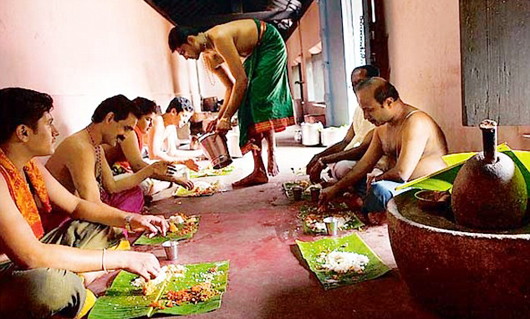
Udupi, Aug 26: What connects Bisi Bele Hulianna, Saaru, Modaka, Huggi, Majjige Palidya and Drakshi Gojju? These are some of the famed dishes of the Madhwa Brahmin community of Udupi, a coastal town in Karnataka where the Krishna temple acts as a pivot in people's lives.
brahmin

Laying out the geographical expanse and scientific logic to the regions Madhwa Brahmins vegetarian food habits, culinary expert Malati Srinivasan and arts and crafts connoisseur Geetha Rao showcase the hitherto unknown vegetarian recipes from Udupi in their book "The Udupi Kitchen."

The authors straddle the traditional and modern and list what was once easily cooked in Udupi households - spice powders, salads and chutneys, savoury snacks, desserts - and elaborate on several recipes which are all-time favourites like Bisi Bele Hulianna, Saaru, Masal Dose and Modaka.

While Bisi Bele Hulianna is a dish of spicy red gram, rice and vegetables, Saaru is spicy red gram soup, Huggi is rice and green gram with black pepper and cumin and Modaka is dumplings with coconut and jiggery filling.

Majjige Palidya is ash gourd with coconut and cumin in sour yoghurt and Drakshi Gojju is raisins in sweet, sour and spicy gravy.

Split into 12 sections, the Udupi Kitchen, published by Westland Ltd, celebrates vegetarian food with aplomb from a town where food is religion as well as a complete mouth-watering experience.

At the core of Udupi cuisine is the use of indigenous vegetables and fruits, cereals and pulses special to the Parashurama Kshetra and traditional Brahmins ate only vegetarian fare without onion and garlic.

According to the authors, Udupi cuisine has a vast variety and is not limited to tiffins or snacks.

"As I began working on this project, I realised how vast and varied our family’s repertoire of Udupi (Madhwa) cuisine was. I wrote down 175 recipes, but have used about a 100 of them in the book," says Srinivasan.

"Writing a cook book for both Indian and non-Indian readers required that a comprehensive multi-lingual glossary be compiled. It also meant using internationally accepted terminology: 'henchu' or 'tava' became griddle, bandle or 'kadhai' became wok, 'tappele' or 'bartan' became saucepan," says Rao.

She says for some kitchen tools like 'eelgemane' and 'ogarane chamcha', which had no "internationally understood" words, substitute words like curved knife blade and tempering-ladle had to be coined.

The story of Udupi cuisine is the story of how a temple-based, Brahmanical culinary tradition got modernised and became a global phenomenon. Food is religion in Udupi.

Fourteen varieties of food are cooked daily and offered to the deity at different times of the day. The food offered to god is 'naivediya', and the food eaten by human beings is 'prasada', food that is blessed.

In Udupi, meals are served on banana leaves in a particular order. Many recipes and foods have also proven health benefits. For example, dishes made from the inner banana stem prevent kidney stones, pepper rasam helps with the lactation of new mothers, jackfruit seeds have high protein content and so on.

The authors also say that the original of the masal dose or the famous masala dosa is attributed to Udupi.

Before it was invented, plain dosa was served with potato playa, without onions, in a separate cup. With changing food tastes, the Udupi chefs began to saute the mashed potatoes with onions and spices.

"As onions were considered taboo food for orthodox Brahmins, it is said that the doses were stuffed with onion-laced playa, instead of served in a separate cup, so that the onion could be 'hidden'," the authors say.

Comments

Usha moorthy
 - 
Wednesday, 8 Jun 2016

I'm extremely pleased that I now have a book to refer to for genuine udupi food!!! Thanks to the authors for painstakingly bringing together these wonderful recipes!!;

Add new comment

  • Coastaldigest.com reserves the right to delete or block any comments.
  • Coastaldigset.com is not responsible for its readers’ comments.
  • Comments that are abusive, incendiary or irrelevant are strictly prohibited.
  • Please use a genuine email ID and provide your name to avoid reject.
News Network
April 11,2020

Bengaluru, Apr 11: The coronavirus-driven lockdown will continue for another 15 days, but relaxations will be allowed in a graded manner, Karnataka Chief Minister B S Yediyurappa said after a four-hour-long video conference with Prime Minister Narendra Modi on Saturday.

“Agriculture and industrial sectors will be given relaxation. Government offices will be allowed to work with partial strength. But the PM said detailed guidelines will be issued in two days,” Yediyurappa said, briefing reporters. 

“Importantly, the lockdown for the next two weeks will be different than how it was in the past three weeks. The Centre, keeping in mind economic activities, especially agriculture, industry and employment of labourers, the Centre will tell us what needs to be done,” the CM said.
 
According to Yediyurappa, PM Modi told all chief ministers that the next 2-3 weeks will be critical. “The next few weeks will decide whether or not we have succeeded. If the situation worsens, we have to face the crisis,” Yediyurappa said, quoting Modi. 

Apparently, Modi sought details on the COVID-19 situation from 12-13 states where the situation is grave. “He did not take a report from Karnataka,” Yediyurappa said. “This morning, seven new cases were reported in the state, taking our tally to 214. Nationally, we were in the third place; we’re now 11th,” he said, hailing the efforts of officials involved in fighting the pandemic. 

The CM said it was “inevitable” to continue the lockdown for another 15 days. “But for citizens to get essential supplies, there’s no bar on them going by walk alone. Also, we will see to it that agricultural activities are not affected anywhere,” Yediyurappa said.

Comments

Add new comment

  • Coastaldigest.com reserves the right to delete or block any comments.
  • Coastaldigset.com is not responsible for its readers’ comments.
  • Comments that are abusive, incendiary or irrelevant are strictly prohibited.
  • Please use a genuine email ID and provide your name to avoid reject.
coastaldigest.com news network
May 8,2020

Mangaluru, May 8: Dr Arathi Krishna, former deputy chairman of Karnataka NRI Forum, today called on Karnataka chief secretary Vijaya Bhaskar and urged him to exert pressure on the Centre through chief minister to expedite evacuation of Kannadigas stuck in Saudi Arabia amidst covid-19 lockdown. 

She also conveyed the message from labourers in Gulf countries requesting for free quarantine facility upon their arrival. Positively responding to the demand, Mr Bhaskar said that free quarantine facility will be arranged at BSF base in Bengaluru apart from paid quarantine facility in different hotels and guest houses.

Dr Arathi Krishna told coastaldigest.com that she also spoke to the officials in-charge of Gulf in the Ministry of External Affairs  and requested them to take necessary steps to add more special flights from Gulf countries to Karnataka. 

The officials have promised to consider operating flight from Riyadh to Mangaluru via Dammam in the second wave of evacuation, the schedule of which is expected to be announced in a few days, she said.

Comments

Add new comment

  • Coastaldigest.com reserves the right to delete or block any comments.
  • Coastaldigset.com is not responsible for its readers’ comments.
  • Comments that are abusive, incendiary or irrelevant are strictly prohibited.
  • Please use a genuine email ID and provide your name to avoid reject.
News Network
May 12,2020

May 12: Children suffering from non-respiratory disease symptoms like diarrhea and fever, or those with a history of exposure to the novel coronavirus, should be suspected of having COVID-19, a new study says.

According to the research, published in the journal Frontiers in Pediatrics, gastrointestinal symptoms first suffered by some children hints at potential infection with SARS-CoV-2 through the digestive tract.

"This case series is the first report to describe the clinical features of COVID-19 with non-respiratory symptoms as the first manifestation in children," the scientists from Tongji Hospital in China wrote in the study.

They explained that the gastrointestinal symptoms could be arising since the type of receptors in lung cells targeted by the virus can also be found in the intestines.

Most children are only mildly affected by COVID-19, and the few severe cases often have underlying health issues, the researchers said.

"It is easy to miss its diagnosis in the early stage, when a child has non-respiratory symptoms, or suffers from another illness," said study co-author Wenbin Li, who works at the Department of Pediatrics, Tongji Hospital.

"Based on our experience of dealing with COVID-19, in regions where this virus is epidemic, children suffering from digestive tract symptoms, especially with fever and/or a history of exposure to this disease, should be suspected of being infected with this virus," Li said.

In the study, the scientists described the clinical features of children admitted to hospital with non-respiratory symptoms, who were subsequently diagnosed with pneumonia and COVID-19.

"These children were seeking medical advice in the emergency department for unrelated problems, for example, one had a kidney stone, another a head trauma," Li said.

The study noted that all the children had pneumonia, which was confirmed by chest X-ray scan before or soon after admission.

These children were then confirmed to have COVID-19.

While their COVID-19 symptoms were initially mild or relatively hidden before their hospital admission, four out of the five cases had digestive tract symptoms as the first manifestation of this disease, the researchers said.

Li hopes that doctors will use the findings to quickly diagnose and isolate patients with similar symptoms, which may aid early treatment and reduce transmission.

According to the researchers, the children's gastrointestinal symptoms, which have also been recorded in adult patients, could be an additional route of infection.

"The gastrointestinal symptoms experienced by these children may be related to the distribution of receptors and the transmission pathway associated with COVID-19 infection in humans," Li explained.

Since the virus infects people via the ACE2 receptor, which can be found in certain cells in the lungs as well as the intestines, COVID-19 might infect patients not only through the respiratory tract in the form of air droplets, but also through the digestive tract by contact or fecal-oral transmission, the study noted.

While COVID-19 tests can occasionally produce false positive readings, Li said all the five children assessed in the study were infected with the disease.

However, he cautioned that more research is needed to confirm their findings.

"We report five cases of COVID-19 in children showing non-respiratory symptoms as the first manifestation after admission to hospital. The incidence and clinical features of similar cases needs further study in more patients," he said.

Comments

Add new comment

  • Coastaldigest.com reserves the right to delete or block any comments.
  • Coastaldigset.com is not responsible for its readers’ comments.
  • Comments that are abusive, incendiary or irrelevant are strictly prohibited.
  • Please use a genuine email ID and provide your name to avoid reject.