



The secrets of Udupi's Madhwa Brahmin kitchen leaked!

[email protected] (News Network | KM Acharya)
August 26, 2015

Udupi, Aug 26: What connects Bisi Bele Hulianna, Saaru, Modaka, Huggi, Majjige Palidya and Drakshi Gojju? These are some of the famed dishes of the Madhwa Brahmin community of Udupi, a coastal town in Karnataka where the Krishna temple acts as a pivot in people's lives.
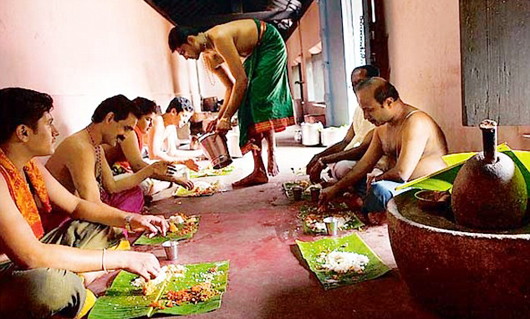
brahmin

Laying out the geographical expanse and scientific logic to the regions Madhwa Brahmins vegetarian food habits, culinary expert Malati Srinivasan and arts and crafts connoisseur Geetha Rao showcase the hitherto unknown vegetarian recipes from Udupi in their book "The Udupi Kitchen."

The authors straddle the traditional and modern and list what was once easily cooked in Udupi households - spice powders, salads and chutneys, savoury snacks, desserts - and elaborate on several recipes which are all-time favourites like Bisi Bele Hulianna, Saaru, Masal Dose and Modaka.

While Bisi Bele Hulianna is a dish of spicy red gram, rice and vegetables, Saaru is spicy red gram soup, Huggi is rice and green gram with black pepper and cumin and Modaka is dumplings with coconut and jiggery filling.

Majjige Palidya is ash gourd with coconut and cumin in sour yoghurt and Drakshi Gojju is raisins in sweet, sour and spicy gravy.

Split into 12 sections, the Udupi Kitchen, published by Westland Ltd, celebrates vegetarian food with aplomb from a town where food is religion as well as a complete mouth-watering experience.

At the core of Udupi cuisine is the use of indigenous vegetables and fruits, cereals and pulses special to the Parashurama Kshetra and traditional Brahmins ate only vegetarian fare without onion and garlic.

According to the authors, Udupi cuisine has a vast variety and is not limited to tiffins or snacks.

"As I began working on this project, I realised how vast and varied our family’s repertoire of Udupi (Madhwa) cuisine was. I wrote down 175 recipes, but have used about a 100 of them in the book," says Srinivasan.

"Writing a cook book for both Indian and non-Indian readers required that a comprehensive multi-lingual glossary be compiled. It also meant using internationally accepted terminology: 'henchu' or 'tava' became griddle, bandle or 'kadhai' became wok, 'tappele' or 'bartan' became saucepan," says Rao.

She says for some kitchen tools like 'eelgemane' and 'ogarane chamcha', which had no "internationally understood" words, substitute words like curved knife blade and tempering-ladle had to be coined.

The story of Udupi cuisine is the story of how a temple-based, Brahmanical culinary tradition got modernised and became a global phenomenon. Food is religion in Udupi.

Fourteen varieties of food are cooked daily and offered to the deity at different times of the day. The food offered to god is 'naivediya', and the food eaten by human beings is 'prasada', food that is blessed.

In Udupi, meals are served on banana leaves in a particular order. Many recipes and foods have also proven health benefits. For example, dishes made from the inner banana stem prevent kidney stones, pepper rasam helps with the lactation of new mothers, jackfruit seeds have high protein content and so on.

The authors also say that the original of the masal dose or the famous masala dosa is attributed to Udupi.

Before it was invented, plain dosa was served with potato playa, without onions, in a separate cup. With changing food tastes, the Udupi chefs began to saute the mashed potatoes with onions and spices.

"As onions were considered taboo food for orthodox Brahmins, it is said that the doses were stuffed with onion-laced playa, instead of served in a separate cup, so that the onion could be 'hidden'," the authors say.

Comments

Usha moorthy
 - 
Wednesday, 8 Jun 2016

I'm extremely pleased that I now have a book to refer to for genuine udupi food!!! Thanks to the authors for painstakingly bringing together these wonderful recipes!!;

Add new comment

  • Coastaldigest.com reserves the right to delete or block any comments.
  • Coastaldigset.com is not responsible for its readers’ comments.
  • Comments that are abusive, incendiary or irrelevant are strictly prohibited.
  • Please use a genuine email ID and provide your name to avoid reject.
coastaldigest.com news network
June 23,2020

Mangaluru, Jun 23: The wholesale fresh fish dealers have voluntarily decided to suspend sale for 10 days from June 24 in the wake of fresh coronavirus outbreak in the region. 

Convening the collective decision of the traders in a letter, K Ashraf, working president of the association of Mangaluru fisheries harbour fish traders and commission agents, has urged the deputy commissioner to formally impose ban on fish trade in the city for next 10 days to prevent the spread of the covid-19. 

Mr Ashraf stated that decision was taken as many fish traders suffering from symptoms such as cough, cold and fever for last few days and some of the traders have got themselves admitted in hospitals for treatment. 

The letter urged the DC to prevent and ban unauthorized traders selling fish not only in Bander but also in neighbourhoods like Ullal Kotepur, Hoige Bazar, Bengre, Farangipet, near VRL, Kudroli, Kallapu and Maripalla. 
 

Comments

Add new comment

  • Coastaldigest.com reserves the right to delete or block any comments.
  • Coastaldigset.com is not responsible for its readers’ comments.
  • Comments that are abusive, incendiary or irrelevant are strictly prohibited.
  • Please use a genuine email ID and provide your name to avoid reject.
News Network
July 18,2020

Bengaluru, Jul 18: Bringing a major change in the  administration of Bengaluru, which has emerged as a Covid-19 hotspot, the state government on Saturday transferred B H Anil Kumar out of the BBMP and brought N Manjunath Prasad to take his place. 

Manjunath Prasad, who headed the Bruhat Bengaluru Mahanagara Palike (BBMP) before being replaced by Kumar, will take over with immediate effect. The government has also placed him in concurrent charge of the Revenue Department as well as the Disaster Management, Bhoomi and UPOR.

Kumar, an Additional Chief Secretary, has been put in a place where earlier a secretary was posted. He now heads the Department of Public Enterprises. The posting would have brought him two spots down had it not been for the government upgrading it to the level of additional chief secretary. 

Anil Kumar, who was earlier praised for his work to contain the coronavirus pandemic, had faced criticism by the High Court of Karnataka for the BBMP's failure to help people in containment zones as well as other issues on the spread of the pandemic. 

Sources in the government said, pressure has been building up against Anil Kumar over the last two months after most of the Bengaluru MLAs complained to the chief minister's office.

"No MLA backed him. Everyone had a problem," a source said. 

Things came to the head with regard to a Rs 436 crore project given to KRIDL. "The issue reached the chief minister's office as all the MLAs took an issue with the way the project was awarded," a source said. 

Another source said that Kumar came under fire after a central team flagged the issue of failing Covid-19 surveillance measures in Bengaluru. The central team's criticism, it is widely believed in the government, came as the last straw. 

Comments

Add new comment

  • Coastaldigest.com reserves the right to delete or block any comments.
  • Coastaldigset.com is not responsible for its readers’ comments.
  • Comments that are abusive, incendiary or irrelevant are strictly prohibited.
  • Please use a genuine email ID and provide your name to avoid reject.
coastaldigest.com news network
June 13,2020

Mangaluru, June 13: Commending the Karnataka government move to ban the online classes for children up to Standard 5, Mangaluru MLA U T Khader has demanded to impose ban on all education apps that offer online coaching to school children.

"I welcome the government’s decision of banning online classes up to class 5. I would like to know why education apps of corporate companies are allowed to continue when schools are banned to conduct online classes. Why the government could not ban those education apps that offer online classes?” the former minister questioned.

He warned that private schools in the state may commence their online classes through such apps of corporate companies if the present situation continues.

Not all parents in the state can afford buying smart phones required for online classes, he said. "Only 30% of the school children in the state have access to smart phones. Most of the parents cannot afford to buy smart phones for their children. Government should take into consideration the mental stress of academically brilliant children among poor families. Those children may go under depression when they do not have access to online classes. The government can cancel some of the schemes like distribution of bicycles and reserve such funds to find solutions to the problems poor children face at present,” Khader said.

Comments

Add new comment

  • Coastaldigest.com reserves the right to delete or block any comments.
  • Coastaldigset.com is not responsible for its readers’ comments.
  • Comments that are abusive, incendiary or irrelevant are strictly prohibited.
  • Please use a genuine email ID and provide your name to avoid reject.