



The secrets of Udupi's Madhwa Brahmin kitchen leaked!

[email protected] (News Network | KM Acharya)
August 26, 2015

Udupi, Aug 26: What connects Bisi Bele Hulianna, Saaru, Modaka, Huggi, Majjige Palidya and Drakshi Gojju? These are some of the famed dishes of the Madhwa Brahmin community of Udupi, a coastal town in Karnataka where the Krishna temple acts as a pivot in people's lives.
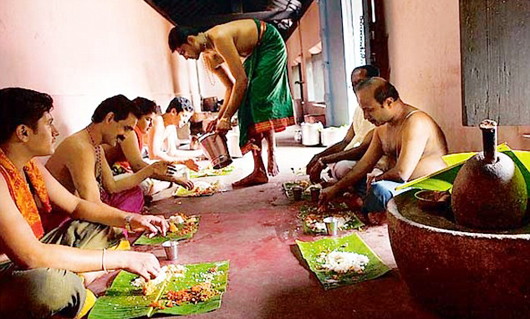
brahmin

Laying out the geographical expanse and scientific logic to the regions Madhwa Brahmins vegetarian food habits, culinary expert Malati Srinivasan and arts and crafts connoisseur Geetha Rao showcase the hitherto unknown vegetarian recipes from Udupi in their book "The Udupi Kitchen."

The authors straddle the traditional and modern and list what was once easily cooked in Udupi households - spice powders, salads and chutneys, savoury snacks, desserts - and elaborate on several recipes which are all-time favourites like Bisi Bele Hulianna, Saaru, Masal Dose and Modaka.

While Bisi Bele Hulianna is a dish of spicy red gram, rice and vegetables, Saaru is spicy red gram soup, Huggi is rice and green gram with black pepper and cumin and Modaka is dumplings with coconut and jiggery filling.

Majjige Palidya is ash gourd with coconut and cumin in sour yoghurt and Drakshi Gojju is raisins in sweet, sour and spicy gravy.

Split into 12 sections, the Udupi Kitchen, published by Westland Ltd, celebrates vegetarian food with aplomb from a town where food is religion as well as a complete mouth-watering experience.

At the core of Udupi cuisine is the use of indigenous vegetables and fruits, cereals and pulses special to the Parashurama Kshetra and traditional Brahmins ate only vegetarian fare without onion and garlic.

According to the authors, Udupi cuisine has a vast variety and is not limited to tiffins or snacks.

"As I began working on this project, I realised how vast and varied our family’s repertoire of Udupi (Madhwa) cuisine was. I wrote down 175 recipes, but have used about a 100 of them in the book," says Srinivasan.

"Writing a cook book for both Indian and non-Indian readers required that a comprehensive multi-lingual glossary be compiled. It also meant using internationally accepted terminology: 'henchu' or 'tava' became griddle, bandle or 'kadhai' became wok, 'tappele' or 'bartan' became saucepan," says Rao.

She says for some kitchen tools like 'eelgemane' and 'ogarane chamcha', which had no "internationally understood" words, substitute words like curved knife blade and tempering-ladle had to be coined.

The story of Udupi cuisine is the story of how a temple-based, Brahmanical culinary tradition got modernised and became a global phenomenon. Food is religion in Udupi.

Fourteen varieties of food are cooked daily and offered to the deity at different times of the day. The food offered to god is 'naivediya', and the food eaten by human beings is 'prasada', food that is blessed.

In Udupi, meals are served on banana leaves in a particular order. Many recipes and foods have also proven health benefits. For example, dishes made from the inner banana stem prevent kidney stones, pepper rasam helps with the lactation of new mothers, jackfruit seeds have high protein content and so on.

The authors also say that the original of the masal dose or the famous masala dosa is attributed to Udupi.

Before it was invented, plain dosa was served with potato playa, without onions, in a separate cup. With changing food tastes, the Udupi chefs began to saute the mashed potatoes with onions and spices.

"As onions were considered taboo food for orthodox Brahmins, it is said that the doses were stuffed with onion-laced playa, instead of served in a separate cup, so that the onion could be 'hidden'," the authors say.

Comments

Usha moorthy
 - 
Wednesday, 8 Jun 2016

I'm extremely pleased that I now have a book to refer to for genuine udupi food!!! Thanks to the authors for painstakingly bringing together these wonderful recipes!!;

Add new comment

  • Coastaldigest.com reserves the right to delete or block any comments.
  • Coastaldigset.com is not responsible for its readers’ comments.
  • Comments that are abusive, incendiary or irrelevant are strictly prohibited.
  • Please use a genuine email ID and provide your name to avoid reject.
News Network
February 27,2020

Benagluru, Feb 27: The sudden hike in bus fares by the state-run transport corporation has triggered a public outrage and protests by the opposition Congress and the Janata Dal-Secular (JD-S) in Karnataka.

Terming the hike as anti-people and inflationary, the Congress urged the ruling BJP to withdraw it forthwith and spare the commuters from the additional burden.

"KSRTC and its affiliates should not further burden the people when the cost of living has gone up and its bus service is used by the majority in the absence of trains in many regions of the state," said Ravi Gowda of the Congress.

In a surprise announcement on Tuesday night, the Karnataka State Road Transport Corporation (KSRTC) and its two affiliates -- North Eastern Karnataka Road Transport Corporation (NEKSRTC )and North Western Karnataka Road Transport Corporation (NWKSRTC) -- increased bus fares by 12% with effect from Wednesday, drawing the ire of commuters and opposition parties alike.

Condemning the fare hike, JD(S) leader and former Chief Minister H D Kumaraswamy urged the KSRTC to roll back the revised fares and give relief to the common man reeling under price rise due to CGST, SGST and food inflation.

"The BJP government has deliberately increased the bus fare ahead of the state budget for 2020-21 fiscal on March 2, catching people unawares. Though student passes have been spared from the hike, regular passengers are forced to pay Rs 5-32 more instead of getting better efficiency, management and productivity," Kumaraswamy said in a statement in Bengaluru.

It's an additional burden on us, said Bengaluru resident K. Venkatesh, while adding,

"The 12 percent hike in bus fares by the KSRTC and its north-east and north-west affiliates from Wednesday will hit passengers hard and make commuting costly.”

"The fare hike will negate the state government's efforts to encourage public transport service and force passengers to travel on the train, which is cheaper, faster and safer," asserted Venugopal Gupta, a cloth merchant in the city.

Justifying the hike, KSRTC Managing Director Shivayogi Kalasad told media that the hike was inevitable due to the steady increase in diesel price, dearness allowance in staff salary and overall cost of operations.

"Since the last fare revision came in May 2014, the operational cost has gone up substantially due to Rs 11.27 per litre hike in diesel price, increase in DA to employees and repairing, maintenance and fleet management costs," Kalasad said.

The financial burden due to fuel price hike is Rs 261 crore, DA Rs 341 crore and operational cost Rs 601 crore per annum for KSRTC alone, he said.

"For the benefit of rural passengers, fares have been reduced to Rs 5 from Rs 7 for the first 3 km. There is no increase in fares for the first 12 km and up to first 6 km in express service," Kalasad added.

Comments

Add new comment

  • Coastaldigest.com reserves the right to delete or block any comments.
  • Coastaldigset.com is not responsible for its readers’ comments.
  • Comments that are abusive, incendiary or irrelevant are strictly prohibited.
  • Please use a genuine email ID and provide your name to avoid reject.
News Network
January 11,2020

Bengaluru, Jan 11: Scholar and writer M Chidanadamurthy passed away at a private hospital here on Saturday.

He was 88 and is survived by wife, son and daughter.
He was a well-known scholar in Karnataka specialising in the history of Kannada language and ancient Karnataka.

He was also known for his campaign to conserve the monuments Hampi and to secure classical language status to Kannada Language. Murthy has also articulated that uniform civil code and an anti-conversion law must be enacted by the Government in India.

Murthy was the head of the department of Kannada Bangalore University. He was also associated with Kannada Shakti Kendra. As a historian most of Murthy's work has focused on scientific study of the Kannada Inscriptions.

He has attempted to contextualise inscriptions in their socio cultural setup. He has produced many books on the history of Kannada language and Karnataka. He has guided many research students.

Murthy was recipient of Rajayothsava, Sathiya Academy Award , Papama award and Alava’s Nudisiri award.
His mortal remains were kept at his residence for his fellow mates and relatives.

Several dignatories like B S Yediyurappa, S L Bhyrappa, S Suresh Kumar, V Somanna expressed their condolences to the veteran's death.

The final rituals will be held on Sunday with state honour.

Comments

Add new comment

  • Coastaldigest.com reserves the right to delete or block any comments.
  • Coastaldigset.com is not responsible for its readers’ comments.
  • Comments that are abusive, incendiary or irrelevant are strictly prohibited.
  • Please use a genuine email ID and provide your name to avoid reject.
Agencies
February 20,2020

New Delhi, Feb 20: Microsoft has begun testing its free open-source software called "ElectionGuard" in a small Wisconsin town in the US that aims to make voting more secure, verifiable and efficient.

"ElectionGuard" will enable end-to-end verification of elections, open results to third-party organisations for secure validation, and allow individual voters to confirm their votes were correctly counted.

It enables government entities, news outlets, human rights organisations or anyone else to build additional verifiers that independently can certify election results have been accurately counted and have not been altered, according to the company.

The software would create a paper trail and assure voters their votes were properly tallied.

"On Tuesday, Fulton residents are using the technology while choosing who will join the local school board and hold a seat on Wisconsin's state Supreme Court," reports CNBC.

With the test, the company aims to see if voters like the experience and make sure everything works fine.

In May last year, Microsoft CEO Satya Nadella announced "ElectionGuard".

According to Tom Burt, Corporate Vice President, Customer Security and Trust, voting system manufacturers will be free to build ElectionGuard into their systems in a variety of ways.

"These are exciting steps that enable individual voters to confirm their vote was properly counted, and assures those voters using an ElectionGuard system of the most secure and trustworthy vote in the history of the US," Burt said in a recent blog post.

"ElectionGuard" is not intended to replace paper ballots but rather to supplement and improve systems that rely on them, and it is not designed to support internet voting.

The software provides each voter a tracker with a unique code that can be used to follow an encrypted version of the vote through the entire election process via a web portal provided by election authorities.

During the process of vote-casting, voters have an optional step that allows them to confirm that their trackers and encrypted votes accurately reflect their selections.

But once a vote is cast, neither the tracker nor any data provided through the web portal can be used to reveal the contents of the vote.

After the election is complete, the tracker codes can be used by voters to confirm that their votes were not altered or tampered with and that they were properly counted, said Microsoft.

On the security front, "ElectionGuard" uses something called homomorphic encryption - which enables mathematical procedures "like counting - to be done with fully encrypted data".

Comments

Add new comment

  • Coastaldigest.com reserves the right to delete or block any comments.
  • Coastaldigset.com is not responsible for its readers’ comments.
  • Comments that are abusive, incendiary or irrelevant are strictly prohibited.
  • Please use a genuine email ID and provide your name to avoid reject.