



The secrets of Udupi's Madhwa Brahmin kitchen leaked!

[email protected] (News Network | KM Acharya)
August 26, 2015

Udupi, Aug 26: What connects Bisi Bele Hulianna, Saaru, Modaka, Huggi, Majjige Palidya and Drakshi Gojju? These are some of the famed dishes of the Madhwa Brahmin community of Udupi, a coastal town in Karnataka where the Krishna temple acts as a pivot in people's lives.
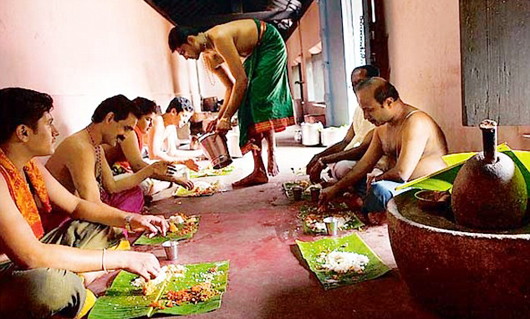
brahmin

Laying out the geographical expanse and scientific logic to the regions Madhwa Brahmins vegetarian food habits, culinary expert Malati Srinivasan and arts and crafts connoisseur Geetha Rao showcase the hitherto unknown vegetarian recipes from Udupi in their book "The Udupi Kitchen."

The authors straddle the traditional and modern and list what was once easily cooked in Udupi households - spice powders, salads and chutneys, savoury snacks, desserts - and elaborate on several recipes which are all-time favourites like Bisi Bele Hulianna, Saaru, Masal Dose and Modaka.

While Bisi Bele Hulianna is a dish of spicy red gram, rice and vegetables, Saaru is spicy red gram soup, Huggi is rice and green gram with black pepper and cumin and Modaka is dumplings with coconut and jiggery filling.

Majjige Palidya is ash gourd with coconut and cumin in sour yoghurt and Drakshi Gojju is raisins in sweet, sour and spicy gravy.

Split into 12 sections, the Udupi Kitchen, published by Westland Ltd, celebrates vegetarian food with aplomb from a town where food is religion as well as a complete mouth-watering experience.

At the core of Udupi cuisine is the use of indigenous vegetables and fruits, cereals and pulses special to the Parashurama Kshetra and traditional Brahmins ate only vegetarian fare without onion and garlic.

According to the authors, Udupi cuisine has a vast variety and is not limited to tiffins or snacks.

"As I began working on this project, I realised how vast and varied our family’s repertoire of Udupi (Madhwa) cuisine was. I wrote down 175 recipes, but have used about a 100 of them in the book," says Srinivasan.

"Writing a cook book for both Indian and non-Indian readers required that a comprehensive multi-lingual glossary be compiled. It also meant using internationally accepted terminology: 'henchu' or 'tava' became griddle, bandle or 'kadhai' became wok, 'tappele' or 'bartan' became saucepan," says Rao.

She says for some kitchen tools like 'eelgemane' and 'ogarane chamcha', which had no "internationally understood" words, substitute words like curved knife blade and tempering-ladle had to be coined.

The story of Udupi cuisine is the story of how a temple-based, Brahmanical culinary tradition got modernised and became a global phenomenon. Food is religion in Udupi.

Fourteen varieties of food are cooked daily and offered to the deity at different times of the day. The food offered to god is 'naivediya', and the food eaten by human beings is 'prasada', food that is blessed.

In Udupi, meals are served on banana leaves in a particular order. Many recipes and foods have also proven health benefits. For example, dishes made from the inner banana stem prevent kidney stones, pepper rasam helps with the lactation of new mothers, jackfruit seeds have high protein content and so on.

The authors also say that the original of the masal dose or the famous masala dosa is attributed to Udupi.

Before it was invented, plain dosa was served with potato playa, without onions, in a separate cup. With changing food tastes, the Udupi chefs began to saute the mashed potatoes with onions and spices.

"As onions were considered taboo food for orthodox Brahmins, it is said that the doses were stuffed with onion-laced playa, instead of served in a separate cup, so that the onion could be 'hidden'," the authors say.

Comments

Usha moorthy
 - 
Wednesday, 8 Jun 2016

I'm extremely pleased that I now have a book to refer to for genuine udupi food!!! Thanks to the authors for painstakingly bringing together these wonderful recipes!!;

Add new comment

  • Coastaldigest.com reserves the right to delete or block any comments.
  • Coastaldigset.com is not responsible for its readers’ comments.
  • Comments that are abusive, incendiary or irrelevant are strictly prohibited.
  • Please use a genuine email ID and provide your name to avoid reject.
News Network
May 12,2020

May 12: Children suffering from non-respiratory disease symptoms like diarrhea and fever, or those with a history of exposure to the novel coronavirus, should be suspected of having COVID-19, a new study says.

According to the research, published in the journal Frontiers in Pediatrics, gastrointestinal symptoms first suffered by some children hints at potential infection with SARS-CoV-2 through the digestive tract.

"This case series is the first report to describe the clinical features of COVID-19 with non-respiratory symptoms as the first manifestation in children," the scientists from Tongji Hospital in China wrote in the study.

They explained that the gastrointestinal symptoms could be arising since the type of receptors in lung cells targeted by the virus can also be found in the intestines.

Most children are only mildly affected by COVID-19, and the few severe cases often have underlying health issues, the researchers said.

"It is easy to miss its diagnosis in the early stage, when a child has non-respiratory symptoms, or suffers from another illness," said study co-author Wenbin Li, who works at the Department of Pediatrics, Tongji Hospital.

"Based on our experience of dealing with COVID-19, in regions where this virus is epidemic, children suffering from digestive tract symptoms, especially with fever and/or a history of exposure to this disease, should be suspected of being infected with this virus," Li said.

In the study, the scientists described the clinical features of children admitted to hospital with non-respiratory symptoms, who were subsequently diagnosed with pneumonia and COVID-19.

"These children were seeking medical advice in the emergency department for unrelated problems, for example, one had a kidney stone, another a head trauma," Li said.

The study noted that all the children had pneumonia, which was confirmed by chest X-ray scan before or soon after admission.

These children were then confirmed to have COVID-19.

While their COVID-19 symptoms were initially mild or relatively hidden before their hospital admission, four out of the five cases had digestive tract symptoms as the first manifestation of this disease, the researchers said.

Li hopes that doctors will use the findings to quickly diagnose and isolate patients with similar symptoms, which may aid early treatment and reduce transmission.

According to the researchers, the children's gastrointestinal symptoms, which have also been recorded in adult patients, could be an additional route of infection.

"The gastrointestinal symptoms experienced by these children may be related to the distribution of receptors and the transmission pathway associated with COVID-19 infection in humans," Li explained.

Since the virus infects people via the ACE2 receptor, which can be found in certain cells in the lungs as well as the intestines, COVID-19 might infect patients not only through the respiratory tract in the form of air droplets, but also through the digestive tract by contact or fecal-oral transmission, the study noted.

While COVID-19 tests can occasionally produce false positive readings, Li said all the five children assessed in the study were infected with the disease.

However, he cautioned that more research is needed to confirm their findings.

"We report five cases of COVID-19 in children showing non-respiratory symptoms as the first manifestation after admission to hospital. The incidence and clinical features of similar cases needs further study in more patients," he said.

Comments

Add new comment

  • Coastaldigest.com reserves the right to delete or block any comments.
  • Coastaldigset.com is not responsible for its readers’ comments.
  • Comments that are abusive, incendiary or irrelevant are strictly prohibited.
  • Please use a genuine email ID and provide your name to avoid reject.
News Network
March 28,2020

Gadag, Mar 28: At a time when the adminsitration is insisting on social diatancing due to COVID-19 outbreak, scores of people gathered in large numbers at an Agricultural Produce Market Committee (APMC) market in Gadag district to buy essential commodities.

Both men and women could be seen standing in large groups near the vendors to buy fruits and vegetables. Some of the customers were also heard bargaining with the sellers in the morning today.

A couple of days back, Prime Minister Narendra Modi emphasised that social distancing is the only way to counter the spread of COVID-19, saying the virus does not discriminate and it can infect anyone.

Interacting with the people of Varanasi through video conferencing, the Prime Minister had stated that some people, despite being empowered with knowledge, are not pay heed to warning which is unfortunate.

He said the 'Mahabharata' war was won in 18 days and the war against coronavirus will take 21 days and the aim is to win it.

According to the Union Health Ministry, there are 873 confirmed cases of COVID-19 in India.

Comments

Add new comment

  • Coastaldigest.com reserves the right to delete or block any comments.
  • Coastaldigset.com is not responsible for its readers’ comments.
  • Comments that are abusive, incendiary or irrelevant are strictly prohibited.
  • Please use a genuine email ID and provide your name to avoid reject.
News Network
June 6,2020

New Delhi, Jun 6: With the coronavirus pandemic showing no signs of abating, it seems unlikely that Muslims from India will be able to undertake the Hajj pilgrimage this year.

However, the government will take a final decision on the matter only after Saudi Arabia makes its position on hosting the pilgrimage clear.

A circular issued by the Hajj Committee of India on Friday said only a few weeks are left for the preparatory work in India for Hajj 2020, yet the Saudi authorities have not communicated any further development regarding the pilgrimage.

"In view of the several inquiries received and concerns expressed over uncertainty over Hajj 2020, it has been decided by the Hajj Committee of India that, those pilgrims who desire to cancel their Hajj journey this year, their 100 per cent amount paid so far will be refunded without any deductions," the circular issued by Hajj Committee of India CEO Maqsood Ahmed Khan said.

"Coronavirus cases are increasing in Saudi Arabia and two lakh people have to go from here. We had made preparations, but now there is very little time left. We are waiting for an official word from Saudi Arabia," a top source said.

In response to a question, the source said, "This time, it is unlikely that people will be able to undertake Hajj from India."

Uncertainty has been looming large over this year's Hajj in the wake of the coronavirus pandemic and though Saudi Arabia has not made a decision on whether the annual pilgrimage will be held or not, it did ask Muslims to delay their bookings till there is more clarity.

The bilateral annual Hajj 2020 agreement between India and Saudi Arabia was signed last December. In 2020, a total of 2 lakh Indian Muslims were expected to perform Hajj.

Over 95,000 COVID-19 cases and more than 600 deaths have been reported in Saudi Arabia due to the coronavirus pandemic, according to Johns Hopkins University data.

Some countries have decided not to send their people for Hajj this time. The most prominent among these is Indonesia, the country with the largest Muslim population in the world.

The Hajj 2020 is proposed in the period between late July and early August.

The Hajj is one of the five pillars of Islam which every Muslim is required to complete at least once in their lifetime if they are healthy enough and have the means to do so.

Comments

Add new comment

  • Coastaldigest.com reserves the right to delete or block any comments.
  • Coastaldigset.com is not responsible for its readers’ comments.
  • Comments that are abusive, incendiary or irrelevant are strictly prohibited.
  • Please use a genuine email ID and provide your name to avoid reject.