



The secrets of Udupi's Madhwa Brahmin kitchen leaked!

[email protected] (News Network | KM Acharya)
August 26, 2015

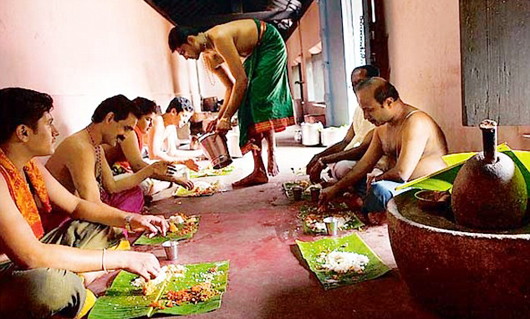
Udupi, Aug 26: What connects Bisi Bele Hulianna, Saaru, Modaka, Huggi, Majjige Palidya and Drakshi Gojju? These are some of the famed dishes of the Madhwa Brahmin community of Udupi, a coastal town in Karnataka where the Krishna temple acts as a pivot in people's lives.
brahmin

Laying out the geographical expanse and scientific logic to the regions Madhwa Brahmins vegetarian food habits, culinary expert Malati Srinivasan and arts and crafts connoisseur Geetha Rao showcase the hitherto unknown vegetarian recipes from Udupi in their book "The Udupi Kitchen."

The authors straddle the traditional and modern and list what was once easily cooked in Udupi households - spice powders, salads and chutneys, savoury snacks, desserts - and elaborate on several recipes which are all-time favourites like Bisi Bele Hulianna, Saaru, Masal Dose and Modaka.

While Bisi Bele Hulianna is a dish of spicy red gram, rice and vegetables, Saaru is spicy red gram soup, Huggi is rice and green gram with black pepper and cumin and Modaka is dumplings with coconut and jiggery filling.

Majjige Palidya is ash gourd with coconut and cumin in sour yoghurt and Drakshi Gojju is raisins in sweet, sour and spicy gravy.

Split into 12 sections, the Udupi Kitchen, published by Westland Ltd, celebrates vegetarian food with aplomb from a town where food is religion as well as a complete mouth-watering experience.

At the core of Udupi cuisine is the use of indigenous vegetables and fruits, cereals and pulses special to the Parashurama Kshetra and traditional Brahmins ate only vegetarian fare without onion and garlic.

According to the authors, Udupi cuisine has a vast variety and is not limited to tiffins or snacks.

"As I began working on this project, I realised how vast and varied our family’s repertoire of Udupi (Madhwa) cuisine was. I wrote down 175 recipes, but have used about a 100 of them in the book," says Srinivasan.

"Writing a cook book for both Indian and non-Indian readers required that a comprehensive multi-lingual glossary be compiled. It also meant using internationally accepted terminology: 'henchu' or 'tava' became griddle, bandle or 'kadhai' became wok, 'tappele' or 'bartan' became saucepan," says Rao.

She says for some kitchen tools like 'eelgemane' and 'ogarane chamcha', which had no "internationally understood" words, substitute words like curved knife blade and tempering-ladle had to be coined.

The story of Udupi cuisine is the story of how a temple-based, Brahmanical culinary tradition got modernised and became a global phenomenon. Food is religion in Udupi.

Fourteen varieties of food are cooked daily and offered to the deity at different times of the day. The food offered to god is 'naivediya', and the food eaten by human beings is 'prasada', food that is blessed.

In Udupi, meals are served on banana leaves in a particular order. Many recipes and foods have also proven health benefits. For example, dishes made from the inner banana stem prevent kidney stones, pepper rasam helps with the lactation of new mothers, jackfruit seeds have high protein content and so on.

The authors also say that the original of the masal dose or the famous masala dosa is attributed to Udupi.

Before it was invented, plain dosa was served with potato playa, without onions, in a separate cup. With changing food tastes, the Udupi chefs began to saute the mashed potatoes with onions and spices.

"As onions were considered taboo food for orthodox Brahmins, it is said that the doses were stuffed with onion-laced playa, instead of served in a separate cup, so that the onion could be 'hidden'," the authors say.

Comments

Usha moorthy
 - 
Wednesday, 8 Jun 2016

I'm extremely pleased that I now have a book to refer to for genuine udupi food!!! Thanks to the authors for painstakingly bringing together these wonderful recipes!!;

Add new comment

  • Coastaldigest.com reserves the right to delete or block any comments.
  • Coastaldigset.com is not responsible for its readers’ comments.
  • Comments that are abusive, incendiary or irrelevant are strictly prohibited.
  • Please use a genuine email ID and provide your name to avoid reject.
News Network
April 9,2020

New Delhi, Apr 9: The Delhi Police has traced Tablighi Jamaat leader Maulana Saad Kandhalvi, who has been on the run after an FIR was registered against him for organising a religious gathering last month despite restrictions to combat the coronavirus, sources said on Wednesday.

The cleric has been traced to Zakir Nagar in southeast Delhi, sources said.

His lawyer Tauseef Khan, however, said Saad is under self-quarantine and will join investigation after his quarantine period is over.

On March 31, Delhi Police's Crime Branch lodged an FIR against seven people, including the cleric, on a complaint by Station House Officer Nizamuddin for holding the congregation here allegedly in violation of the orders against large gathering and not maintaining social distancing to contain the spread of coronavirus.

A day later, the Delhi Police's Crime Branch wrote to Saad and others, seeking the details under Section 91 of the Code of Criminal Procedure. A second notice was also issued to him this week.

"Saad is currently under self-quarantine and will join investigation once the period of 14 days gets over," his advocate, Tauseef Khan, told PTI.

Saad's quarantine is expected to end next week.

His lawyer said a reply to the second notice will be given soon.

In an audio message last week, Saad said he was exercising self-quarantine after several hundreds who visited the Tablighi Jamaat's Nizamudddin markaz tested positive for coronavirus.

Visited by thousands last month, the Nizamudddin centre also turned out to be a hotspot for spread of coronavirus not only in national capital and country.

According to the FIR, the Delhi Police contacted the centre on March 21 and reminded them of the government order that prohibited any political or religious gathering of more than 50 people.

However, no one paid any heed to the police's direction, it said. Moreover, an audio recording purportedly of Saad was found in circulation on WhatsApp on March 21, in which he was heard asking his followers to defy the lockdown and social distancing and to attend the religious gathering of the Markaz.

On March 24, the government ordered 21-day nationwide lockdown and restricted any social, political or religious gathering.

The same day a meeting was held at Hazarat Nizamuddin police station between SHO and officer bearers of the centre.

The meeting was attended by Saad, Mohammad Ashraf, Mohammad Salman, Yunus, Mursaleen Saifi, Jishan and Mufti Shehzad and they were informed about lockdown orders.

So far, several hundred cases of COVID-19 cases across the country have been found to be linked to the Tablighi Jamaat congregation held in Delhi last month.

More than 25,500 Tablighi members and their contacts have been quarantined in the country after the Centre and the state governments conducted a "mega operation" to identify them.

At least 9,000 people participated in the religious congregation in Nizamuddin. Later, many of the attendees travelled to various parts of the country.

Comments

Add new comment

  • Coastaldigest.com reserves the right to delete or block any comments.
  • Coastaldigset.com is not responsible for its readers’ comments.
  • Comments that are abusive, incendiary or irrelevant are strictly prohibited.
  • Please use a genuine email ID and provide your name to avoid reject.
News Network
May 25,2020

The government of India has added 141 more flights to West Asian countries for the second phase of Vande Bharat Mission, its massive repatriation programme for citizens stranded overseas because of Covid-19-related travel restrictions.

The second phase was to end on May 22. However, External Affairs Ministry Spokesperson Anurag Srivastava said the ongoing phase will last till June 13 and that India is looking at making Frankfurt a hub for the mission.

With these new flights, more than half of them to the United Arab Emirates, the total number of flights in the second phase of the programme have gone up to more than 400, people familiar with developments said on condition of anonymity.

The flights were added due to increased demand from citizens stranded in West Asian countries and the availability of adequate quarantine facilities in states for the returning Indians, the people said. As with all the flights operated so far under Vande Bharat Mission, priority will be given in the second phase to Indian nationals with compelling reasons for returning to the country, they added.

The additional flights are from the UAE (81 flights), Oman and Saudi Arabia (15 flights each), Kuwait (14 flights), Qatar (11 flights) and Bahrain (five flights).

A majority of the flights are bound for Kerala (84 flights), while the other destinations are Delhi (10 flights), Tamil Nadu (nine flights), Telangana (six flights) Gujarat and Jammu and Kashmir (five flights each), Bihar, Rajasthan and Uttar Pradesh (four flights each), Punjab (three flights), Odisha and West Bengal (two flights each), Chandigarh, Karnataka and Goa (one flight each).

The other 260-odd flights being operated during the second phase of Vande Bharat Mission are from Armenia, Australia, Bangladesh, Belarus, Belgium, Canada, Egypt, Finland, France, Georgia, Germany, Indonesia, Ireland, Israel, Italy, Japan, Jordan, Kazakhstan, Kenya, Kyrgyzstan, Malaysia, Mauritius, Myanmar, Nepal, the Netherlands, New Zealand, Nigeria, Oman, the Philippines, Russia, Singapore, South Korea, Spain, Sri Lanka, Sweden, Tajikistan, the UK, Ukraine and the US.

The second phase of the repatriation programme began on May 16 and will continue till June 13, with all the flights being operated by state-run Air India and its subsidiary Air India Express. Private airlines are likely to be included in the third phase.

As of Thursday, a total of 23,475 Indians have been repatriated under Vande Bharat Mission. The second phase had included new destinations such as Istanbul, Ho Chi Minh City and Lagos, and had increased flights to the US and Europe.

More than 259,000 Indians in 98 countries across the world have registered to return under Vande Bharat Mission. Most of them are workers (28%), students (25%), professionals (14.5%), and short-term visa holders such as tourists (7.6%). Fishermen, deportees and Indian nationals who benefited from visa amnesties have also registered.

Comments

Uwaiz
 - 
Tuesday, 26 May 2020

No flights from oman to manglore nor to Banglore 

Add new comment

  • Coastaldigest.com reserves the right to delete or block any comments.
  • Coastaldigset.com is not responsible for its readers’ comments.
  • Comments that are abusive, incendiary or irrelevant are strictly prohibited.
  • Please use a genuine email ID and provide your name to avoid reject.
Agencies
May 8,2020

Washington D.C., May 8: The prime time for brain development in a child's life is the first year, where the infant spends most of the time asleep. It is the time when neural connections form and sensory memories are encoded.

However, when sleep is disrupted, as occurs more often among children with autism, brain development may be affected, too.

New research led by the University of Washington finds that sleep problems in a baby's first 12 months may not only precede an autism diagnosis but also may be associated with altered growth trajectory in a key part of the brain, the hippocampus.

The study, which was published in the American Journal of Psychiatry, researchers report that in a sample of more than 400 taken of 6- to 12-month-old infants, those who were later diagnosed with autism were more likely to have had difficulty falling asleep.

It also states that this sleep difficulty was associated with altered growth trajectories in the hippocampus.

"The hippocampus is critical for learning and memory, and changes in the size of the hippocampus have been associated with poor sleep in adults and older children.

As many as 80 per cent of the children with autism spectrum disorder have sleep problems," said Annette Estes, director of the UW Autism Center and senior author of the study.

"In our clinical experience, parents have a lot of concerns about their children's sleep, and in our work on early autism intervention, we observed that sleep problems were holding children and families back," added Estes, who is also a UW professor of speech and hearing sciences.

"It could be that altered sleep is part-and-parcel of autism for some children. One clue is that behavioural interventions to improve sleep don't work for all children with autism, even when their parents are doing everything just right. This suggests that there may be a biological component to sleep problems for some children with autism," said Estes.

To consider links among sleep, brain development, and autism, researchers at the IBIS Network looked at MRI scans of 432 infants, surveyed parents about sleep patterns, and measured cognitive functioning using a standardized assessment.

At the outset of the study, infants were classified according to their risk for developing autism: Those who were at higher risk of developing autism -- about two-thirds of the study sample -- had an older sibling who had already been diagnosed.

Infant siblings of children with autism have a 20 per cent chance of developing autism spectrum disorder -- a much higher risk than children in the general population.

In the current study, 127 of the 432 infants were identified as "low risk" at the time the MRI scans were taken because they had no family history of autism.

They later evaluated all the participants at 24 months of age to determine whether they had developed autism. Of the roughly 300 children originally considered "high familial risk," 71 were diagnosed with autism spectrum disorder at that age.

Problems with sleep were more common among the infants later diagnosed with an autism spectrum disorder, as were larger hippocampi. No other subcortical brain structures were affected, including the amygdala, which is responsible for certain emotions and aspects of memory, or the thalamus, a signal transmitter from the spinal cord to the cerebral cortex.

The authors note that while parents reported more sleep difficulties among infants who developed autism compared to those who did not, the differences were very subtle and only observed when looking at group averages across hundreds of infants.

Sleep patterns in the first years of life change rapidly as infants transition from sleeping around the clock to a more adult-like sleep/wake cycle. Until further research is completed, Estes said, it is not possible to interpret challenges with sleep as an early sign of increased risk for autism.

Comments

Add new comment

  • Coastaldigest.com reserves the right to delete or block any comments.
  • Coastaldigset.com is not responsible for its readers’ comments.
  • Comments that are abusive, incendiary or irrelevant are strictly prohibited.
  • Please use a genuine email ID and provide your name to avoid reject.