


The secrets of Udupi's Madhwa Brahmin kitchen leaked!

[email protected] (News Network | KM Acharya)
August 26, 2015

Udupi, Aug 26: What connects Bisi Bele Hulianna, Saaru, Modaka, Huggi, Majjige Palidya and Drakshi Gojju? These are some of the famed dishes of the Madhwa Brahmin community of Udupi, a coastal town in Karnataka where the Krishna temple acts as a pivot in people's lives.
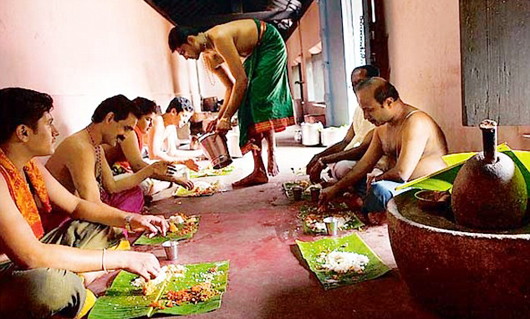
brahmin

Laying out the geographical expanse and scientific logic to the regions Madhwa Brahmins vegetarian food habits, culinary expert Malati Srinivasan and arts and crafts connoisseur Geetha Rao showcase the hitherto unknown vegetarian recipes from Udupi in their book "The Udupi Kitchen."

The authors straddle the traditional and modern and list what was once easily cooked in Udupi households - spice powders, salads and chutneys, savoury snacks, desserts - and elaborate on several recipes which are all-time favourites like Bisi Bele Hulianna, Saaru, Masal Dose and Modaka.

While Bisi Bele Hulianna is a dish of spicy red gram, rice and vegetables, Saaru is spicy red gram soup, Huggi is rice and green gram with black pepper and cumin and Modaka is dumplings with coconut and jiggery filling.

Majjige Palidya is ash gourd with coconut and cumin in sour yoghurt and Drakshi Gojju is raisins in sweet, sour and spicy gravy.

Split into 12 sections, the Udupi Kitchen, published by Westland Ltd, celebrates vegetarian food with aplomb from a town where food is religion as well as a complete mouth-watering experience.

At the core of Udupi cuisine is the use of indigenous vegetables and fruits, cereals and pulses special to the Parashurama Kshetra and traditional Brahmins ate only vegetarian fare without onion and garlic.

According to the authors, Udupi cuisine has a vast variety and is not limited to tiffins or snacks.

"As I began working on this project, I realised how vast and varied our family’s repertoire of Udupi (Madhwa) cuisine was. I wrote down 175 recipes, but have used about a 100 of them in the book," says Srinivasan.

"Writing a cook book for both Indian and non-Indian readers required that a comprehensive multi-lingual glossary be compiled. It also meant using internationally accepted terminology: 'henchu' or 'tava' became griddle, bandle or 'kadhai' became wok, 'tappele' or 'bartan' became saucepan," says Rao.

She says for some kitchen tools like 'eelgemane' and 'ogarane chamcha', which had no "internationally understood" words, substitute words like curved knife blade and tempering-ladle had to be coined.

The story of Udupi cuisine is the story of how a temple-based, Brahmanical culinary tradition got modernised and became a global phenomenon. Food is religion in Udupi.

Fourteen varieties of food are cooked daily and offered to the deity at different times of the day. The food offered to god is 'naivediya', and the food eaten by human beings is 'prasada', food that is blessed.

In Udupi, meals are served on banana leaves in a particular order. Many recipes and foods have also proven health benefits. For example, dishes made from the inner banana stem prevent kidney stones, pepper rasam helps with the lactation of new mothers, jackfruit seeds have high protein content and so on.

The authors also say that the original of the masal dose or the famous masala dosa is attributed to Udupi.

Before it was invented, plain dosa was served with potato playa, without onions, in a separate cup. With changing food tastes, the Udupi chefs began to saute the mashed potatoes with onions and spices.

"As onions were considered taboo food for orthodox Brahmins, it is said that the doses were stuffed with onion-laced playa, instead of served in a separate cup, so that the onion could be 'hidden'," the authors say.

Comments

Usha moorthy
 - 
Wednesday, 8 Jun 2016

I'm extremely pleased that I now have a book to refer to for genuine udupi food!!! Thanks to the authors for painstakingly bringing together these wonderful recipes!!;

Add new comment

  • Coastaldigest.com reserves the right to delete or block any comments.
  • Coastaldigset.com is not responsible for its readers’ comments.
  • Comments that are abusive, incendiary or irrelevant are strictly prohibited.
  • Please use a genuine email ID and provide your name to avoid reject.
Media Release
May 6,2020

Mangaluru, May 6: The Kanara Chamber of Commerce and Industry has urged the government to consider erstwhile undivided Dakshina Kannada (now DK & Udupi) as one unit for the purpose of movement of people. KCCI president Isaac Vas has written a letter to Karnataka chief secretary T M Vijay Bhaskar in this regard. 

Mr Vas said: Even though the erstwhile Dakshina Kannada district was bifurcated in 1997 for administration purposes, the two districts are actually an urban agglomeration with most of the population residing in suburbs/towns. Office Staff, technical crew and labour of many industries reside in either district and commute daily for work within an efficient transport system.

The present restriction on Inter-district movement in view of the Lockdown is hindering the kick starting of industries and commerce. Workers are deprived of their livelihood and Industry and business owners are finding it challenging to move forward. To add to this, the migrant labour is moving back to their native places further aggravating the situation. Many Industries and Commercial establishments have requested us to take up this matter with the government, he said.

“Hence, we kindly request you to consider these two districts as one geographical area for the movement of people and private vehicles,” he said adding that this would facilitate movement of people for employment and business in either districts of Dakshina Kannada & Udupi.

He pointed out that Bangalore Rural, Bangalore Urban, Ramanagara, Chikkaballapur and Kolar are considered as a single unit as per your order No. RD158/TNR 2020 dt 03/05/2020 (Clause 2(a)).

Comments

Add new comment

  • Coastaldigest.com reserves the right to delete or block any comments.
  • Coastaldigset.com is not responsible for its readers’ comments.
  • Comments that are abusive, incendiary or irrelevant are strictly prohibited.
  • Please use a genuine email ID and provide your name to avoid reject.
News Network
July 29,2020

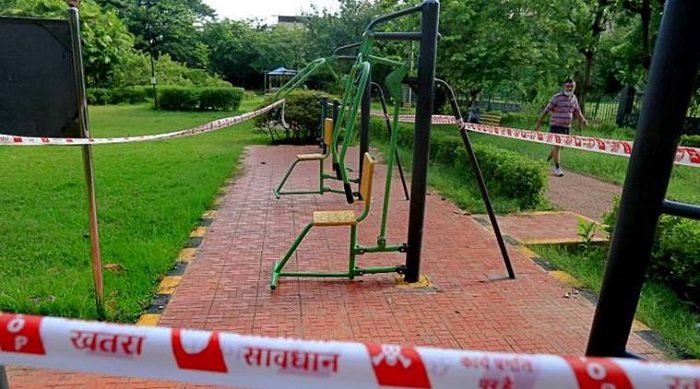
New Delhi, July 29: The government of India today announced Unlock 3.0, lifting of night curfew from August 1 and opening of yoga institutes and gymnasiums from August 5 while educational institutes will remain closed throughout August.

According to the Unlock 3.0 guidelines issued by the Ministry of Home Affairs (MHA), the lockdown in containment zones will be extended until August 30. The new guidelines will be in effect from August 1.

The operation of Metro rail and international flights will remain suspended. Cinema halls, swimming pools, entertainment parks, theatres, bars, auditoriums, assembly halls and similar places will remain shut. Large gatherings are also prohibited.

Yoga institutes and gymnasiums will start operating from August 5 for which the Ministry of Health and Family Welfare will be issuing Standard Operating Procedures. 

Independence Day celebrations will be held with social distancing norms in place.

Restrictions on the movement of individuals during the night (Night curfew between 10 PM and 5 AM) have been removed.

According to the order, states have been given powers to prohibit certain activities outside containment zones or impose such restrictions as deemed necessary based on their assessment of the situation.

"However, there shall be no restriction on inter-state and intra-state movement of persons and goods. No separate permission/approval/e-permit will be required for such movements," the order said. 

In the previous two Unlock guidelines, the government had substantially opened various activities.

Comments

Add new comment

  • Coastaldigest.com reserves the right to delete or block any comments.
  • Coastaldigset.com is not responsible for its readers’ comments.
  • Comments that are abusive, incendiary or irrelevant are strictly prohibited.
  • Please use a genuine email ID and provide your name to avoid reject.
News Network
July 25,2020

Dharward, Jul 25: In a shocking incident, a man reportedly killed his wife and daughter by feeding them poison and ended his life by hanging in his house. The incident took place in Dharwad on Saturday. 

The deceased have been identified as Mounesh Pattar (36), his wife Arpita (28) and their four-year-old daughter Sukruta. 

Mounesh was working in a private company in Dharwad and was depressed from the last one week fearing job loss. 

It was alleged that he might lose his job as the management decided to remove more than 40 employees due to covid -19 lockdown.

On Friday late night, he reportedly gave poison to his wife and daughter and later committed suicide by hanging self. The incident came to light on Saturday morning.

A case is registered at Sub Urban police station and further investigation is on.

Comments

Add new comment

  • Coastaldigest.com reserves the right to delete or block any comments.
  • Coastaldigset.com is not responsible for its readers’ comments.
  • Comments that are abusive, incendiary or irrelevant are strictly prohibited.
  • Please use a genuine email ID and provide your name to avoid reject.