


The secrets of Udupi's Madhwa Brahmin kitchen leaked!

[email protected] (News Network | KM Acharya)
August 26, 2015

Udupi, Aug 26: What connects Bisi Bele Hulianna, Saaru, Modaka, Huggi, Majjige Palidya and Drakshi Gojju? These are some of the famed dishes of the Madhwa Brahmin community of Udupi, a coastal town in Karnataka where the Krishna temple acts as a pivot in people's lives.
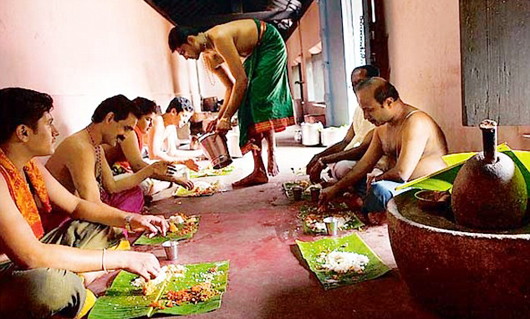
brahmin

Laying out the geographical expanse and scientific logic to the regions Madhwa Brahmins vegetarian food habits, culinary expert Malati Srinivasan and arts and crafts connoisseur Geetha Rao showcase the hitherto unknown vegetarian recipes from Udupi in their book "The Udupi Kitchen."

The authors straddle the traditional and modern and list what was once easily cooked in Udupi households - spice powders, salads and chutneys, savoury snacks, desserts - and elaborate on several recipes which are all-time favourites like Bisi Bele Hulianna, Saaru, Masal Dose and Modaka.

While Bisi Bele Hulianna is a dish of spicy red gram, rice and vegetables, Saaru is spicy red gram soup, Huggi is rice and green gram with black pepper and cumin and Modaka is dumplings with coconut and jiggery filling.

Majjige Palidya is ash gourd with coconut and cumin in sour yoghurt and Drakshi Gojju is raisins in sweet, sour and spicy gravy.

Split into 12 sections, the Udupi Kitchen, published by Westland Ltd, celebrates vegetarian food with aplomb from a town where food is religion as well as a complete mouth-watering experience.

At the core of Udupi cuisine is the use of indigenous vegetables and fruits, cereals and pulses special to the Parashurama Kshetra and traditional Brahmins ate only vegetarian fare without onion and garlic.

According to the authors, Udupi cuisine has a vast variety and is not limited to tiffins or snacks.

"As I began working on this project, I realised how vast and varied our family’s repertoire of Udupi (Madhwa) cuisine was. I wrote down 175 recipes, but have used about a 100 of them in the book," says Srinivasan.

"Writing a cook book for both Indian and non-Indian readers required that a comprehensive multi-lingual glossary be compiled. It also meant using internationally accepted terminology: 'henchu' or 'tava' became griddle, bandle or 'kadhai' became wok, 'tappele' or 'bartan' became saucepan," says Rao.

She says for some kitchen tools like 'eelgemane' and 'ogarane chamcha', which had no "internationally understood" words, substitute words like curved knife blade and tempering-ladle had to be coined.

The story of Udupi cuisine is the story of how a temple-based, Brahmanical culinary tradition got modernised and became a global phenomenon. Food is religion in Udupi.

Fourteen varieties of food are cooked daily and offered to the deity at different times of the day. The food offered to god is 'naivediya', and the food eaten by human beings is 'prasada', food that is blessed.

In Udupi, meals are served on banana leaves in a particular order. Many recipes and foods have also proven health benefits. For example, dishes made from the inner banana stem prevent kidney stones, pepper rasam helps with the lactation of new mothers, jackfruit seeds have high protein content and so on.

The authors also say that the original of the masal dose or the famous masala dosa is attributed to Udupi.

Before it was invented, plain dosa was served with potato playa, without onions, in a separate cup. With changing food tastes, the Udupi chefs began to saute the mashed potatoes with onions and spices.

"As onions were considered taboo food for orthodox Brahmins, it is said that the doses were stuffed with onion-laced playa, instead of served in a separate cup, so that the onion could be 'hidden'," the authors say.

Comments

Usha moorthy
 - 
Wednesday, 8 Jun 2016

I'm extremely pleased that I now have a book to refer to for genuine udupi food!!! Thanks to the authors for painstakingly bringing together these wonderful recipes!!;

Add new comment

  • Coastaldigest.com reserves the right to delete or block any comments.
  • Coastaldigset.com is not responsible for its readers’ comments.
  • Comments that are abusive, incendiary or irrelevant are strictly prohibited.
  • Please use a genuine email ID and provide your name to avoid reject.
News Network
April 25,2020

Mandya, Apr 25: An FIR was registered against JD(S) MLC KT Srikante Gowda, his son, and three others for protesting against coronavirus testing of journalists in Karnataka's Mandya city on Saturday.

According to the police, JD(S) MLC KT Srikante Gowda, his son Krishik Gowda, Chandrakala Aythu, Jagadish, and Raju have been named as accused in the FIR filed at Mandya West police station.

The FIR has been registered under several sections of the Indian Penal Code (IPC) and Disaster Management Act including unlawful assembly, rioting, wrongful restraint, voluntarily causing hurt, negligent act likely to spread infection of a deadly disease, etc.

Gowda, along with a group of locals, had created a ruckus objecting to the coronavirus testing of journalists at Ambedkar Bhawan in Mandya here earlier today.

Police said that a journalists' association had filed a written complaint seeking the registration of an FIR in the matter.

As per an order by the state health department, medical professionals were conducting health tests of journalists at Ambedkar Bhawan in Mandya when Gowda along with some locals started protesting, officials said.

Further actions are being taken, police said.

Comments

Add new comment

  • Coastaldigest.com reserves the right to delete or block any comments.
  • Coastaldigset.com is not responsible for its readers’ comments.
  • Comments that are abusive, incendiary or irrelevant are strictly prohibited.
  • Please use a genuine email ID and provide your name to avoid reject.
News Network
May 29,2020

Bengaluru, May 29: Seven out of ten (72 per cent) workers in Karnataka reported having lost their employment during the COVID-19-induced lockdown, according to findings of a survey by Azim Premji University, in collaboration with ten civil society organisations.

The university said in a statement it conducted "a detailed" phone survey of 5,000 workers across 12 states in the country, to gauge the impact of the COVID-19 lockdown on employment, livelihoods, and access to government relief schemes.

The survey covered self-employed, casual, and regular wage and salaried workers and it released the findings for Karnataka on Thursday.

Seventy-six per cent of urban workers and 66 per cent of rural workers lost their employment, the survey findings said.

For non-agricultural self-employed workers and wage workers, who were still employed, average weekly earnings fell by two-third.

More than four in ten salaried workers (44 per cent) saw either a reduction in their salary or received no salary during the lockdown.

Six out of ten households reported that they did not have enough money to buy even a weeks worth of essential items, according to the survey.

Eight out ten households reported a reduction in food intake, while less than three in ten vulnerable households (27 per cent) in urban Karnataka received any form of cash transfer from the government, it said.

In summary, the disruption in the Karnatakas economy and labour markets is enormous. Livelihoods have been devastated at unprecedented levels during the lockdown.

The recovery from this could be slow and very painful, the statement said.

As a response to the findings of this survey, the team which has conducted the survey suggested a universalisation of the PDS to expand its reach and implementation of expanded rations for at least the next six months.

It suggested cash transfers equal to at least Rs.7000 per month for two months, and proactive steps like expansion of MGNREGA, introduction of urban employment guarantee, and investment in universal basic services, among others.

Comments

Add new comment

  • Coastaldigest.com reserves the right to delete or block any comments.
  • Coastaldigset.com is not responsible for its readers’ comments.
  • Comments that are abusive, incendiary or irrelevant are strictly prohibited.
  • Please use a genuine email ID and provide your name to avoid reject.
Agencies
January 9,2020

New Delhi, Jan 9: A total of 10,349 people involved in the farming sector, including 5,763 farmers or cultivators, committed suicide in 2018, the National Crime Records Bureau (NCRB)'s report on 'Crime in India-2018' reveals.

The annual data was released around three months after the government released the NCRB report on 'Crime in India-2017'.

As per the latest data, of the 10,349 persons, who committed suicide in 2018, 4,586 were agricultural labourers.

The number of suicides in the farming sector in 2018 accounted for 7.7 per cent of the total suicide-victims (1,34,516) in the country, the NCRB data said.

Suicides in the country in 2018 rose to 1,34,516 from 1,29,887 in 2017.

The rate of suicides was up from 9.9 per cent in 2017 to 10.2 per cent in 2018. In 2017, a total of 10,655 farming sector-suicides were reported.

West Bengal, Bihar, Odisha, Uttarakhand, Meghalaya, Goa, Chandigarh, Daman and Diu, Delhi, Lakshadweep and Puducherry reported zero suicides of farmers or cultivators and agricultural labourers during 2018, said the report.

Comments

Add new comment

  • Coastaldigest.com reserves the right to delete or block any comments.
  • Coastaldigset.com is not responsible for its readers’ comments.
  • Comments that are abusive, incendiary or irrelevant are strictly prohibited.
  • Please use a genuine email ID and provide your name to avoid reject.