


The secrets of Udupi's Madhwa Brahmin kitchen leaked!

[email protected] (News Network | KM Acharya)
August 26, 2015

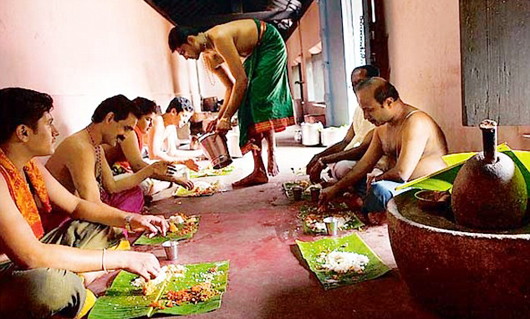
Udupi, Aug 26: What connects Bisi Bele Hulianna, Saaru, Modaka, Huggi, Majjige Palidya and Drakshi Gojju? These are some of the famed dishes of the Madhwa Brahmin community of Udupi, a coastal town in Karnataka where the Krishna temple acts as a pivot in people's lives.
brahmin

Laying out the geographical expanse and scientific logic to the regions Madhwa Brahmins vegetarian food habits, culinary expert Malati Srinivasan and arts and crafts connoisseur Geetha Rao showcase the hitherto unknown vegetarian recipes from Udupi in their book "The Udupi Kitchen."

The authors straddle the traditional and modern and list what was once easily cooked in Udupi households - spice powders, salads and chutneys, savoury snacks, desserts - and elaborate on several recipes which are all-time favourites like Bisi Bele Hulianna, Saaru, Masal Dose and Modaka.

While Bisi Bele Hulianna is a dish of spicy red gram, rice and vegetables, Saaru is spicy red gram soup, Huggi is rice and green gram with black pepper and cumin and Modaka is dumplings with coconut and jiggery filling.

Majjige Palidya is ash gourd with coconut and cumin in sour yoghurt and Drakshi Gojju is raisins in sweet, sour and spicy gravy.

Split into 12 sections, the Udupi Kitchen, published by Westland Ltd, celebrates vegetarian food with aplomb from a town where food is religion as well as a complete mouth-watering experience.

At the core of Udupi cuisine is the use of indigenous vegetables and fruits, cereals and pulses special to the Parashurama Kshetra and traditional Brahmins ate only vegetarian fare without onion and garlic.

According to the authors, Udupi cuisine has a vast variety and is not limited to tiffins or snacks.

"As I began working on this project, I realised how vast and varied our family’s repertoire of Udupi (Madhwa) cuisine was. I wrote down 175 recipes, but have used about a 100 of them in the book," says Srinivasan.

"Writing a cook book for both Indian and non-Indian readers required that a comprehensive multi-lingual glossary be compiled. It also meant using internationally accepted terminology: 'henchu' or 'tava' became griddle, bandle or 'kadhai' became wok, 'tappele' or 'bartan' became saucepan," says Rao.

She says for some kitchen tools like 'eelgemane' and 'ogarane chamcha', which had no "internationally understood" words, substitute words like curved knife blade and tempering-ladle had to be coined.

The story of Udupi cuisine is the story of how a temple-based, Brahmanical culinary tradition got modernised and became a global phenomenon. Food is religion in Udupi.

Fourteen varieties of food are cooked daily and offered to the deity at different times of the day. The food offered to god is 'naivediya', and the food eaten by human beings is 'prasada', food that is blessed.

In Udupi, meals are served on banana leaves in a particular order. Many recipes and foods have also proven health benefits. For example, dishes made from the inner banana stem prevent kidney stones, pepper rasam helps with the lactation of new mothers, jackfruit seeds have high protein content and so on.

The authors also say that the original of the masal dose or the famous masala dosa is attributed to Udupi.

Before it was invented, plain dosa was served with potato playa, without onions, in a separate cup. With changing food tastes, the Udupi chefs began to saute the mashed potatoes with onions and spices.

"As onions were considered taboo food for orthodox Brahmins, it is said that the doses were stuffed with onion-laced playa, instead of served in a separate cup, so that the onion could be 'hidden'," the authors say.

Comments

Usha moorthy
 - 
Wednesday, 8 Jun 2016

I'm extremely pleased that I now have a book to refer to for genuine udupi food!!! Thanks to the authors for painstakingly bringing together these wonderful recipes!!;

Add new comment

  • Coastaldigest.com reserves the right to delete or block any comments.
  • Coastaldigset.com is not responsible for its readers’ comments.
  • Comments that are abusive, incendiary or irrelevant are strictly prohibited.
  • Please use a genuine email ID and provide your name to avoid reject.
coastaldigest.com news network
February 5,2020

Bengaluru, Jan 5: B S Yediyurappa-led Karnataka cabinet has finally decided to resume supply of subsidised rice and wheat to students of welfare institutions and hostels including those run by religious mutts under the Dasoha Scheme’s welfare programme. The supply was stopped over two months ago.

“Cabinet has decided to continue supply of subsidised foodgrains (rice and wheat) for the benefit of 37,700 children under the Dasoha scheme in 351 welfare institutions for the next one year at the cost of Rs 18 crore,” said J C Madhuswamy, Law and Parliamentary Affairs Minister. Under this scheme, institutions that provide free accommodation and food for students are entitled to avail 10 kg rice and 5 kg wheat per student every month at subsidised rates. But following a central government directive in November, the state government had stopped supply to private institutions since December.

Hours before the cabinet meeting, Khader addressed a press conference and said, “This government is snatching away food from children by stalling the supply of foodgrains. Institutions like Suttur Mutt, Siddaganga Mutt that have worldwide fame for their service are being inconvenienced by this,” Khader said.

Finding itself in a fix, especially in a matter that involves mutts, the cabinet was quick to restore the supply. “Foodgrains were being supplied to 183 government-run institutions and 281 institutions run by private entities. As per a central government directive, supply to private institutions was stopped but the decision was made by the previous government,” Shashikala Jolle, Women and Child Development Minister, said.

Comments

Add new comment

  • Coastaldigest.com reserves the right to delete or block any comments.
  • Coastaldigset.com is not responsible for its readers’ comments.
  • Comments that are abusive, incendiary or irrelevant are strictly prohibited.
  • Please use a genuine email ID and provide your name to avoid reject.
News Network
January 29,2020

Bengaluru, Jan 29: The high court has granted bail to a 37-year-old Bangladeshi woman from the Christian community on the strength of Citizenship (Amendment) Act 2019.

The court cited Section 2 of the amended Citizenship Act 1955, according to which minorities from Pakistan, Bangladesh and Afghanistan who entered India on or before December 31, 2014 should not be treated as illegal immigrants, while granting her bail.

Allowing the petition filed by Archana Purnima Pramanik, an illegal immigrant from Bangladesh, who claims to be staying in India since 2003, justice John Michael Cunha on Monday directed her to furnish a bail bond for Rs 2 lakh to the satisfaction of the investigating officer and cooperate with the probe.

The judge observed the allegations made against her must be proved in a full-dressed trial. Archana was booked for obtaining documents such as PAN and Aadhaar cards and also fraudulently obtaining an Indian passport on March 28 last year. Based on a complaint filed by the assistant passport officer, Archana was arrested on November 7, 2019 and her bail petition was dismissed by a sessions court on December 4, 2019.

Born on March 23, 1983 at Tanore, Rajshahi district of Bangladesh, Archana came to India in 2003 to pursue a career in nursing. After obtaining a diploma in general nursing and midwifery at Ranchi in 2006, she worked in many reputed hospitals.

In 2010, she got married to Rajashekaran Krishnamurthy and the marriage was registered at Ranchi. After the wedding, she moved to Bengaluru and obtained PAN, Aadhaar and voter ID cards.

On April 1, 2019, Archana applied for a visa to Bangladesh for herself and her son. During her journey on May 20, 2019, they were detained at Kolkata airport and released later. However, the regional passport office issued a notice revoking Archana’s passport and she was arrested by RT Nagar police on November 7, 2019.

Comments

Add new comment

  • Coastaldigest.com reserves the right to delete or block any comments.
  • Coastaldigset.com is not responsible for its readers’ comments.
  • Comments that are abusive, incendiary or irrelevant are strictly prohibited.
  • Please use a genuine email ID and provide your name to avoid reject.
News Network
February 29,2020

Mysuru, Feb 29: More than 7,000 industrialists and entrepreneurs have left the country due to a deficit of trust, and incidents like the violence that rocked northeast Delhi will only affect the economy further, Sri Sri Ravi Shankar, founder of Art of Living Foundation, said on Friday.

Sri Sri was speaking at a corporate wellness conference on the theme, 'Wellness and Wellbeing for a Progressive Nation', hosted by CII in Mysuru. He said an atmosphere of fear and mistrust pervades the country and does not augur well for the economy.

"Bankers, too, are suspicious of everyone and not extending loans to industrialists. This has posed lots of problems," he said. "This attitude among bank officials should go as life depends on trust. When there is a deficiency of trust, there is a possibility of the economy slowing down," Sri Sri added

He said society is now facing two important issues - aggression and depression. "Some people stage protests and pelt stones which happened recently in Delhi. This is really unfortunate," he said, adding, "Fear lurks in the nation's capital, which is being used by many to create terror. This will affect the economy. No country will prosper without peace."

Wellness is the need of the hour, he said, adding, "Corporates used to spend half their health to gain wealth and spend half their wealth to regain their health. This isn't good economics. We have to talk and convince people to invest in wellness."

Comments

Add new comment

  • Coastaldigest.com reserves the right to delete or block any comments.
  • Coastaldigset.com is not responsible for its readers’ comments.
  • Comments that are abusive, incendiary or irrelevant are strictly prohibited.
  • Please use a genuine email ID and provide your name to avoid reject.