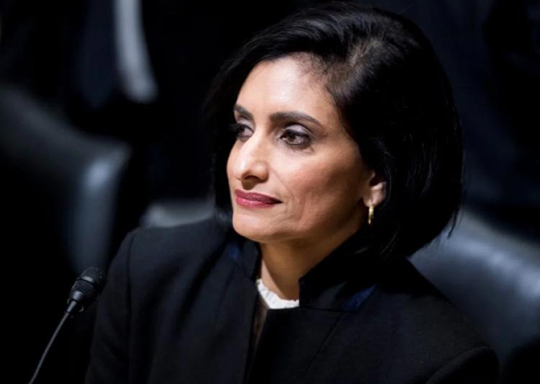
Seema Verma confirmed by Senate for top health post in Trump admin

March 14, 2017

Washington, Mar 14: The US Senate has confirmed Indian-American Seema Verma for a top health care position in the Trump administration and she was set to play a key role in the government's bid to "repeal and replace" Obamacare.

seemaverma

Verma, who has been described by the White House as the "unquestionably qualified" first generation Indian-American, was confirmed by the Senate by a vote of 55-43.

She is likely to play a key role in the health care reform of US President Donald Trump, who has made it a priority to repeal and replace the affordable healthcare of his predecessor Barack Obama.

The second Indian-American in the Trump Administration to be confirmed by the Senate, Verma would head the USD 1 trillion Centers of Medicare and Medicaid Services that provides health services to 130 million people.

US Ambassador to the United Nations Nikki Haley was the first Indian-American Cabinet rank official to serve in any presidential administration. The Senate vote on Verma's confirmation was mostly on party lines.

A health policy consultant, she is known as the architect of health care reforms in several states, including Indiana. Senate Majority Leader Mitch McConnell said Verma is extremely qualified with a health policy background and a record of success.

"She is committed to protecting Medicare and modernising Medicaid so the programmes deliver the best results for those who need it. She also understands the challenges that Obamacare has created for families," he said.

"Ms Verma's knowledge and leadership abilities will serve the American people well at CMS, an agency that touches the lives of millions every day. She will play an important role as we work to repeal and replace Obamacare, and put in place health care reforms that work for the American people," said Senator Richard Burr, Chairman of the Senate Select Committee on Intelligence.

However, Democratic Senator Kamala Harris, the first Indian American Senator voted against Verma. "I voted no on Seema Verma to head Medicare and Medicaid. I disagree with her ideas to cap and cut Medicaid and her views on maternity coverage," Harris said.

In a speech on the Senate floor, Senate Finance Committee Chairman Orrin Hatch said Verma is especially qualified to lead CMS and modernise its programmes to increase the effectiveness of healthcare delivery.

"She brings the experience and, importantly, bipartisan solutions that can and should unite people across the political spectrum in addressing some of the greatest challenges in our healthcare system. I urge all of my colleagues to join me in supporting Ms. Verma's nomination to this important position," he said.

Comments

Add new comment

  • Coastaldigest.com reserves the right to delete or block any comments.
  • Coastaldigset.com is not responsible for its readers’ comments.
  • Comments that are abusive, incendiary or irrelevant are strictly prohibited.
  • Please use a genuine email ID and provide your name to avoid reject.
News Network
February 28,2020

Washington, Feb 28: US intelligence agencies are monitoring the global spread of coronavirus and the ability of governments to respond, sources familiar with the matter said on Thursday, warning that there were concerns about how India would cope with a widespread outbreak.

While there are only a few known cases in India, one source said the country's available countermeasures and the potential for the virus to spread given India's dense population was a focus of serious concern.

US intelligence agencies are also focusing on Iran, where the country's deputy health minister has fallen ill during a worsening outbreak.

US Secretary of State Mike Pompeo said on Tuesday the United States was "deeply concerned" Tehran may have covered up details about the spread of coronavirus. A US government source said Iran's response was considered ineffective because the government only has minimal capabilities to respond to the outbreak.

Another source said US agencies were also concerned about the weak ability of governments in some developing countries to respond to an outbreak.

The US House of Representatives Intelligence Committee has received a briefing on the virus from the spy agencies. "The Committee has received a briefing from the IC (intelligence community) on coronavirus, and continues to receive updates on the outbreak on a daily basis," an official of the House Intelligence Committee told Reuters.

"Addressing the threat has both national security and economic dimensions, requiring a concerted government-wide effort and the IC is playing an important role in monitoring the spread of the outbreak, and the worldwide response," the official added.

A source familiar with the activities of the Senate Intelligence Committee, led by Republican Senator Richard Burr and Democratic Senator Mark Warner, said the panel was receiving daily updates. The role of US intelligence agencies in responding to the coronavirus epidemic at this point principally involves monitoring the spread of the illness around the world and assessing the responses of governments.

They are working closely with health agencies, such as the US Center for Disease Control, in sharing information they collect and targeting further intelligence gathering.

One source said US agencies would use a wide range of intelligence tools, ranging from undercover informants to electronic eavesdropping tools, to track the virus' impact.

Comments

Add new comment

  • Coastaldigest.com reserves the right to delete or block any comments.
  • Coastaldigset.com is not responsible for its readers’ comments.
  • Comments that are abusive, incendiary or irrelevant are strictly prohibited.
  • Please use a genuine email ID and provide your name to avoid reject.
News Network
March 5,2020

Washington, Feb 5: Experts warned a US government panel last night that India's Muslims face risks of expulsion and persecution under the country’s new Citizenship Amendment Act (CAA) which has triggered major protests.

The hearing held inside Congress was called by the US Commission on International Freedom, which has been denounced by the Indian government as biased.

Ashutosh Varshney, a prominent scholar of sectarian violence in India, told the panel that the law championed by prime minister Narendra Modi's government amounted to a move to narrow the democracy's historically inclusive and secular definition of citizenship.

"The threat is serious, and the implications quite horrendous," said Varshney, a professor at Brown University.

"Something deeply injurious to the Muslim minority can happen once their citizenship rights are taken away," he said.

Varshney warned that the law could ultimately lead to expulsion or detention -- but, even if not, contributes to marginalization.

"It creates an enabling atmosphere for violence once you say that a particular community is not fully Indian or its Indianness in grave doubt," he said.

India's parliament in December passed a law that fast-tracks citizenship for persecuted non-Muslim minorities from neighboring countries.

Responding to criticism at the time from the US commission, which advises but does not set policy, India's External Affairs Ministry said the law does not strip anyone's citizenship and "should be welcomed, not criticized, by those who are genuinely committed to religious freedom."

Fears are particularly acute in Assam, where a citizens' register finalized last year left 1.9 million people, many of them Muslims, facing possible statelessness.

Aman Wadud, a human rights lawyer from Assam who traveled to Washington for the hearing, said that many Indians lacked birth certificates or other documentation to prove citizenship and were only seeking "a dignified life."

The hearing did not exclusively focus on India, with commissioners and witnesses voicing grave concern over Myanmar's refusal to grant citizenship to the Rohingya, the mostly Muslim minority that has faced widespread violence.

Gayle Manchin, the vice chair of the commission, also voiced concern over Bahrain's stripping of citizenship from activists of the Shiite majority as well as a new digital ID system in Kenya that she said risks excluding minorities.

More than 40 people were killed last week in New Delhi in sectarian violence sparked by the citizenship law.

India on Tuesday lodged another protest after the UN human rights chief, Michele Bachelet, sought to join a lawsuit in India that challenges the citizenship law's constitutionality.

Comments

Add new comment

  • Coastaldigest.com reserves the right to delete or block any comments.
  • Coastaldigset.com is not responsible for its readers’ comments.
  • Comments that are abusive, incendiary or irrelevant are strictly prohibited.
  • Please use a genuine email ID and provide your name to avoid reject.
Agencies
January 15,2020

Washington, Jan 15: The historic impeachment trial of US President Donald Trump will begin on Tuesday next week, Mitch McConnell, the leader of the Senate's Republican majority, has announced.

Earlier on Tuesday (January 14), Speaker Nancy Pelosi ended the standoff between the Senate and the Democratic-controlled House of Representatives saying that it would vote on next Tuesday to send the impeachment documents to the upper house so it can hold the trial on charges that Trump obstructed Congress and abused presidential powers.

This will be only the third time in the nation's history that a US president is tried after impeachment and Trump can expect to be acquitted like his two predecessors - Bill Clinton in 1998 and Andrew Johnson in 1868 - because there won't be a two-thirds majority to convict and remove him from office.

McConnel told reporters on Tuesday that preparations like swearing in the Senators as jurors for the trial could begin this week ahead of the formal start on next Tuesday.

"This Impeachment Hoax is an outrage," Trump tweeted, repeating his longstanding complaint about it, when the move to hold the trial finally appeared to gain traction.

"The American people deserve the truth and the Constitution demands a trial," Pelosi said.

She had held on to the Articles of Impeachment - the chargesheet against Trump - that the House voted on December 18 in a bid to pressure McConnell to accept her terms for holding the trial and in an attempt to get some Republican senators to break ranks on procedural matters.

But she has agreed to let the process move forward, without an agreement on the main Democratic demand to call in their witnesses at the trial and to introduce new evidence.

The House Intelligence Committee, which conducted the investigation against the president, on Tuesday released what it said was new evidence from Lev Parnas, a former associate of Trump's personal lawyer Rudy Giuliani. Parnas is facing criminal charges.

Pelosi said that starting the trial without witnesses or documents "a pure political cover-up."

The impeachment process is only an investigation by the House and the framing of the chargesheet for the Senate trial that will be presided over by Chief Justice John Roberts with the Senators as jurors and nominees of the House as prosecutors.

While there is no chance for removal of Trump from office, Democrats see the Senate trial as a propaganda mechanism ahead of the elections in November by giving the charges against Trump another public airing and turning voter opinion against Republican senators facing re-election.

Trump called for an outright dismissal of the impeachment by the Senate, but McConnell said, "There is little or no sentiment in the Republican conference for a motion to dismiss."

He added, "Our members feel that we have an obligation to listen to the arguments."

Trump tweeted that by not dismissing the impeachment out of hand, the Senate trial was giving "credence to a trial based on the no evidence, no crime" and "the partisan Democrat Witch Hunt credibility."

Pelosi had hoped to make some Republican senators break ranks with the leaders on the procedures for the trial and has partially succeeded in this as at least four of them appear open to witnesses being called.

While Trump's conviction and ouster from office is virtually impossible because of the two-thirds vote requirement in the 100-member Senate, only a simple majority is required on procedural matters. The Republicans have 53 members and four of them shifting positions could make a difference here.

McConnell appeared confident that he would have a hold on his party senators to set the rules for the trial.

Whether witnesses would be called to testify is still open as the Republicans have said that it would be decided when the trial starts.

The main sticking point is the Democrats demand to call their witnesses to testify at the trial.

The Democrats did not allow the Republicans to call their own witnesses to testify during the impeachment proceeding in the House and Republicans did not seem inclined to oblige them in the Senate.

Trump tweeted, "'We demand fairness' shouts Pelosi and the Do Nothing Democrats, yet the Dems in the House wouldn't let us have 1 witness, no lawyers or even ask questions."

The charges against Trump stem from a July phone call he had with Ukraine's President Volodymyr Zelensky in which he asked him as a "favour" to investigate former Vice President Joe Biden and his son Hunter.

Democrats say that this was an abuse power and amounted to inviting foreign interference in US elections as Biden is the leading candidate for the Democratic nomination to run against Trump in this year's election.

They also say that he withheld crucial military aid to Ukraine, a US ally against Russia, to pressure Zelensky and this endangered US national security. Trump said he delayed the aid to make sure the new government stomped out corruption.

Hunter Biden, who was made to leave the Navy because of alleged drug use and had no experience in the energy industry or in Ukrainian businesses was appointed a director of a gas company there and received monthly payments of $83,000, according to Republicans.

The former vice president, who was looking after Ukrainians affairs, had a prosecutor looking into gas company removed.

He and the Democrats say that it was because the prosecutor was corrupt, while Republicans see it as a conflict of interest.

The obstruction of Congress resulted from Trump's refusal to provide documents that the House demanded and allow some administration officials to testify at the House hearings.


Comments

Add new comment

  • Coastaldigest.com reserves the right to delete or block any comments.
  • Coastaldigset.com is not responsible for its readers’ comments.
  • Comments that are abusive, incendiary or irrelevant are strictly prohibited.
  • Please use a genuine email ID and provide your name to avoid reject.