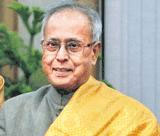
Sena shocks NDA, supports Pranab

June 20, 2012

pranab_1


Patna/New Delhi, June 20: Struggling to find a candidate of its own to contest the presidential election, the BJP-led NDA found itself in acute embarrassment on Tuesday as alliance partner Shiv Sena came out openly in support of the UPA nominee Pranab Mukherjee.

Sena supremo Bal Thackeray made known his party position through party mouthpiece Saamna: “Let bygones be bygones. Let us unanimously support Pranab Mukherjee and show the world that “hum sab ek hai” (we are all united).

Thackeray’s stand came a day after Mukherjee telephoned him and his son Uddhav seeking support for his candidature.

The Sena statement has come as a jolt to the NDA as BJP has been desperately trying to put up a fight against Mukherjee. The coalition suffered a setback on Monday as former president A P J Abdul Kalam declined to contest despite strong efforts made by BJP veteran L K Advani.

Another NDA ally, the JD(U) is also in favour of a consensus on Mukherjee. The saving grace for the NDA is that the Bihar party has not gone public.

With Sena gone out of the NDA as far as presidential elections are concerned, the BJP is now doing evaluating supporting the candidature of P A Sangma, who is insisting on remaining in contest. BJP is not sure which way JD(U) will behave if it insists on the Sangma candidature. The NCP, a UPA partner, on Tuesday expressed confidence that party leader Sangma will opt out of race for Presidential elections and ultimately support Mukherjee.

“He (Sangma) is a senior leader. We are meeting on June 21 and he will attend the meeting. We are confident he will support the UPA candidate,” said NCP general secretary D P Tripathi after meeting Pranab Mukherjee.

Asked about his meeting with Pranab Mukherjee, he said: “It was a courtesy call. We are an ally of UPA, so I came to meet him”.

Hailing Mukherjee as the “right candidate”, Thackeray said : “The farce that is on for the top post of President is not justifiable. The country’s prestige is at stake for political gains. Those who have no merit are also in the race.”

Comments

Add new comment

  • Coastaldigest.com reserves the right to delete or block any comments.
  • Coastaldigset.com is not responsible for its readers’ comments.
  • Comments that are abusive, incendiary or irrelevant are strictly prohibited.
  • Please use a genuine email ID and provide your name to avoid reject.
Agencies
May 26,2020

New Delhi, May 26: As India ranked 10th in the global infection list, overtaking Iran, which was an early hotspot of coronavirus, India's top medical body has said the human trials of COVID-19 vaccine may begin at least in six months.

Dr. Rajni Kant, Director Regional Medical Research Centre and Head at the Indian Council of Medical Research (ICMR) said, "The virus strain isolated at the National Institute of Virology (NIV) laboratory in Pune will be used to develop the vaccine, and this strain has been successfully transferred to the Bharat Biotech International Ltd. (BBIL). It is expected that the human trials of the vaccine will begin in at least six months."

Queried on the focus areas as India inches closer to 1.4 lakh COVID-19 cases, Kant said we should not get anxious about the rapid increase in numbers, especially in the past week, which saw 5,000 Covid-19 cases daily, instead focus on protecting the most vulnerable group.

"We should not fear from increasing Covid-19 cases. The elderly and people with comorbidities need protection. This is the highly vulnerable group, and we need to deploy resources and develop strategies to keep the mortality rate as low as possible in this group," said Kant.

Initially, it was assumed that the country would require thousands of ventilators, but last week, the health ministry said only 0.45 per cent of COVID-19 cases need ventilator support.

Kant insisted the focus should be on five per cent to 10 per cent serious patients. "We are testing more than one lakh daily and our case fatality rate is already one of the lowest in the world. In absence of vaccine, people should follow social distancing guidelines," he added

On the significance of the recovery rate, Kant said the increasing recovery rate of the COVID-19 patients, which is at 41 per cent, is a bright spot in India's fight against deadly viral infection.

Queried on large scale COVID-19 cases in Mumbai, Delhi and Ahmedabad, Kant said the population density in these regions is very high, which proves to be the just right environment for the viral infection.

He insisted on developing robust cluster management strategies in the hard-hit coronavirus spots, and the movement of people should be curtailed in these areas.

"Currently, a lot of people are moving around easily and avoiding social distancing norms. The first phase of the lockdown was very effective, but now things have changed," added Kant.

Comments

Add new comment

  • Coastaldigest.com reserves the right to delete or block any comments.
  • Coastaldigset.com is not responsible for its readers’ comments.
  • Comments that are abusive, incendiary or irrelevant are strictly prohibited.
  • Please use a genuine email ID and provide your name to avoid reject.
News Network
March 16,2020

Mar 16: An investigation into Coffee Day Enterprises Ltd., initiated by its board after the death of founder V.G. Siddhartha, is likely to conclude that at least Rs 2,000 crore is missing from its accounts, according to people familiar with the matter.

The months-long probe following the suicide of Siddhartha in July examined the financial transactions of India’s largest coffee chain and its dealings with dozens of private companies owned by the entrepreneur. The draft report, running more than a hundred pages, points to thousands of rupees that have gone missing, said the people, asking not to be named because the details aren’t public. It also details hundreds of transactions between the founder’s listed and personal businesses that were not conducted at arm’s length, they said.

Though the report is in its final stages, the precise details could change before its release, expected as early as this week, the people said. The missing funds could total more than Rs 2500 crore, one person said.

“The investigation report is still a work in progress, and not finalized,” a spokesman for the company said. “The board of directors and the company are unaware of its content at this point of time. Hence it would be premature to speculate on the investigation findings.”

The priority for management and Siddhartha’s family “is to keep the business running in a challenging environment and meet all stakeholder commitments, including 30,000 jobs associated with the group,” the spokesman added.

The disappearance of the 59-year-old founder last year stunned India’s business community. He had last been seen telling his driver he was going for an evening walk along a bridge in southern India; his body was found by local fishermen two days later. A letter delivered to Coffee Day’s board and employees, which appeared to be signed by Siddhartha, described massive debts and complained of pressure from lenders and tax authorities. It claimed he bore sole responsibility for the company’s financial transactions.

The probe began about a month later when the company brought in Ashok Kumar Malhotra, a retired senior official from India’s federal enforcement agency, to investigate. A senior lawyer practicing in India’s top court is assisting, the company said in a regulatory filing at the time.

The publicly traded Coffee Day was supposed to be India’s answer to Starbucks Corp. More than 1,500 of its Café Coffee Day outlets blanketed cities and highways, with affordable options for the country’s aspiring middle classes. The chain’s tagline: “A lot can happen over coffee.”

But the empire has been battered since the founder’s death. Its shares plummeted about 90% and its market value dropped to about $80 million. Trading was suspended in February.

India’s regulators are tracking the situation and may use the company’s final report as part of a deeper dive into its internal affairs, the people said. Coffee Day showed about Rs 2400 crore in cash and cash equivalents on its balance sheet as of March 2019, the most recent figures the company has issued.

After the death of Siddhartha however, the company faced a severe liquidity crunch and had “zero cash in the bank,” according to one of the people. It struggled with day-to-day expenses and paying salaries has been a strain, the person said.

The draft report details personal guarantees by Siddhartha for loans taken by Coffee Day, and his unsecured loans at high interest rates from local money lenders, the people said. It also probes Coffee Day’s defaults to coffee growers and other vendors, they said.

A related issue is that coffee estates owned by Siddhartha and several employees had been used as collateral for bank loans. The report found that valuations for properties were inflated to get the loans, one person said.

Investigators have examined several theories about what happened to the company’s money, including whether Coffee Day was manipulating its finances to show cash and profit and whether Siddhartha was taking cash out of the listed company to pay off a large investor to whom he had guaranteed a return, the person said. From the filings of his listed and private companies, the entrepreneur’s loans had totaled more than Rs 10,000 crore, and he had been squeezed by borrowing to repay interest on earlier loans, the person said.

In the letter purportedly from Siddhartha, the entrepreneur said he had tried his best but failed as an entrepreneur. “I am solely responsible for all mistakes,” the letter read. “Every financial transaction is my responsibility. My team, auditors and senior management are totally unaware of all my transactions. The law should hold me and only me accountable, as I have withheld this information from everybody including my family.”

As the report nears release, Coffee Day is finalizing a deal with Blackstone Group Inc. for real estate assets. A large tranche of the payment is due in about a week, one person said.

Coffee Day said it is working to reduce its debt load by divesting non-core enterprises.

“The aim is to save employment and preserve this iconic Indian brand,” the spokesman said.

Comments

Add new comment

  • Coastaldigest.com reserves the right to delete or block any comments.
  • Coastaldigset.com is not responsible for its readers’ comments.
  • Comments that are abusive, incendiary or irrelevant are strictly prohibited.
  • Please use a genuine email ID and provide your name to avoid reject.
News Network
February 9,2020

New Delhi, Feb 8: Arvind Kejriwal is set to return as Delhi chief minister and his Aam Aadmi Party (AAP) will virtually sweep the assembly elections, exit polls predicted Saturday.

As polling came to a close at 6 pm, with the Election Commission of India (ECI) projecting a voter turnout at 60.24% (as of 9:50 pm), a poll of polls covering 10 exit polls gave 52 seats to AAP, 17 to the Bharatiya Janata Party and one to the Indian National Congress.

The polls, which are sample surveys conducted among voters exiting polling booths, signalled that the Delhi voter responded to AAP’s campaign that focused on “kaam”, or getting work done.

Kejriwal, a former civil servant and activist who stormed into electoral politics with an anti-corruption campaign in 2013, led a campaign focusing on the development work his government did in Delhi, especially in education and healthcare, as well as sops such as lower electricity bills and free bus rides for women.

The exit polls gave AAP between 47 and 68 seats in the 70-member Assembly.

They predicted an absolute rout for Congress, which ruled Delhi for three terms between 1998 and 2013. The maximum seats to AAP were given by India Today TV-Axis exit poll, which predicted 59-68 seats for the party, while giving 2-11 for the BJP and none to the Congress.

If these figures hold, the results will come as a disappointment for the BJP, which had hoped its sweep in the Lok Sabha elections in 2019 would reflect in the assembly polls.

Delhi’s voter turnout saw a sharp fall over the 2015 elections. According to the Election Commission of India, voter turnout till 9 pm was projected at 60.24% — lower than 67.12% in 2015.

Traditionally, a lower voter turnout is read as a vote for the incumbent.

The voter turnout in Delhi has been similar during the Congress regime under Sheila Dikshit, when she won consecutive terms. In 2003, when Delhi voted a second time for the Dikshit government, the voter turnout was 53.42%, and a comparable 57.58% was the turnout in 2008.

Later, in two consecutive elections — 2013 and 2015 — voters turned out in big numbers to vote Dikshit out of power. In 2013, 65.63% of Delhi turned out and the percentage increased further to 67.12% in 2015.

Across constituencies, Matia Mahal in Central Delhi registered the highest voter turnout of 68.36%, whereas Bawana assembly constituency in North district saw the lowest turnout at 41.95%. Among districts, North East district registered the highest (62.75%) voter turnout, while the lowest turnout was recorded in South East district (54.15%), according to the ECI app.

Comments

Add new comment

  • Coastaldigest.com reserves the right to delete or block any comments.
  • Coastaldigset.com is not responsible for its readers’ comments.
  • Comments that are abusive, incendiary or irrelevant are strictly prohibited.
  • Please use a genuine email ID and provide your name to avoid reject.