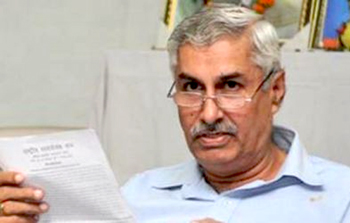
Senior RSS leader shot at in Punjab, critical

August 7, 2016

Jalandhar, Aug 6: Senior RSS leader Brig (retd) Jagdish Gagneja was tonight shot at by some bike-borne persons at Jyoti Chowk area here, police said.

rssJalandhar Commissioner of Police Arpit Shukla said Gagneja, Sah-sarsanghchalak of RSS's Punjab unit, was shot at around 9 PM near Makhdumpura colony here.

He was rushed to a private hospital where his condition is stated to be critical.

Local BJP MLA Manoranjan Kalia said that three bullets hit Gagneja.

Police have started probe in the matter.

Punjab Pradesh Congress Committee President Amarinder Singh condemned the attack on the RSS leader.

"Such nefarious designs deserve to be nipped in the bud lest these push Punjab into anarchy," he said in a statement.

People may not agree or approve of RSS ideology, but in a democracy everyone has a right to pursue his political and ideological beliefs, Amarinder said.

"Such intimidation is unacceptable," he said.

Comments

Shaad
 - 
Sunday, 7 Aug 2016

One member of Gow Rakshak Team (GST) down.

Add new comment

  • Coastaldigest.com reserves the right to delete or block any comments.
  • Coastaldigset.com is not responsible for its readers’ comments.
  • Comments that are abusive, incendiary or irrelevant are strictly prohibited.
  • Please use a genuine email ID and provide your name to avoid reject.
News Network
January 23,2020

Mumbai, Jan 23: Rashmi Sahijwala never expected to start working at the age of 59, let alone join India’s gig economy—now she is part of an army of housewives turning their homes into “cloud kitchens” to feed time-starved millennials.

Asia’s third-largest economy is battling a slowdown so sharp it is creating a drag on global growth, the International Monetary Fund said Monday, but there are some bright spots.

The gig economy, aided by cheap mobile data and abundant labour, has flourished in India, opening up new markets across the vast nation.

Although Indian women have long battled for access to education and employment opportunities, the biggest hurdle for many is convincing conservative families to let them leave home.

But new apps like Curryful, Homefoodi, and Nanighar are tapping the skills of housewives to slice, dice and prepare meals for hungry urbanites from the comfort of their homes.

The so-called cloud kitchens—restaurants that have no physical presence and a delivery-only model—are rising in popularity as there is a boom in food delivery apps such as Swiggy and Zomato.

“We want to be the Uber of home-cooked food,” said Ben Mathew, who launched Curryful in 2018, convinced that housewives were a huge untapped resource.

His company—which employs five people for the app’s daily operations—works with 52 women and three men, and the 31-year-old web entrepreneur hopes to get one million female chefs on-board by 2022.

“We usually train them in processes of sanitisation, cooking, prep time and packaging... and then launch them on the platform,” Mathew told news agency.

One of the first housewives to join Curryful in November 2018 shortly after its launch, Sahijwala was initially apprehensive, despite having four decades of experience in the kitchen.

But backed by her children, including her son who gave her regular feedback about her proposed dishes, she took the plunge.

Since then, she’s undergone a crash course in how to run a business, from creating weekly menus to buying supplies from wholesale markets to cut costs.

The learning curve was steep and Sahijwala switched from cooking everything from scratch to preparing curries and batters for breads in advance to save time and limit leftovers.

She even bought a massive freezer to store fruits and vegetables despite her husband’s reservations about the cost.

“I told him that I am a professional now,” she told news agency.

‘Internet restaurants’

Kallol Banerjee, co-founder of Rebel Foods which runs 301 cloud kitchens backing up 2,200 “internet restaurants”, was among the first entrepreneurs to embrace the concept in 2012.

“We could do more brands from one kitchen and cater to different customer requirements at multiple price points,” Banerjee told AFP.

The chefs buy the ingredients, supply the cookware and pay the utility bills.

The apps—which make their money through charging commission, such as more than 18 percent per order for Curryful—offer training and supply the chefs with containers and bags to pack the food in.

Curryful chef Chand Vyas, 55, spent years trying to set up a lunch delivery business but finally gave up after failing to compete with dabbawalas, Mumbai’s famously efficient food porters.

Today Vyas works seven hours a day, five days a week in her kitchen, serving up a bevy of Indian vegetarian staples, from street food favourites to lentils and rice according to the app’s weekly set menus.

“I don’t understand marketing or how to run a business but I know how to cook. So, the current partnership helps me focus on just that while Curryful takes care of the rest,” Vyas told AFP.

She pockets up to $150 (Rs 10,000 approx) a month after accounting for the commissions and costs, but hopes to earn more as the orders increase.

In contrast, a chef at a bricks-and-mortar restaurant takes home a monthly wage of between $300 (Rs 20,000 approx) and $1,000 (Rs 70,000) approx for working six days a week.

With India’s cloud kitchen sector expected to reach $1.05 billion by 2023, according to data platform Inc42, other companies are also keen to get a slice of the action.

Swiggy, for example, has invested 2.5 billion rupees ($35.3 million) in opening 1,000 cloud kitchens across the nation.

Back in her Mumbai kitchen, Sahijwala is elated to have embarked on a career at an age when her contemporaries are eyeing retirement.

Over the past year, she has seen her profit grow to $200 (Rs 15,000 approx) a month, but more importantly, she said, “My passion has finally found an outlet.

“I am just glad life has given me this chance.”

Comments

Add new comment

  • Coastaldigest.com reserves the right to delete or block any comments.
  • Coastaldigset.com is not responsible for its readers’ comments.
  • Comments that are abusive, incendiary or irrelevant are strictly prohibited.
  • Please use a genuine email ID and provide your name to avoid reject.
Agencies
July 18,2020

New Delhi, Jul 18: National carrier Air India on Friday said that it is in a ‘very challenging financial’ situation and is taking recourse to several initiatives, with a view to ensuring the continuance of its operations.

The airline, in a statement, noted that it has introduced the partially voluntary 'Leave Without Pay' (LWP) scheme on July 14.

"The scheme primarily enables employees to avail the benefits of proceeding on leave without pay on a voluntary basis. The LWP scheme has been introduced for grant of leave without pay and allowances for permanent employees for a period of six months or two years, which is extendable upto 5 years," the statement said.

"Air India had brought out similar scheme earlier... Several hundred employees have, in the past, availed of the LWP Scheme."

As per the statement, in the wake of the ongoing Covid-19 pandemic, there may be employees who are unable to attend their office duties in person on account of personal reasons.

"The LWP scheme enables employees to take a break from their office responsibility for a defined period of time with the approval of the management, while retaining their employment with the company," the statement said.

"They will continue to avail facilities such as passage, medical and housing at specified rates."

Accordingly, the LWP scheme provides the opportunity to employees to take up alternative employment with the approval of the management during the period of the said leave, the airline said.

"The LWP scheme is a win-win situation for both the management as well as employees as it provides flexibility to employees and simultaneously reduces the wage bill for the company," the statement said.

"It is important to note here that the Covid-19 outbreak has very seriously impacted the airline sector and currently, the airline operations of the company are a small fraction of the prior Covid level operations."

The airline said that employees are encouraged to apply for availing the benefit of the scheme, in the prescribed format, by August 15.

"The only addition in this scheme as compared to the earlier LWP scheme is that the management can pass an order requiring the employees to go on leave for a period of six months or two years (extendable upto 5 years) compulsorily taking into consideration 'Suitability, Efficiency, Competence, Quality of performance, Health, Non-availability of employee and Redundancy'," the statement said.

Furthermore, the airline said that this provision has been introduced for use, "very sparingly", with a view to ensuring that the overall efficiency of the organisation, improves and the management will ensure that this will be implemented with complete fairness and transparency as per prescribed procedure.

Consequent to the announcement of the scheme, Air India unions are discussing their strategy against the move which might involve legal recourse.

An Air India union leader on Friday told IANS: "This is going to affect the livelihood of many. Why not every employee of AI take LWP a few days every month. This way the burden can be shared."

"The motive of the top management is to save their money by snatching money from lower employees."

According to Air India PIM document, as on November 1, 2019, the airline, on a standalone basis (without subsidiaries), had around 14,000 employees, including fixed term contract staff.

The development comes as the Centre has re-initiated the airline's divestment plan with new norms.

Interestingly, this time, it has sweetened the deal by substantially reducing the debt on the airline's account books and offered a 100 per cent stake in the loss-making airline.

The last date for bid submission to acquire Air India has also been extended to August 31.

Comments

Add new comment

  • Coastaldigest.com reserves the right to delete or block any comments.
  • Coastaldigset.com is not responsible for its readers’ comments.
  • Comments that are abusive, incendiary or irrelevant are strictly prohibited.
  • Please use a genuine email ID and provide your name to avoid reject.
News Network
March 25,2020

New Delhi, Mar 25: The total number of confirmed coronavirus cases in India rose to 562, according to the Ministry of Health and Family Welfare on Wednesday.
This includes 512 active cases, while 40 infected people have already been cured or discharged.
The Union Health Ministry said that total deaths due to the disease now stand at 9, as the second death reported in Delhi is COVID-19 negative. One patient has also migrated due to the infection.
The Central government has taken several steps to contain the rapid spread of the virus including the screening 15,24,266 passengers at the airports.
Prime Minister Narendra Modi had on Tuesday announced a 21-day lockdown in the entire country effective from midnight to deal with the spread of coronavirus, saying that "social distancing" is the only option to deal with the disease, which spreads rapidly.
In a televised address to the nation, Prime Minister Modi said that it is vital to break the chain of the disease and experts have said that at least 21 days are needed for it.
The Prime Minister, who had also addressed the nation last week, said the lockdown has drawn a "Lakshman Rekha" in every home and people should stay indoors for their own protection and for that of their families. 

Comments

Add new comment

  • Coastaldigest.com reserves the right to delete or block any comments.
  • Coastaldigset.com is not responsible for its readers’ comments.
  • Comments that are abusive, incendiary or irrelevant are strictly prohibited.
  • Please use a genuine email ID and provide your name to avoid reject.