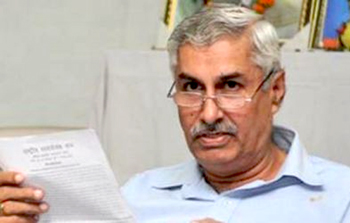
Senior RSS leader shot at in Punjab, critical

August 7, 2016

Jalandhar, Aug 6: Senior RSS leader Brig (retd) Jagdish Gagneja was tonight shot at by some bike-borne persons at Jyoti Chowk area here, police said.

rssJalandhar Commissioner of Police Arpit Shukla said Gagneja, Sah-sarsanghchalak of RSS's Punjab unit, was shot at around 9 PM near Makhdumpura colony here.

He was rushed to a private hospital where his condition is stated to be critical.

Local BJP MLA Manoranjan Kalia said that three bullets hit Gagneja.

Police have started probe in the matter.

Punjab Pradesh Congress Committee President Amarinder Singh condemned the attack on the RSS leader.

"Such nefarious designs deserve to be nipped in the bud lest these push Punjab into anarchy," he said in a statement.

People may not agree or approve of RSS ideology, but in a democracy everyone has a right to pursue his political and ideological beliefs, Amarinder said.

"Such intimidation is unacceptable," he said.

Comments

Shaad
 - 
Sunday, 7 Aug 2016

One member of Gow Rakshak Team (GST) down.

Add new comment

  • Coastaldigest.com reserves the right to delete or block any comments.
  • Coastaldigset.com is not responsible for its readers’ comments.
  • Comments that are abusive, incendiary or irrelevant are strictly prohibited.
  • Please use a genuine email ID and provide your name to avoid reject.
News Network
January 13,2020

Jan 13: For the first time in years, the government of India’s Prime Minister Narendra Modi is playing defense. Protests have sprung up across the country against an amendment to India’s laws — which came into effect on Friday — that makes it easier for members of some religions to become citizens of India. The government claims this is simply an attempt to protect religious minorities in the Muslim-majority countries that border India; but protesters see it as the first step toward a formal repudiation of India’s constitutionally guaranteed secularism — and one that must be resisted.

Modi was re-elected prime minister last year with an enhanced majority; his hold over the country’s politics is absolute. The formal opposition is weak, discredited and disorganized. Yet, somehow, the anti-Citizenship Act protests have taken hold. No political party is behind them; they are generally arranged by student unions, neighborhood associations and the like.

Yet this aspect of their character is precisely what will worry Modi and his right-hand man, Home Minister Amit Shah. They know how to mock and delegitimize opposition parties with ruthless efficiency. Yet creating a narrative that paints large, flag-waving crowds as traitors is not quite that easy.

For that is how these protests look: large groups of young people, many carrying witty signs and the national flag. They meet and read the preamble to India’s Constitution, into which the promise of secularism was written in the 1970’s.

They carry photographs of the Constitution’s drafter, the Columbia University-trained economist and lawyer B. R. Ambedkar. These are not the mobs the government wanted. They hoped for angry Muslims rampaging through the streets of India’s cities, whom they could point to and say: “See? We must protect you from them.” But, in spite of sometimes brutal repression, the protests have largely been nonviolent.

One, in Shaheen Bagh in a Muslim-dominated sector of New Delhi, began simply as a set of local women in a square, armed with hot tea and blankets against the chill Delhi winter. It has now become the focal point of a very different sort of resistance than what the government expected. Nothing could cure the delusions of India’s Hindu middle class, trained to see India’s Muslims as dangerous threats, as effectively as a group of otherwise clearly apolitical women sipping sweet tea and sharing their fears and food with anyone who will listen.

Modi was re-elected less than a year ago; what could have changed in India since then? Not much, I suspect, in most places that voted for him and his party — particularly the vast rural hinterland of northern India. But urban India was also possibly never quite as content as electoral results suggested. India’s growth dipped below 5% in recent quarters; demand has crashed, and uncertainty about the future is widespread. Worse, the government’s response to the protests was clearly ill-judged. University campuses were attacked, in one case by the police and later by masked men almost certainly connected to the ruling party.

Protesters were harassed and detained with little cause. The courts seemed uninterested. And, slowly, anger began to grow on social media — not just on Twitter, but also on Instagram, previously the preserve of pretty bowls of salad. Instagram is the one social medium over which Modi’s party does not have a stranglehold; and it is where these protests, with their photogenic signs and flags, have found a natural home. As a result, people across urban India who would never previously have gone to a demonstration or a political rally have been slowly politicized.

India is, in fact, becoming more like a normal democracy. “Normal,” that is, for the 2020’s. Liberal democracies across the world are politically divided, often between more liberal urban centers and coasts, and angrier, “left-behind” hinterlands. Modi’s political secret was that he was that rare populist who could unite both the hopeful cities and the resentful countryside. Yet this once magic formula seems to have become ineffective. Five of India’s six largest cities are not ruled by Modi’s Bharatiya Janata Party in any case — the financial hub of Mumbai changed hands recently. The BJP has set its sights on winning state elections in Delhi in a few weeks. Which way the capital’s voters will go is uncertain. But that itself is revealing — last year, Modi swept all seven parliamentary seats in Delhi.

In the end, the Citizenship Amendment Act is now law, the BJP might manage to win Delhi, and the protests might die down as the days get unmanageably hot and state repression increases. But urban India has put Modi on notice. His days of being India’s unifier are over: From now on, like all the other populists, he will have to keep one eye on the streets of his country’s cities.


Comments

Add new comment

  • Coastaldigest.com reserves the right to delete or block any comments.
  • Coastaldigset.com is not responsible for its readers’ comments.
  • Comments that are abusive, incendiary or irrelevant are strictly prohibited.
  • Please use a genuine email ID and provide your name to avoid reject.
News Network
January 17,2020

Mumbai, Jan 17: A 68-year-old convict of the 1993 Mumbai serial blasts case, Jalees Ansari, went missing on Thursday morning while being on parole, officials said.

Ansari, a resident of Mominpura in Agripada here who is serving a life term, is suspected to be involved in many bomb blast cases across the country, an official said.

He was on parole for 21 days from the Ajmer Central Prison, Rajasthan, and was expected to surrender before prison authorities on Friday, he said.

During the parole period, he was ordered to visit the Agripada Police Station everyday between 10.30 am and 12 pm to mark his attendance, he said.

However, Ansari did not visit the police station on Thursday during the designated time, the official said.

In the afternoon, his 35-year-old son Jaid Ansari approached the police station with a complaint about his “missing” father, he said.

According to the complaint, Jalees Ansari woke up in the early hoursand told family members he is going to offer namaz, but did not return home.

On his complaint, the Agripada Police registered a missing case, he said.

The Crime Branch of the Mumbai Police and the Maharashtra ATS have launched a massive manhunt to trace him, he said.

Jalees, who is known as Doctor Bomb, was allegedly connected with terror outfits like SIMI and Indian Mujahidin and taught terror groups how to make bombs, he said.

He was also questioned by the NIA in 2011 in connection with the 2008 bomb blast in Mumbai, he said.

Comments

Add new comment

  • Coastaldigest.com reserves the right to delete or block any comments.
  • Coastaldigset.com is not responsible for its readers’ comments.
  • Comments that are abusive, incendiary or irrelevant are strictly prohibited.
  • Please use a genuine email ID and provide your name to avoid reject.
News Network
May 22,2020

Thiruvananthapuram, May 22: Domestic flyers arriving in Kerala must undergo strict home quarantine as per the lockdown guidelines, in view of increasing COVID-19 cases in the state, Health Minister K K Shailaja said on Friday.

"Even if the domestic flight services resume, those coming in must remain under strict home quarantine as per the guidelines.

There is no change in that. Most people will be coming from the major hotspots of the country," she said.

Announcing the resumption of domestic flight services from May 25, the Civil Aviation Ministry had indicated on Thursday that it was not in favour of quarantining passengers on short-haul flights.

However, the Assam government has made it mandatory for all air passengers coming to that state to stay in quarantine for 14 days.

Apart from the health department and the local self government institutions, Shailaja said the people of Kerala must also ensure that every returnee to the state remained under strict home quarantine in order to curb the spread of the disease.

"We need to strictly keep under observation all those who come fromoutside the state and make sure that they do not come into contact with others including their family members.

They should be effectively remain under room quarantine at their residence," she said.

The state reported 690 cases after 24 more tested positive for coronavirus on Thursday.

As of now over 80,000 people are under observation across the state.

On the death of a 73-year-old woman, who came from Mumbai, on Thursday, the minister said, "Khadijakuttycame from Mumbai along with three others. She alighted at Chavakkad. Her son who picked her up from there took her to the govt hospital as she was tired. She was given good care."

"However, as her condition worsened, had taken a decision to sent her to the medicalcollege. Her swab test was taken and she was tested positive, but she passed away," Shailaja said.

The minister sounded a word of caution that there would be an increase in cases in the coming days as the influx of people coming from abroad and other states would continue.

"We cannot prevent anyone from coming. They are our brothers and were suffering there. We need to save those who come here and also those who are here," the Minister said.

Shailaja said the southern state had successfully managed the first two phases of the viral outbreak in January and March.

"There were three deaths. But we managed to save the rest of the people including a 93-year-old man," she said.

The Minister further said the situation in the state changed after flight services resumed and the border roads were re-opened after May 7.

"Our fatality rate is low and recovery rate is high.

After May 7, when the flight restrictions were lifted and people from other states started coming in, we reported 188 cases.

At least 90 per cent of the positive cases came from outside and the rest are their contacts," she noted.

Comments

Add new comment

  • Coastaldigest.com reserves the right to delete or block any comments.
  • Coastaldigset.com is not responsible for its readers’ comments.
  • Comments that are abusive, incendiary or irrelevant are strictly prohibited.
  • Please use a genuine email ID and provide your name to avoid reject.