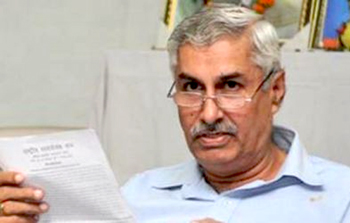
Senior RSS leader shot at in Punjab, critical

August 7, 2016

Jalandhar, Aug 6: Senior RSS leader Brig (retd) Jagdish Gagneja was tonight shot at by some bike-borne persons at Jyoti Chowk area here, police said.

rssJalandhar Commissioner of Police Arpit Shukla said Gagneja, Sah-sarsanghchalak of RSS's Punjab unit, was shot at around 9 PM near Makhdumpura colony here.

He was rushed to a private hospital where his condition is stated to be critical.

Local BJP MLA Manoranjan Kalia said that three bullets hit Gagneja.

Police have started probe in the matter.

Punjab Pradesh Congress Committee President Amarinder Singh condemned the attack on the RSS leader.

"Such nefarious designs deserve to be nipped in the bud lest these push Punjab into anarchy," he said in a statement.

People may not agree or approve of RSS ideology, but in a democracy everyone has a right to pursue his political and ideological beliefs, Amarinder said.

"Such intimidation is unacceptable," he said.

Comments

Shaad
 - 
Sunday, 7 Aug 2016

One member of Gow Rakshak Team (GST) down.

Add new comment

  • Coastaldigest.com reserves the right to delete or block any comments.
  • Coastaldigset.com is not responsible for its readers’ comments.
  • Comments that are abusive, incendiary or irrelevant are strictly prohibited.
  • Please use a genuine email ID and provide your name to avoid reject.
News Network
March 27,2020

New Delhi, Mar 27: The Delhi government has arranged to serve lunch and dinner to the needy in 325 schools in Delhi, chief minister Arvind Kejriwal said on Friday amid reports of people going hungry without access to food during the ongoing nationwide lockdown.

From Saturday, arrangements will be put in place to feed about four lakh people daily at different centres across Delhi, he said addressing the media. "We have made arrangements to provide lunch and dinner in 325 schools. Around 500 people will be provided with food in all these schools. So far we were providing food to 20,000 people daily, the number will now increase to around 2,00,000 from today."

He also said that "from tomorrow, we'll be providing food to 4,00,000 people daily. We're distributing the centres across Delhi."

Stating that the total number of confirmed positive COVID-19 cases in Delhi is now 39, Kejriwal said "We are ready to face any challenge.".

"There are a total of 39 coronavirus positive cases in Delhi as of today, of which 29 cases are of those who had come from outside and were kept in quarantine and 10 of these were cases of local transmission," said Kejriwal at a press conference.

The Chief Minister said that a team of 5 doctors has been set up to look into the preparedness needed to deal with an increase in the number of positive cases for coronavirus in future.

He said, "The team of doctors under the chairmanship of Dr Shiv Kumar Sarin, the head of Institute of Liver and Biliary Sciences, presented a detailed report on March 26 on the preparedness needed to deal with a situation if the number of positive cases for coronavirus increases."

"The report has categorized three situations - if the number of positive cases increases to 100 per day, 500 per day and 1000 per day," he said while adding that the doctors have clearly stated what preparedness should be taken for each situation including the number of ventilators, isolation beds, doctors and nurses required.

He also cited concerns raised by chief ministers of several states including Jharkhand's Hemant Soren and West Bengal's Mamata Banerjee.

Kejriwal said "we consider all those living in Delhi as Delhiites and everyone will be taken care of."
The number of cases tested positive for coronavirus rose to 724 on Friday, according to the Ministry of Health and Family Welfare. 

Comments

Add new comment

  • Coastaldigest.com reserves the right to delete or block any comments.
  • Coastaldigset.com is not responsible for its readers’ comments.
  • Comments that are abusive, incendiary or irrelevant are strictly prohibited.
  • Please use a genuine email ID and provide your name to avoid reject.
News Network
April 15,2020

New Delhi, Apr 15: As the world grapples with coronavirus, researchers have found the presence of a different kind of coronavirus -- bat coronavirus (BtCoV) --in two bat species from Kerala, Himachal Pradesh, Puducherry and Tamil Nadu, according to a study by the Indian Council of Medical Research (ICMR).

There is no evidence or research to claim that these bat coronaviruses can cause disease in humans, said Dr Pragya D Yadav, Scientist at the National Institute of Virology (NIV), Pune and also the first author of study.

The study has been published in the Indian Journal of Medical Research,

Twenty-five bats of Rousettus and Pteropus species from Kerala, Himachal Pradesh, Puducherry and Tamil Nadu were found positive for BtCoV in Kerala, Himachal Pradesh, Puducherry and Tamil Nadu.

"These bat coronaviruses have no relation with SARS-CoV2 responsible for the COVID-19 pandemic," Yadav said, adding that Pteropus bat species were earlier found positive for Nipah virus in 2018 and 2019 in Kerala.

"Bats are considered to be the natural reservoir for many viruses, of which some are potential human pathogens. In India, an association of Pteropus medius bats with the Nipah virus was reported in the past. It is suspected that the recently emerged severe acute respiratory syndrome coronavirus 2 (SARS-CoV-2) also has its association with bats," the objective of the study titled 'Detection of coronaviruses in Pteropus and Rousettus species of bats from different states of India' stated.

"In the present scenario of changing demography and ecological manipulations, it is challenging to have checks on the encounters of bats with other animals and humans," the study stated, highlighting that the need for active and continuous surveillance remains crucial for outbreak alerts for bat-associated viral agents with epidemic potential, which would be helpful in timely interventions.

"Although CoVs in the subfamily coronavirinae do not usually produce clinical symptoms in their natural hosts (bats), accidental transmission of these viruses to humans and other animals may result in respiratory, enteric, hepatic or neurologic diseases of variable severity. It is still not understood as to why only certain CoVs can infect people," the study said.

The scientists stressed on the need of proactive surveillance of zoonotic infections in bats.

The detection and identification of such viruses from bats also recommends cross-sectional antibody surveys (human and domestic animals) in localities where the viruses have been detected.

Similarly, if the epidemiological situation demands, evidence-based surveillance should also be conducted, the study said while emphasing on the need of developing strong mechanisms for working jointly with various stakeholders such as wildlife, poultry, animal husbandry and human health departments.

"In conclusion, our study showed detection of bat CoVs in two species of Indian bats. Continuous active surveillance is required to identify the emerging novel viruses with epidemic potential," Dr Yadav said.

Elaborating on the study, Dr Yadav said throat and rectal swab samples of two bat species -- Rousettus and Pteropus -- from seven states were screened for the bat coronvirus during which the representative samples collected from Kerala, Himachal Pradesh, Puducherry and Tamil Nadu tested positive while those from Karnataka, Chandigarh, Punjab, Telengana, Gujarat and Odisha came out negative.

The reverse-transcription polymerase chain reaction (RT-PCR) tests and sequencing were used for the confirmation of the findings.

"This is an ongoing study to understand the prevalence of the Nipah virus in bats," she said.

Comments

Add new comment

  • Coastaldigest.com reserves the right to delete or block any comments.
  • Coastaldigset.com is not responsible for its readers’ comments.
  • Comments that are abusive, incendiary or irrelevant are strictly prohibited.
  • Please use a genuine email ID and provide your name to avoid reject.
Agencies
June 15,2020

New Delhi, Jun 15: Average temperature of India experienced a rise of 0.7 degree Celsius, along with decline in rainfall, significant increase in frequency of very severe cyclonic storms and droughts in over a decade due to human activities, the Ministry of Earth Sciences in its research report said.

The contentions were made in a report issued by the ministry on the impact of climate change. It will be published by Union Minister Harsh Vardhan on June 19.

According to the report, "Since the middle of the twentieth century, India witnessed rise in temperature; decrease in monsoon; rise in extreme temperature and rainfall, droughts, and sea levels; and increase intensity of severe cyclones.

The report, prepared by researchers of the Centre for Climate Change Research, a cell under The Ministry's Indian Institute of Tropical Meteorology, Pune, further stated that there is compelling scientific evidence that human activities have influenced these changes in regional climate.

India's average temperature has risen by around 0.7 degrees Celsius during 1901-2018, it said, adding that the rise is largely on account of GHG-induced warming and partially offset by forcing due to anthropogenic aerosols.

It states that the average temperature over India is projected to rise by 4.4 degrees Celsius, while the intensity of heat waves is likely to increase by 3-4 times by the end of the century.

In the 30-year period between 1986 and 2015, temperatures of the warmest day and the coldest night of the year have risen by about 0.63 degrees Celsius and 0.4 degree Celsius.

According to the report, by the end of the century, the temperatures of the warmest day and the coldest night are projected to rise by approximately 4.7 degrees Celsius and 5.5 degrees Celsius, respectively.

Alarmingly, sea surface temperature of the tropical Indian Ocean has also risen by one degrees Celsius on average during 1951-2015.

"The frequency of very severe cyclonic storms during the post-monsoon season has increased significantly (+1 event per decade) during the last two decades (2000-2018)," it added.

This came in the backdrop of Cyclone 'Amphan' and 'Nisarga' which made landfalls on May 20 and June 3 and killed several people, flattened villages, and destroyed farms.

"This is the first-ever climate change assessment report for India. This report will be very useful for policy makers, researchers, social scientists, economists, and students," said M. Rajeevan, secretary, the Ministry of Earth Sciences.

Besides this, the report also highlighted various other unnerving data on climate change in the country. Both the frequency and extent of droughts have increased significantly during 1951-2016.

The overall decrease of seasonal "summer monsoon rainfall" during the last 6-7 decades has led to an increased propensity for droughts over India.

"In particular, areas over central India, southwest coast, southern peninsula and north-eastern India have experienced more than 2 droughts per decade, on average, during this period. The area affected by drought has also increased by 1.3 per cent per decade over the same period."

The Hindu Kush Himalayas (HKH) also experienced a temperature rise of about 1.3 degree Celsius during 1951-2014.

Several areas of the Himalayas have experienced a declining trend in snowfall and also retreat of glaciers in recent decades. By the end of the twenty-first century, its annual mean surface temperature is projected to increase by about 5.2 degree Celsius.

The summer monsoon precipitation from June to September over India has also declined by around 6 per cent from 1951 to 2015, with notable decreases over the Indo-Gangetic Plains and the Western Ghats, the report further states.


Comments

Add new comment

  • Coastaldigest.com reserves the right to delete or block any comments.
  • Coastaldigset.com is not responsible for its readers’ comments.
  • Comments that are abusive, incendiary or irrelevant are strictly prohibited.
  • Please use a genuine email ID and provide your name to avoid reject.