



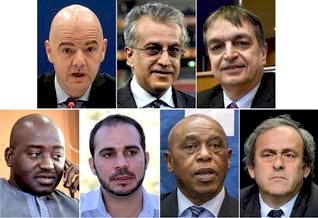
The seven official FIFA presidential candidates

October 29, 2015

FIFAParis, Oct 29: Profiles of the seven candidates for the FIFA presidency confirmed by football’s governing body on Wednesday:

PRINCE ALI BIN AL HUSSEIN: The 39-year-old brother of Jordan’s King Abdullah was a member of his country’s special forces, specialising in parachute jumps. The prince was on the FIFA executive from 2011 until this year when he first challenged Sepp Blatter for the presidency. Prince Ali championed the cause of allowing women to play football in a hijab. He has repeatedly demanded greater transparency within FIFA and promised to increase the share of revenues sent back to the national associations. He has condemned the “backroom deals” that he says are one of the biggest causes of FIFA’s long-standing troubles. The prince has been one of the main advocates of releasing the Garcia report into the 2010 votes that gave the 2018 and 2022 World Cups to Russia and Qatar respectively.

MICHEL PLATINI: One of the greatest footballers of all time and until he was implicated in a Swiss criminal investigation into FIFA, one of the sport’s most skilful politicians. After being co-chairman of France’s 1998 World Cup organisation, he became president of UEFA in 2007 and has since been re-elected twice. But the Frenchman’s 90-day suspension while FIFA investigates a 1.8 million euro ($2 million) payment from the world body without a written contract has seriously hit the chances of the man who was once hot favourite. Platini, 60, made his name as a sports administrator by pressing for football’s riches and decision-making to be spread between members.

JEROME CHAMPAGNE: The 57-year-old was a French diplomat in Oman, Los Angeles and Brazil before becoming a protocol advisor for the 1998 World Cup organisers. He joined FIFA in 1999 and rose to become deputy secretary general under Sepp Blatter, leaving in 2010. “I am not ashamed of the FIFA years,” he told AFP. Though not a footballer, Champagne was a freelance journalist for the magazine France Football . Champagne had tried to challenge Blatter in the election this year but could not get the required five signatures from national associations to enter. He has vowed to bring in greater transparency, stronger ethical standards and modernise the world body’s administration.

TOKYO SEXWALE: The South African anti-apartheid campaigner, who entered the race on Saturday, wants to make history by becoming the first African to head football’s governing body in its 111-year history. A former politician and one of his country’s wealthiest men Sexwale, 62, was jailed alongside Nelson Mandela. He served 13 years of an 18-year jail term on Robben Island on terrorism charges. A member of South Africa’s 2010 World Cup bid team he serves on FIFA’s anti-racism and anti-discrimination committee, likening racism to “a monster that is trying to infiltrate sporting fields”. He is also a FIFA media committee member.

SHEIKH SALMAN BIN EBRAHIM AL KHALIFA: The soft-spoken Bahraini royal took over an Asian confederation in turmoil in 2013 after Mohamed bin Hammam was kicked out in disgrace, but he now enjoys an iron grip on the body. Enjoys strong backing from Kuwaiti powerbroker Sheikh Ahmad al Fahad al Sabah, one of the most influential figures in world sport and a major player in both FIFA and the Olympic movement. This year, Shaikh Salman was re-elected unopposed for a full, four-year term and became a FIFA vice-president into the bargain. But he has been dogged by allegations that he was complicit in Bahrain’s harsh crackdown on pro-democracy activists in 2011, charges he denies.

GIANNI INFANTINO: The 45-year-old Swiss lawyer joined UEFA in 2000 and became general secretary in 2009. Multi-lingual, Infantino’s original role was to deal with legal, commercial and professional football matters. He was subsequently appointed as director of legal affairs and club licensing division in 2004. He worked on fostering close contacts with the European Union, the Council of Europe and governmental authorities. Prior to joining UEFA he had a lot of experience working in sport. He had been an advisor to various football bodies in Italy, Spain and Switzerland before then working as the general secretary of the International Centre for Sports Studies at the University of Neuchatel.

MUSA BILITY: President of the Liberian Football Association, Bility’s candidacy is something of surprise. He is one of a select band of Africans to stand for the presidency following current acting FIFA head Issa Hayatou in 2002, and Sexwale this time around. “If we are to change football, then we have to make sure that those (that) have been running FIFA for the last 20-25 years have nothing to do with it,” the 48-year-old Bility told the BBC after announcing his candidature.

Comments

Add new comment

  • Coastaldigest.com reserves the right to delete or block any comments.
  • Coastaldigset.com is not responsible for its readers’ comments.
  • Comments that are abusive, incendiary or irrelevant are strictly prohibited.
  • Please use a genuine email ID and provide your name to avoid reject.
Agencies
April 2,2020

Lausanne, Apr 2: The postponement of the Tokyo Olympics and the shutdown of the sporting calendar because of the coronavirus pandemic are going to hit international sports federations hard financially.

Many sports that are part of the Games depend heavily on the payouts every four years from the International Olympic Committee (IOC).

"The situation is tense and very gloomy. An assessment will be made, but clearly some posts are under threat," said an official of a major international federation.

The 28 international federations (IF) of the sports that were due to be present at the Tokyo Olympics, would have received substantial sums from the IOC.

However, the postponement of the Games until 2021 could lead to a freeze of their payment.

"We have a lot of IF with substantial reserves, but others work on a different business model, they have income from major events which are suspended, which can be a problem for the cashflow if they don't have enough reserves," said Andrew Ryan, director general of the Association of International Olympic Summer Sports Federations (ASOIF), which is responsible for distributing this money.

The five additions to the Tokyo Games programme - karate, surfing, skateboarding, climbing and baseball/softball - are not eligible.

The Olympic payout totalled 520 million after the Rio Games, four years ago.

"The Olympic money could be less than for Rio 2016," Ryan warned before adding: "My advice is to budget the same as in Rio".

The federations receive money on a sliding scale determined by their audience and size.

The three largest (athletics, swimming and gymnastics) can expect approximately 40 million.

For the second tier, made up of cycling, basketball, volleyball, football and tennis, the sum is 25 million.

For group three, which contains eight sports, including boxing, rowing, judo and table tennis, it is 17 million.

The nine sports in the next level (including sailing, canoing and fencing) receive 12 million.

For the three in the last category (rugby, golf, modern pentathlon) the payout is 7 million.

For the largest associations, such as football's FIFA which has a 1.5 billion nest egg, or basketball body FIBA which has CHF 44.4 million (42 million euros) in reserves, IOC aid represents a small proportion of their income.

For others, it is vital.

"Some IF probably don't have the cashflow to survive one year," said Ryan.

For most federations, the postponement of the Olympic Games has a domino effect, forcing them to reschedule their own money-earning competitions.

"The revenues from these events will eventually come in," said Ryan. "But this impacts the cashflow." World Athletics has already postponed the 2021 World Championships in Eugene, Oregon to 2022.

The International Swimming Federation (FINA) will have to do the same for its World Championships scheduled for next summer in Fukuoka, Japan, when they would probably clash with the Tokyo Games.

"One edition of the World Championships means for us 10 million in revenues," said one sports federation official, speaking on condition of anonymity.

"If this income is postponed, totally or partially, for a year, we will face major problems, especially if the IOC money, originally expected in September, is not paid out."

The Singapore-based International Table Tennis Federation has already taken steps, with "the Executive Committee agreeing to reduce their expenses and senior staff offering to take a salary reduction," said marketing director Matt Pound, but, he added,"further cuts will take place if needed."

- 'Significant loss of revenue' -

The ITTF has suspended all its competitions until June and that is costly.

Kim Andersen, the Danish president of London-based World Sailing, said commercial revenues are not immune.

"The IOC will eventually pay out its aid, but what weighs most heavily is the uncertainty about whether our competitions will be held and whether our sponsors will be maintained," he said.

The IOC is not prepared to go into details of what it plans.

"It is not possible at this stage to assess the overall impact" of the postponement of the Tokyo Olympics, an official told AFP.

"It depends on a number of variables that are currently being studied." According to an official of one federation: "the IOC will discuss on a case-by-case basis, sport by sport".

Another option is for the federations to ask for a share of the public aid set up to deal with the coronavirus crisis, in Switzerland, where 22 ASOIF members are based and also in the United Kingdom, home of World Sailing.

"Can sports federations benefit from federal aid? The answer is yes, in principle," Philippe Leuba, State Councillor of the canton of Vaud, in charge of the economy and sport, told.

Comments

Add new comment

  • Coastaldigest.com reserves the right to delete or block any comments.
  • Coastaldigset.com is not responsible for its readers’ comments.
  • Comments that are abusive, incendiary or irrelevant are strictly prohibited.
  • Please use a genuine email ID and provide your name to avoid reject.
Agencies
June 23,2020

Islamabad, Jun 23: Seven more Pakistan cricketers, including Muhammad Hafeez and Wahab Riaz, selected for the tour of England have tested positive for COVID-19, taking the total to 10, the PCB revealed on Tuesday.

The seven who tested positive on Tuesday are Kashif Bhatti, Muhammad Hasnain, Fakhar Zaman, Muhammad Rizwan, Imran Khan, Hafeez and Riaz. Shadab Khan, Haider Ali and Haris Rauf had returned positive tests on Monday.

“It is not a great situation to be in and what it shows is these are 10 fit and young athletes...if it can happen to players it can happen to anyone,” Pakistan Cricket Board (PCB) CEO, Wasim Khan told a media conference.

He said a support staff member, masseur Malang Ali, had also tested positive for COVID-19.

Khan said that the players and officials would now assemble in Lahore and another round of tests would be carried out on June 25 and a revised squad would be announced the next day.

The squad has to leave on June 28 for the series scheduled to be held next month, he said.

“It is a matter of concern but we shouldn’t panic at this time as we have time on our hands,” Khan said.

He said the players and officials would be retested on reaching England.

Comments

Add new comment

  • Coastaldigest.com reserves the right to delete or block any comments.
  • Coastaldigset.com is not responsible for its readers’ comments.
  • Comments that are abusive, incendiary or irrelevant are strictly prohibited.
  • Please use a genuine email ID and provide your name to avoid reject.
News Network
June 1,2020

Jun 1: Premier India pacer Jasprit Bumrah won't miss the hugs and high-fives as part of a wicket celebration but he will certainly miss applying saliva on the ball and feels an alternative should be provided to maintain the red cherry.

The ICC Cricket Committee, led by former India captain Anil Kumble, recommended a ban on using saliva on the ball as an interim measure to deal with the COVID-19 pandemic. However, the Committee did not allow the use of artificial substances as a substitute move.

The new rule makes life tougher for the bowlers and Bumrah, like many former and current fast bowlers, feels there ought to be an alternative.

"I was not much of a hugger anyway and not a high-five person as well, so that doesn't trouble me a lot. The only thing that interests me is the saliva bit," said Bumrah in a chat with Ian Bishop and Shaun Pollock on ICC's video series 'Inside Out'.

"I don't know what guidelines we'll have to follow when we come back, but I feel there should be an alternative," he added.

Bumrah said not being able to use saliva makes the game more batsman-friendly.

"If the ball is not well maintained, it's difficult for the bowlers. The grounds are getting shorter and shorter, the wickets are becoming flattered and flatter.

"So we need something, some alternative for the bowlers to maintain the ball so that it can do something - maybe reverse in the end or conventional swing."

When former West Indian pacer Bishop pointed out that the conditions have been favorable to the fast bowlers over the last couple of years, Bumrah nodded in agreement.

"In Test match cricket, yes. That is why it's my favorite format because we have something over there. But in one-day cricket and T20 cricket… one-day cricket there are two new balls, so it hardly reverses at the end.

"We played in New Zealand, the ground (boundary) was 50 metres. So even if you are not looking to hit a six, it will go for six. In Test matches I have no problem, I'm very happy with the way things are going."

He finds it amusing that the batsmen keep complaining about the swinging ball.

"Whenever you play, I've heard the batsmen - not in our team, everywhere - complaining the ball is swinging. But the ball is supposed to swing! The ball is supposed to do something! We are not here just to give throwdowns, isn't it? (laughter)

"This is what I tell batsmen all the time. In one-day cricket, when did the ball reverse last, I don't know. Nowadays the new ball doesn't swing a lot as well. So whenever I see batsmen say the ball is swinging or seaming and that is why I got out - the ball is supposed to do that.

"Because it doesn't happen so much in the other formats, it's a new thing for the batsmen when the ball is swinging or seaming," said the 26-year-old.

The Ahmedabad-born pacer finds himself in an unusual position as he has not bowled for over two months due to the lockdown imposed in the wake of the coronavirus outbreak.

When India will play next is not clear yet and Bumrah said he is not sure about how his body will hold up when he returns to action.

"I really don't know how your body reacts when you don't bowl for two months, three months. I'm trying to keep up with training so that as soon as the grounds open up, the body is in decent shape.

"I've been training almost six days a week but I've not bowled for a long period of time so I don't know how the body will react when I bowl the first ball.

"I'm looking at it as a way to renew your own body. We'll never get such a break again, so even if you have a small niggle here and there, you can be a refreshed person when you come back. You can prolong your career," he said.

Bumrah has risen rapidly in international cricket despite experts having reservations about his longevity due to his unorthodox action.

The gritty fast bowler sees similarities in his career graph to Swedish football star Zlatan Ibrahimovic.

"Our personalities are different. But the story I could relate to is that not many people thought he would make it big. There was a similar case with me growing up as well.

"Wherever I went, it was the general feedback from people that 'this guy would not do anything, he would not be a top-rated bowler, he won't be able to play for a long period of time with this kind of action'.

"So, having the self-belief is important and the only validation that is required is your own validation. I saw that in his (Ibrahimovic's) story, so that's the thing I could relate to," added Bumrah.

Comments

Add new comment

  • Coastaldigest.com reserves the right to delete or block any comments.
  • Coastaldigset.com is not responsible for its readers’ comments.
  • Comments that are abusive, incendiary or irrelevant are strictly prohibited.
  • Please use a genuine email ID and provide your name to avoid reject.