


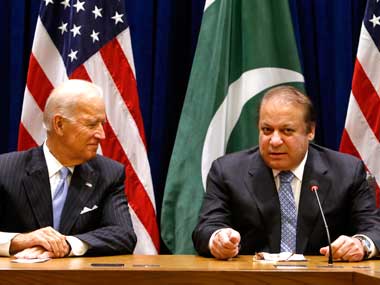
Sharif rakes up Kashmir issue at UN, blames India for cancelling talks

September 27, 2014

NawazSharifUnited Nations, Sep 27: Pakistan Prime Minister Nawaz Sharif today raked up the Kashmir issue at the UN General Assembly here and blamed India for "another missed opportunity" to address outstanding issues by canceling the Foreign Secretary-level talks. Asserting that a "veil" cannot be drawn over the "core" issue of Kashmir, he said Pakistan is ready to work for resolution of this problem through negotiations.

"Our support and advocacy of the right to self-determination of the people of Jammu and Kashmir is our historic commitment and a duty, as a party to the Kashmir dispute," he said while addressing the annual UN General Assembly session.

Needling India, Sharif said that more than six decades ago, the UN had passed resolutions to hold a plebiscite in Jammu and Kashmir. "The people of Jammu and Kashmir are still waiting for the fulfillment of that promise," he said.

"Many generations of Kashmiris have lived their lives under occupation, accompanied by violence and abuse of their fundamental rights. Kashmiri women, in particular, have undergone immense suffering and humiliation," he said. For decades, attempts have been made, both under UN auspices and bilaterally in the spirit of the Lahore Declaration, to resolve this dispute, he said.

"The core issue of Jammu and Kashmir has to be resolved. This is the responsibility of the international community. We cannot draw a veil on the issue of Kashmir, until it is addressed in accordance with the wishes of the people of Jammu and Kashmir," Sharif told the gathering.

India had called off the Foreign Secretary-level talks in August after Pakistan High Commissioner Abdul Basit met Kashmiri Hurriyat leaders in New Delhi, ignoring India's warning not to meet the separatist leaders.

In his address, Sharif said, "We were disappointed at the cancellation of the Foreign Secretary-level talks. The world community, too, rightly saw it as another missed opportunity "Pakistan is convinced that we must remain engaged in the dialogue process for settling disputes and building economic and trade relations. Let us not ignore the dividends of peace."

Both India and Pakistan have separately stated that there was no planned meeting of Sharif and Prime Minister Narendra Modi on the margins of the UN session. Sharif, however, gave enough indications that Pakistan was not averse to resumption of the dialogue process with India.

"Pakistan is ready to work for resolution of this problem through negotiations," he added. Sharif said that it is his government's "aspiration and effort" to build a peaceful neighborhood by pursuing a policy of constructive engagement.

"In South Asia, our people have missed opportunities for prosperity because of unresolved conflicts. We have a choice today: continue with the status quo or to seize the moment to resolve all outstanding issues and free up our shared energies for cooperation. To take this course of high statesmanship, we need more, not less, dialogue and diplomacy. We need to respect each other's rights and sensibilities. We must have relationships based on equality, mutual respect and transparency," he said.

Sharif said that as a "responsible" nuclear weapon state, Pakistan will continue to support the objectives of nuclear disarmament and non-proliferation; and pursue a policy of nuclear restraint and credible minimum deterrence.

"Pakistan is not participating in any arms race in the region. Yet we cannot be oblivious to the emerging security scenarios and buildup of armaments. We too, have the obligation to maintain a robust and reliable deterrence," he said.

Condemning terrorism, Sharif told the UN General Assembly that his country is fighting terrorism "planted" on its soil and has resolved to fight the "scourge" to the finish. "We condemn terrorism in all its forms and manifestations. We are fighting terrorism planted on Pakistan's soil. Our valiant soldiers are laying down their lives to take out terrorists and tear down their evil networks. The entire nation is behind them," Sharif said.

He said that in the past 13 years, Pakistan "as a frontline state" has sacrificed tremendously due to terrorism. "Over 50,000 people have lost their lives and thousands have suffered serious injuries. Our economy has lost hundreds of billions of dollars in direct costs and denied investment opportunities...It is the resolve of our nation to fight this scourge to the finish," he said.

Stating that Pakistan remains committed to forging a deeper bilateral relationship with Afghanistan on the basis of equal security and shared prosperity, Sharif said, "Our two nations confront common challenges, which call for greater cooperation and understanding between our two nations. I congratulate the people of Afghanistan over the successful completion of the electoral process and offer our warm felicitations and good wishes to the new Afghan leadership."

"It is our earnest hope that these landmark processes would culminate in the emergence of a stronger, more stable, and unified Afghanistan. We also hope that the process of inclusive Afghan-led and Afghan-owned reconciliation would move forward, contributing to greater harmony, stability and prosperity in Afghanistan," he added.

Comments

Add new comment

  • Coastaldigest.com reserves the right to delete or block any comments.
  • Coastaldigset.com is not responsible for its readers’ comments.
  • Comments that are abusive, incendiary or irrelevant are strictly prohibited.
  • Please use a genuine email ID and provide your name to avoid reject.
Agencies
July 7,2020

Washington DC, Jul 7: With US President Donald Trump promoting re-opening the economy, the country has now four epicentres of coronavirus instead of one -- Los Angeles, cities in Texas, cities in Florida and Arizona. This has led to the governors fearing that their hospitals could be overrun with patients.

"We are right back where we were at the peak of the epidemic during the New York outbreak...The difference now is that we really had one epicentre of spread when New York was going through its hardship. Now, we really have four major epicentres of spread -- Los Angeles, cities in Texas, cities in Florida and Arizona. Florida looks to be in the worst shape," Scott Gottlieb, former Food and Drug Administration commissioner was quoted by The Washington Post as saying in an interview.

As per the latest data, Florida, New York and California have crossed the 200,000 mark of coronavirus cases.

After Texas continued to break its own record of registering the highest number of coronavirus cases, Austin Mayor Steve Adler (D) was quoted as saying in an interview, "If we do not change this trajectory, then I am within two weeks of having our hospitals overrun."

He further said that intensive care units in the city will start overflowing within 10 days.

Echoing similar sentiments, Judge Lina Hidalgo, the top elected official in Harris County, said, "As long as we're doing as little as possible and hoping for the best, we are always going to be chasing this thing. We are always going to be behind and the virus will always outrun us...And so what we need right now is to do what works, which is a stay-home order."

She was stripped of authority to issue stay-at-home orders after Governor Greg Abbott decided to move forward with the reopening plan.

"It is clear that the (coronavirus) growth is exponential at this point...We have been breaking record after record after record... the last couple of weeks," Miami Mayor Francis Suarez was quoted as saying in an interview.

"The city of Miami was the last city in the entire state of Florida to open. I was criticized for waiting so long. But there is no doubt that the fact that when we reopened, people started socialising as if... the virus didn't exist."

He further said that if the numbers do not begin to fall "more drastic measures" will be taken in the coming week.

As per the latest update by the Johns Hopkins University, a total of 2,938,625 people in the US have tested coronavirus positive and 130,306 deaths have been reported so far.

Comments

Add new comment

  • Coastaldigest.com reserves the right to delete or block any comments.
  • Coastaldigset.com is not responsible for its readers’ comments.
  • Comments that are abusive, incendiary or irrelevant are strictly prohibited.
  • Please use a genuine email ID and provide your name to avoid reject.
Agencies
July 2,2020

Moscow, Jul 2: Russian voters approved changes to the constitution that will allow President Vladimir Putin to hold power until 2036, but the weeklong plebiscite that concluded Wednesday was tarnished by widespread reports of pressure on voters and other irregularities.

With most of the nation's polls closed and 20% of precincts counted, 72% voted for the constitutional amendments, according to election officials.

For the first time in Russia, polls were kept open for a week to bolster turnout without increasing crowds casting ballots amid the coronavirus pandemic a provision that Kremlin critics denounced as an extra tool to manipulate the outcome.

A massive propaganda campaign and the opposition's failure to mount a coordinated challenge helped Putin get the result he wanted, but the plebiscite could end up eroding his position because of the unconventional methods used to boost participation and the dubious legal basis for the balloting.

By the time polls closed in Moscow and most other parts of Western Russia, the overall turnout was at 65%, according to election officials. In some regions, almost 90% of eligible voters cast ballots.

On Russia's easternmost Chukchi Peninsula, nine hours ahead of Moscow, officials quickly announced full preliminary results showing 80% of voters supported the amendments, and in other parts of the Far East, they said over 70% of voters backed the changes.

Kremlin critics and independent election observers questioned the turnout figures.

We look at neighboring regions, and anomalies are obvious there are regions where the turnout is artificially (boosted), there are regions where it is more or less real, Grigory Melkonyants, co-chair of the independent election monitoring group Golos, told The Associated Press.

Putin voted at a Moscow polling station, dutifully showing his passport to the election worker. His face was uncovered, unlike most of the other voters who were offered free masks at the entrance.

The vote completes a convoluted saga that began in January, when Putin first proposed the constitutional changes.

He offered to broaden the powers of parliament and redistribute authority among the branches of government, stoking speculation he might seek to become parliamentary speaker or chairman of the State Council when his presidential term ends in 2024.

His intentions became clear only hours before a vote in parliament, when legislator Valentina Tereshkova, a Soviet-era cosmonaut who was the first woman in space in 1963, proposed letting him run two more times.

The amendments, which also emphasize the primacy of Russian law over international norms, outlaw same-sex marriages and mention a belief in God as a core value, were quickly passed by the Kremlin-controlled legislature.

Putin, who has been in power for more than two decades longer than any other Kremlin leader since Soviet dictator Josef Stalin said he would decide later whether to run again in 2024.

He argued that resetting the term count was necessary to keep his lieutenants focused on their work instead of darting their eyes in search for possible successors.

Analyst Gleb Pavlovsky, a former Kremlin political consultant, said Putin's push to hold the vote despite the fact that Russia has thousands of new coronavirus infections each day reflected his potential vulnerabilities.

Putin lacks confidence in his inner circle and he's worried about the future, Pavlovsky said.

He wants an irrefutable proof of public support.

Even though the parliament's approval was enough to make it law, the 67-year-old Russian president put his constitutional plan to voters to showcase his broad support and add a democratic veneer to the changes.

But then the coronavirus pandemic engulfed Russia, forcing him to postpone the April 22 plebiscite.

The delay made Putin's campaign blitz lose momentum and left his constitutional reform plan hanging as the damage from the virus mounted and public discontent grew.

Plummeting incomes and rising unemployment during the outbreak have dented his approval ratings, which sank to 59%, the lowest level since he came to power, according to the Levada Center, Russia's top independent pollster.

Moscow-based political analyst Ekaterina Schulmann said the Kremlin had faced a difficult dilemma: Holding the vote sooner would have brought accusations of jeopardizing public health for political ends, while delaying it raised the risks of defeat.

Holding it in the autumn would have been too risky, she said.

In Moscow, several activists briefly lay on Red Square, forming the number 2036 with their bodies in protest before police stopped them.

Some others in Moscow and St. Petersburg staged one-person pickets and police didn't intervene.

Several hundred opposition supporters rallied in central Moscow to protest the changes, defying a ban on public gatherings imposed for the coronavirus outbreak. Police didn't intervene and even handed masks to the participants.

Authorities mounted a sweeping effort to persuade teachers, doctors, workers at public sector enterprises and others who are paid by the state to cast ballots. Reports surfaced from across the vast country of managers coercing people to vote.

The Kremlin has used other tactics to boost turnout and support for the amendments.

Comments

Add new comment

  • Coastaldigest.com reserves the right to delete or block any comments.
  • Coastaldigset.com is not responsible for its readers’ comments.
  • Comments that are abusive, incendiary or irrelevant are strictly prohibited.
  • Please use a genuine email ID and provide your name to avoid reject.
News Network
June 18,2020

Washington, Jun 18: US Defence officials are concerned over China's use of COVID-19 situation to gain stakes in strategically important companies of United States as the impact of novel coronavirus has left several companies in dire need of capital.

Amid the pandemic, it getting hard for the defence department to keep an eye on national security and help protect smaller companies down the chain, CNN reported.

"We are paying close attention to any indicators that China is leveraging Covid-19 to take advantage of a situation where defence companies need capital more than ever," a defence official told CNN.

In April, Ellen Lord, undersecretary of defence for acquisition and sustainment said it is paying close attention to 'adversaries' against the 'economic warfare' with the United States.

"We have to be very, very careful about the focused efforts some of our adversaries have to really undergo sort of economic warfare with us, which has been going on for some time," Ellen Lord, undersecretary of defence for acquisition and sustainment was quoted as saying by CNN.

US Committee on Foreign Investment protects its interest against hostile countries gaining ownership in strategically important companies. But the pandemic is changing the definition of national security concerns to include drugs, protective gear and medical supplies.

"These are now national security needs and we probably should have been thinking about it a long time ago in terms of biowarfare that we should have a trusted industrial base or a set of trusted allies -- the UK, or NATO allies or Japan or Korea -- who are trusted in that regard," Bill Greenwalt, a former Pentagon official.

Give the threat posed by foreign acquisition, Pentagon has been offering tools to help small US businesses defend themselves against adversarial investment and conducting background checks with other government agencies to ensure transparency.

US President Donald Trump's trade adviser Peter Navarro recently told CNN if Trump wins reelection, Washington DC will likely take offshore supply chains as national security priorities.

"If we fail to do that in the face of this crisis, we will have failed this country and all future generations of Americans," Navarro said.

The US State Department has also warned US allies to "avoid economic overreliance on China" and "guard their critical infrastructure" from China's influence.

Chad P Bown, a senior fellow at the Peterson Institute for International Economics, pointed to recent China's economic coercion of Australia on the political matter saying, "this is how China operates and everybody knows it."

Comments

Add new comment

  • Coastaldigest.com reserves the right to delete or block any comments.
  • Coastaldigset.com is not responsible for its readers’ comments.
  • Comments that are abusive, incendiary or irrelevant are strictly prohibited.
  • Please use a genuine email ID and provide your name to avoid reject.