


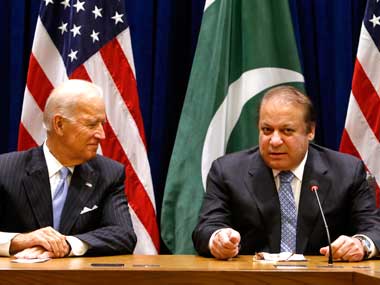
Sharif rakes up Kashmir issue at UN, blames India for cancelling talks

September 27, 2014

NawazSharifUnited Nations, Sep 27: Pakistan Prime Minister Nawaz Sharif today raked up the Kashmir issue at the UN General Assembly here and blamed India for "another missed opportunity" to address outstanding issues by canceling the Foreign Secretary-level talks. Asserting that a "veil" cannot be drawn over the "core" issue of Kashmir, he said Pakistan is ready to work for resolution of this problem through negotiations.

"Our support and advocacy of the right to self-determination of the people of Jammu and Kashmir is our historic commitment and a duty, as a party to the Kashmir dispute," he said while addressing the annual UN General Assembly session.

Needling India, Sharif said that more than six decades ago, the UN had passed resolutions to hold a plebiscite in Jammu and Kashmir. "The people of Jammu and Kashmir are still waiting for the fulfillment of that promise," he said.

"Many generations of Kashmiris have lived their lives under occupation, accompanied by violence and abuse of their fundamental rights. Kashmiri women, in particular, have undergone immense suffering and humiliation," he said. For decades, attempts have been made, both under UN auspices and bilaterally in the spirit of the Lahore Declaration, to resolve this dispute, he said.

"The core issue of Jammu and Kashmir has to be resolved. This is the responsibility of the international community. We cannot draw a veil on the issue of Kashmir, until it is addressed in accordance with the wishes of the people of Jammu and Kashmir," Sharif told the gathering.

India had called off the Foreign Secretary-level talks in August after Pakistan High Commissioner Abdul Basit met Kashmiri Hurriyat leaders in New Delhi, ignoring India's warning not to meet the separatist leaders.

In his address, Sharif said, "We were disappointed at the cancellation of the Foreign Secretary-level talks. The world community, too, rightly saw it as another missed opportunity "Pakistan is convinced that we must remain engaged in the dialogue process for settling disputes and building economic and trade relations. Let us not ignore the dividends of peace."

Both India and Pakistan have separately stated that there was no planned meeting of Sharif and Prime Minister Narendra Modi on the margins of the UN session. Sharif, however, gave enough indications that Pakistan was not averse to resumption of the dialogue process with India.

"Pakistan is ready to work for resolution of this problem through negotiations," he added. Sharif said that it is his government's "aspiration and effort" to build a peaceful neighborhood by pursuing a policy of constructive engagement.

"In South Asia, our people have missed opportunities for prosperity because of unresolved conflicts. We have a choice today: continue with the status quo or to seize the moment to resolve all outstanding issues and free up our shared energies for cooperation. To take this course of high statesmanship, we need more, not less, dialogue and diplomacy. We need to respect each other's rights and sensibilities. We must have relationships based on equality, mutual respect and transparency," he said.

Sharif said that as a "responsible" nuclear weapon state, Pakistan will continue to support the objectives of nuclear disarmament and non-proliferation; and pursue a policy of nuclear restraint and credible minimum deterrence.

"Pakistan is not participating in any arms race in the region. Yet we cannot be oblivious to the emerging security scenarios and buildup of armaments. We too, have the obligation to maintain a robust and reliable deterrence," he said.

Condemning terrorism, Sharif told the UN General Assembly that his country is fighting terrorism "planted" on its soil and has resolved to fight the "scourge" to the finish. "We condemn terrorism in all its forms and manifestations. We are fighting terrorism planted on Pakistan's soil. Our valiant soldiers are laying down their lives to take out terrorists and tear down their evil networks. The entire nation is behind them," Sharif said.

He said that in the past 13 years, Pakistan "as a frontline state" has sacrificed tremendously due to terrorism. "Over 50,000 people have lost their lives and thousands have suffered serious injuries. Our economy has lost hundreds of billions of dollars in direct costs and denied investment opportunities...It is the resolve of our nation to fight this scourge to the finish," he said.

Stating that Pakistan remains committed to forging a deeper bilateral relationship with Afghanistan on the basis of equal security and shared prosperity, Sharif said, "Our two nations confront common challenges, which call for greater cooperation and understanding between our two nations. I congratulate the people of Afghanistan over the successful completion of the electoral process and offer our warm felicitations and good wishes to the new Afghan leadership."

"It is our earnest hope that these landmark processes would culminate in the emergence of a stronger, more stable, and unified Afghanistan. We also hope that the process of inclusive Afghan-led and Afghan-owned reconciliation would move forward, contributing to greater harmony, stability and prosperity in Afghanistan," he added.

Comments

Add new comment

  • Coastaldigest.com reserves the right to delete or block any comments.
  • Coastaldigset.com is not responsible for its readers’ comments.
  • Comments that are abusive, incendiary or irrelevant are strictly prohibited.
  • Please use a genuine email ID and provide your name to avoid reject.
Agencies
June 9,2020

Wuhan, Jun 9: China on Tuesday dismissed as "incredibly ridiculous" a Harvard study, which pointed to a surge in traffic outside Wuhan hospitals from August 2019 suggesting that the coronavirus hit the area far earlier than reported.

A whitepaper on coronavirus released by China on Sunday said the virus was first noticed on December 17 and Chinese virologists confirmed human-to-human transmission on January 19, prompting authorities to impose lockdown of Wuhan from January 23.

US President Donald Trump and leaders of several countries have accused China of not being transparent in reporting the deadly disease, leading to huge human casualties and economic crisis across the world.

The new study by Harvard researchers says satellite images show an increase in traffic outside five hospitals in Wuhan from late August to December.

The traffic spike coincided with a rise in online searches for information on symptoms like "cough" and "diarrhoea".

China said the study was "ridiculous" and based on "superficial" information, BBC reported.

It is believed that the virus first appeared in China some time in November. Authorities reported a cluster of pneumonia cases with an unknown cause to the World Health Organization (WHO) on December 31.

"Clearly, there was some level of social disruption taking place well before what was previously identified as the start of the novel coronavirus pandemic," Dr John Brownstein, who led the research, told ABC news.

The study has not been peer-reviewed.

The researchers examined commercial satellite data from outside five Wuhan hospitals, comparing data from late summer and autumn 2018 to the same time period in 2019.

In one case, researchers counted 171 cars parked at one of Wuhan''s largest hospitals, Tianyou Hospital, in October 2018.

Satellite data from the same time in 2019 showed 285 vehicles in the same place, an increase of 67 per cent.

A surge in online searches for words associated with the symptoms of coronavirus on the Chinese search engine Baidu seemed to emerge at the same time.

"This is all about a growing body of information pointing to something taking place in Wuhan at the time," Dr Brownstein said.

"Many studies are still needed to fully uncover what took place and for people to really learn about how these disease outbreaks unfold and emerge in populations. So this is just another point of evidence," he said.

Asked for her reaction at the media briefing, Chinese Foreign Ministry spokeswoman Hua Chunying dismissed the findings as "incredibly ridiculous".

"I think it is ridiculous, incredibly ridiculous, to come up with this conclusion based on superficial observations such as traffic volume," she said.

"(I have) Not seen the research you mentioned. If the conclusion is drawn based on traffic volumes (and) other superficial observations, it won’t be a sound conclusion," she said and referred to the allegations about the COVID-19 originating from the Wuhan Institute of Virology (WIV) by Trump.

"That allegation was proved to be wrong," she said.

When pointed out that China says it respects science based inquiry and Harvard is one of the top universities in the world, Hua said, "on the origin of virus there are lot of conspiracy theories against China”.

"That is very unfair. At the moment, the pressing task is to enhance coordination to contain the spread of the virus. Someday, I am sure the truth will be out. China deserves a fair and objective evaluation," she said and referred to the whitepaper released by the Chinese government detailing evolution of coronavirus in Wuhan and how Beijing handled the situation.

Recently, the World Health Assembly (WHA), the decision-making body of Geneva-based World Health Organization (WHO), passed a resolution to probe the origin of the virus. China also backed the resolution.

As of Monday, the overall confirmed cases on the mainland had reached 83,043, including 58 patients who were still being treated, with no one in severe condition, China’s National Health Commission, (NHC) said.

Altogether 78,351 people had been discharged after recovery and 4,634 people had died of the disease, it said.

Comments

Add new comment

  • Coastaldigest.com reserves the right to delete or block any comments.
  • Coastaldigset.com is not responsible for its readers’ comments.
  • Comments that are abusive, incendiary or irrelevant are strictly prohibited.
  • Please use a genuine email ID and provide your name to avoid reject.
News Network
June 1,2020

Washington, Jun 1: Police fired tear gas outside the White House late Sunday as major US cities were put under curfew to suppress rioting as anti-racism protestors again took to the streets to voice fury at police brutality.

With the Trump administration branding instigators of six nights of rioting as domestic terrorists, there were more confrontations between protestors and police and fresh outbreaks of looting.

Violent clashes erupted repeatedly in a small park next to the White House, with authorities using tear gas, pepper spray and flash bang grenades to disperse crowds who lit several large fires and damaged property.

Local US leaders appealed to citizens to give constructive outlet to their rage over the death of an unarmed black man in Minneapolis, while night-time curfews were imposed in cities including Washington, Los Angeles and Houston.

One closely watched protest was outside the state capitol in Minneapolis' twin city of St. Paul, where several thousand people gathered before marching down a highway.

"We have black sons, black brothers, black friends, we don't want them to die. We are tired of this happening, this generation is not having it, we are tired of oppression," said Muna Abdi, a 31-year-old black woman who joined the protest.

"I want to make sure he stays alive," she added in reference to her son, aged three.

Hundreds of police and National Guard troops were deployed ahead of the protest.

At one point, some of the protestors who had reached a bridge were forced to scramble for cover when a truck drove at speed after having apparently breached a barricade.

The driver was later taken to hospital after the protestors hauled him from the vehicle, although there were no immediate reports of other casualties.

There were other large-scale protests in cities including New York and Miami.

Washington's mayor ordered a curfew from 11:00 pm until 6:00 am, as a report in the New York Times said that President Donald Trump had been rushed by Secret Service agents into an underground bunker at the White House on Friday night during an earlier protest.

Stores ransacked

Large-scale violence has rocked many US cities in recent days, and looters ransacked stores in a neighborhood of Philadelphia on Sunday.

In the Los Angeles suburb of Santa Monica, looting was reported at stores in a popular beachside shopping center.

Officials in LA -- a city scarred by the 1992 riots over the police beating of Rodney King, an African-American man -- imposed a curfew from 4:00 pm Sunday until dawn.

"Please, use your discretion and go early, go home, stay home and help us make sure that those who want to change this conversation from being about racial justice to be about burning things and looting things, don't win the day," the city's mayor Eric Garcetti said on CNN.

The shocking videotaped death last Monday of an unarmed black man, George Floyd, at the hands of police in Minneapolis ignited the nationwide wave of outrage over law enforcement's repeated use of lethal force against unarmed African Americans.

Floyd stopped breathing after Minneapolis police officer Derek Chauvin knelt on his neck for nearly nine minutes.

Chauvin has been charged with third-degree murder and is due to make his first appearance in court on Monday. Three other officers with him have been fired but for now face no charges.

Governor Tim Walz has mobilized all of Minnesota's National Guard troops  -- the state guard's biggest mobilization ever -- to help restore order.

Police fired tear gas and stun grenades to clear streets of curfew violators Saturday night in Minneapolis.

Walz extended a curfew for a third night Sunday and praised police and guardsmen for holding down violence. "They did so in a professional manner. They did so without a single loss of life and minimal property damage," he said.

"Congratulations to our National Guard for the great job they did immediately upon arriving in Minneapolis, Minnesota, last night," President Donald Trump tweeted, adding that they "should be used in other States before it is too late!"

The Department of Defense said that around 5,000 National Guard troops had been mobilized in 15 states as well as the capital Washington, with another 2,000 on standby.

The widespread resort to uniformed National Guards units is rare, and it evoked disturbing memories of the rioting in US cities in 1967 and 1968 in a turbulent time of protest over racial and economic disparities.

Trump blamed the extreme left for the violence, saying he planned to designate a group known as Antifa as a terrorist organization.

"The violence instigated and carried out by Antifa and other similar groups in connection with the rioting is domestic terrorism and will be treated accordingly," added Attorney General Bill Barr.

'A nation in pain'

Atlanta Mayor Keisha Lance Bottoms said Trump, who has often urged police to use tough tactics, was not helping matters.

"We are beyond a tipping point in this country, and his rhetoric only enflames that," she said on CBS.

Joe Biden, Trump's likely Democratic opponent in November's presidential election, visited the scene of one anti-racism protest.

"We are a nation in pain right now, but we must not allow this pain to destroy us," Biden tweeted, posting a picture of him speaking with an African-American family at the site where protesters had gathered in Delaware late Saturday.

Floyd's death has triggered protests beyond the United States, with hundreds rallying outside the US embassy in London in solidarity.

"I'm here because I'm tired, I'm fed up with it. When does this stop?" Doreen Pierre told AFP at the protest.

In Germany, England football international Jadon Sancho marked one of his three goals for Borussia Dortmund against Paderborn by lifting his jersey to reveal a T-shirt bearing the words "Justice for George Floyd".

Comments

Add new comment

  • Coastaldigest.com reserves the right to delete or block any comments.
  • Coastaldigset.com is not responsible for its readers’ comments.
  • Comments that are abusive, incendiary or irrelevant are strictly prohibited.
  • Please use a genuine email ID and provide your name to avoid reject.
News Network
July 1,2020

Jul 1: Hong Kong police moved swiftly on Wednesday against protesters gearing up for the first rally since the introduction of sweeping security legislation, making their first arrest under it and warning of punishment for pro-independence material.

Beijing on Tuesday unveiled the details of the much-anticipated law after weeks of uncertainty, pushing China's freest city and one of the world's most glittering financial hubs onto a more authoritarian path.

As hundreds of protesters gathered downtown for an annual rally marking the 23rd anniversary of the former British colony's handover to China, riot police used pepper spray to arrest at least two people, while one metro station closed.

Police, who earlier banned the rally, cited the law for the first time in confronting protesters and they also made their first arrest under it - a man holding a flag advocating independence.

"You are displaying flags or banners/chanting slogans/or conducting yourselves with an intent such as secession or subversion, which may constitute offences under the ... national security law," police said in a message displayed on a purple banner.

The law will punish crimes of secession, subversion, terrorism and collusion with foreign forces with up to life in prison, heralding a more authoritarian era for the Asian financial hub.

China's parliament adopted it in response to months of pro-democracy protests last year triggered by fears that Beijing was stifling the city's freedoms, guaranteed by a "one country, two systems" formula agreed when it returned to Chinese rule.

Authorities in Beijing and Hong Kong have repeatedly said the legislation is aimed at a few "troublemakers" and will not affect rights and freedoms, nor investor interests.

But critics fear it will crush the freedoms that are seen as key to Hong Kong's success as a financial centre.

"With the release of the full detail of the law, it should be clear to those in any doubt that this is not the Hong Kong they grew up in," said Hasnain Malik, head of equity research, Tellimer in Dubai.

"The difference is that U.S. and China relations are far worse and this could be used as a pretext to impede the role of Hong Kong as a finance hub."

In Beijing, Zhang Xiaoming, executive deputy director of Beijing's Hong Kong and Macau Affairs Office, told reporters suspects arrested by Beijing's new security office in Hong Kong could be tried on the mainland.

He said the mainland's national security office abided by Chinese law and that Hong Kong's legal system could not be expected to implement the laws of the mainland. Article 55 of the law states that Beijing's national security office in Hong Kong could exercise jurisdiction over "complex" or "serious" cases.

Mainland security agencies will also be based in Hong Kong officially for the first time, with powers that go beyond city laws.

"The law is a birthday gift to (Hong Kong) and will show its precious value in the future," Zhang said, adding the law would not be applied retroactively.

On July 1 last year, hundreds of protesters stormed and vandalised the city's legislature to protest against a now-scrapped bill that would have allowed extraditions to mainland China.

Those protests evolved into calls for greater democracy, paralysing parts of the city and paving the way for Beijing's imposition of the law this week.

'INEVITABLE'

Speaking at a flag-raising ceremony to mark the handover anniversary, the city's Beijing-backed leader, Carrie Lam, said the law was the most important development since the city's return to Chinese rule.

"It is also an inevitable and prompt decision to restore stability," Lam said at the same harbour-front venue where 23 years ago the last colonial governor, Chris Patten, a staunch critic of the security law, tearfully handed back Hong Kong to Chinese rule.

Some pro-Beijing officials and political commentators say the law is aimed at sealing Hong Kong's "second return" to the motherland after the first failed to bring residents to heel.

Luo Huining, the head of Beijing's top representative office in Hong Kong, said at the ceremony the law was a "common aspiration" of Hong Kong citizens.

Critics denounced the lack of transparency surrounding the details of the legislation until it was unveiled. It came into force at 11 p.m. (1500 GMT) on Tuesday.

Some pro-democracy activists gave up membership of their groups just before the law came into force, though calling for the campaign for democracy to go on offshore.

"I saw this morning there are celebrations for Hong Kong's handover, but to me it is a funeral, a funeral for 'one country two systems'," said democracy lawmaker Kwok Ka-ki.

Comments

Add new comment

  • Coastaldigest.com reserves the right to delete or block any comments.
  • Coastaldigset.com is not responsible for its readers’ comments.
  • Comments that are abusive, incendiary or irrelevant are strictly prohibited.
  • Please use a genuine email ID and provide your name to avoid reject.