


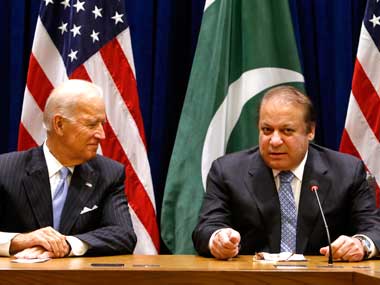
Sharif rakes up Kashmir issue at UN, blames India for cancelling talks

September 27, 2014

NawazSharifUnited Nations, Sep 27: Pakistan Prime Minister Nawaz Sharif today raked up the Kashmir issue at the UN General Assembly here and blamed India for "another missed opportunity" to address outstanding issues by canceling the Foreign Secretary-level talks. Asserting that a "veil" cannot be drawn over the "core" issue of Kashmir, he said Pakistan is ready to work for resolution of this problem through negotiations.

"Our support and advocacy of the right to self-determination of the people of Jammu and Kashmir is our historic commitment and a duty, as a party to the Kashmir dispute," he said while addressing the annual UN General Assembly session.

Needling India, Sharif said that more than six decades ago, the UN had passed resolutions to hold a plebiscite in Jammu and Kashmir. "The people of Jammu and Kashmir are still waiting for the fulfillment of that promise," he said.

"Many generations of Kashmiris have lived their lives under occupation, accompanied by violence and abuse of their fundamental rights. Kashmiri women, in particular, have undergone immense suffering and humiliation," he said. For decades, attempts have been made, both under UN auspices and bilaterally in the spirit of the Lahore Declaration, to resolve this dispute, he said.

"The core issue of Jammu and Kashmir has to be resolved. This is the responsibility of the international community. We cannot draw a veil on the issue of Kashmir, until it is addressed in accordance with the wishes of the people of Jammu and Kashmir," Sharif told the gathering.

India had called off the Foreign Secretary-level talks in August after Pakistan High Commissioner Abdul Basit met Kashmiri Hurriyat leaders in New Delhi, ignoring India's warning not to meet the separatist leaders.

In his address, Sharif said, "We were disappointed at the cancellation of the Foreign Secretary-level talks. The world community, too, rightly saw it as another missed opportunity "Pakistan is convinced that we must remain engaged in the dialogue process for settling disputes and building economic and trade relations. Let us not ignore the dividends of peace."

Both India and Pakistan have separately stated that there was no planned meeting of Sharif and Prime Minister Narendra Modi on the margins of the UN session. Sharif, however, gave enough indications that Pakistan was not averse to resumption of the dialogue process with India.

"Pakistan is ready to work for resolution of this problem through negotiations," he added. Sharif said that it is his government's "aspiration and effort" to build a peaceful neighborhood by pursuing a policy of constructive engagement.

"In South Asia, our people have missed opportunities for prosperity because of unresolved conflicts. We have a choice today: continue with the status quo or to seize the moment to resolve all outstanding issues and free up our shared energies for cooperation. To take this course of high statesmanship, we need more, not less, dialogue and diplomacy. We need to respect each other's rights and sensibilities. We must have relationships based on equality, mutual respect and transparency," he said.

Sharif said that as a "responsible" nuclear weapon state, Pakistan will continue to support the objectives of nuclear disarmament and non-proliferation; and pursue a policy of nuclear restraint and credible minimum deterrence.

"Pakistan is not participating in any arms race in the region. Yet we cannot be oblivious to the emerging security scenarios and buildup of armaments. We too, have the obligation to maintain a robust and reliable deterrence," he said.

Condemning terrorism, Sharif told the UN General Assembly that his country is fighting terrorism "planted" on its soil and has resolved to fight the "scourge" to the finish. "We condemn terrorism in all its forms and manifestations. We are fighting terrorism planted on Pakistan's soil. Our valiant soldiers are laying down their lives to take out terrorists and tear down their evil networks. The entire nation is behind them," Sharif said.

He said that in the past 13 years, Pakistan "as a frontline state" has sacrificed tremendously due to terrorism. "Over 50,000 people have lost their lives and thousands have suffered serious injuries. Our economy has lost hundreds of billions of dollars in direct costs and denied investment opportunities...It is the resolve of our nation to fight this scourge to the finish," he said.

Stating that Pakistan remains committed to forging a deeper bilateral relationship with Afghanistan on the basis of equal security and shared prosperity, Sharif said, "Our two nations confront common challenges, which call for greater cooperation and understanding between our two nations. I congratulate the people of Afghanistan over the successful completion of the electoral process and offer our warm felicitations and good wishes to the new Afghan leadership."

"It is our earnest hope that these landmark processes would culminate in the emergence of a stronger, more stable, and unified Afghanistan. We also hope that the process of inclusive Afghan-led and Afghan-owned reconciliation would move forward, contributing to greater harmony, stability and prosperity in Afghanistan," he added.

Comments

Add new comment

  • Coastaldigest.com reserves the right to delete or block any comments.
  • Coastaldigset.com is not responsible for its readers’ comments.
  • Comments that are abusive, incendiary or irrelevant are strictly prohibited.
  • Please use a genuine email ID and provide your name to avoid reject.
News Network
February 1,2020

Washington, Feb 1: The Indian economy experienced some abrupt slowdown in 2019 due to turbulence in non-banking financial institutions and major reform measures such as GST and demonetisation, but it is not in a recession, IMF Managing Director Kristalina Georgieva has said.

"The Indian economy indeed has experienced an abrupt slowdown in 2019. We had to revise our growth projections, downwards to four percent for last year. We are expecting 5.8 per cent (growth rate) in 2020 and then an upward trajectory to 6.5 percent in 2021," Georgieva told a group of foreign journalists here on Friday.

"It appears that the main reason for this slowdown was the non-banking financial institutions experiencing a turbulence," she said on the eve of Union Finance Minister Nirmala Sitharaman presenting the annual budget in Parliament on Saturday.

She said India had undertaken some important reforms that over the longer term would be beneficial for the country, but they do have some short-term impact.

"For example, coming with the unified tax system, and the demonetisation that took place. These are steps that over time are beneficial, but of course they might, might be somewhat disruptive over short term," Georgieva said in response to a question.

The International Monetary Fund (IMF) Managing Director said that there is not a lot of fiscal space in India. “But we also recognise that the policies of the government on that side, on the fiscal side have been prudent. We will see how the reading of the budget, the submission of the budget goes, tomorrow,” she said.

In the medium-term, she said, the IMF remains optimistic about India. “This is why we see that upswing potential for the growth in the country,” she said.

Georgieva said that the current economic slowdown cannot be described as a recession. "No.... You're far from that. But it is a significant slowdown, not the recession," she said.

The IMF managing Director noted that the consumption in India also slowed down and that contributed to the overall slowdown in the economy. The IMF would be keen to see what India does to get relatively sound macroeconomic fundamentals to pay off in terms of better growth trajectory, she said ahead of the budget.

One thing that is important for India is that budgetary revenue have been below target. "The country knows that. The finance minister knows it. They need to increase budgetary revenue collection so they can improve their fiscal position. I said it's tight on the spending side, but I also want to stress that there is room to improve collection on the revenue side," she said.

Comments

Add new comment

  • Coastaldigest.com reserves the right to delete or block any comments.
  • Coastaldigset.com is not responsible for its readers’ comments.
  • Comments that are abusive, incendiary or irrelevant are strictly prohibited.
  • Please use a genuine email ID and provide your name to avoid reject.
News Network
April 15,2020

Seoul, Apr 15: Wearing masks and gloves, South Korean voters cast their ballots on Wednesday to elect 300 parliamentary lawmakers amid the coronavirus outbreak.

Voting kicked off at 6 am (local time) and was to run until 6 pm (local time) at 14,330 polling stations across the country, according to the National Election Commission (NEC). The number of eligible voters is 44 million, according to Yonhap news agency.

The once-in-four-years legislative election is widely seen as a referendum on President Moon Jae-in, whose five-year term will end in mid-2022, as well as a test of the country's fight against COVID-19 under the leadership of Moon, The Strait Times reported.

South Korea has received international praise for its massive testing capability and other innovative measures, such as drive-through testing and high-tech contact tracing.

Experts, therefore, expect the ruling Democratic Party (DP) to extend its lead in Parliament, given that the government's handling of the virus outbreak is viewed positively both at home and abroad, as per The Strait Times.

At least 10,564 people in the country have been infected by coronavirus, which has claimed 222 lives. About 2,800 patients are undergoing treatment.

The number of new cases has fallen from a high of 813 on February 29 to below 50 for six days in a row as an intensive social distancing campaign that started on March 21 remained in place.

Several surveys cited by the newspaper also showed that voters consider the pandemic as the biggest factor in their decision. A recent poll showed that 72.6 per cent of respondents rated the government's response to the outbreak as positive.

The NEC has said that public safety at polling stations will be a priority to prevent any possible spread of the virus.

All 14,330 polling stations and 251 counting stations will be disinfected on polling day, the NEC was quoted.

Voters will undergo temperature screening and those registering temperatures of 37.5 degrees Celsius or higher or display respiratory symptoms will have to exercise their franchise at a separate booth.

Tuesday was the last of 13 days of campaigning, which saw most candidates reducing their ground activities and face-to-face encounters with voters. Instead, the candidates boosted their online presence with videos and social media engagements in a bid to win votes, according to The Strait Times.

In addition, the government has also decided to temporarily lift quarantine rules to permit self-isolators to vote in the elections. Some 50,000 people in self-isolation who have no symptoms and expressed a willingness to vote will be allowed to cast ballots after the regular voting ends in the evening.

Comments

Add new comment

  • Coastaldigest.com reserves the right to delete or block any comments.
  • Coastaldigset.com is not responsible for its readers’ comments.
  • Comments that are abusive, incendiary or irrelevant are strictly prohibited.
  • Please use a genuine email ID and provide your name to avoid reject.
News Network
July 1,2020

As Peru begins to ease its strict coronavirus lockdown, the country's biggest LGBTQ nightclub opened its doors on Tuesday, but there will be no nighttime revellers; its dance floor will instead be filled with shelves stocked with groceries.

Instead of slinging cocktails at the bar or dancing on stage, ValeTodo Downtown's famed staff of drag queens will sell customers daily household products as the space reopens as a market while nightclubs are ordered to remain closed.

The Peruvian government will lift the lockdown in most regions of the country at the beginning of July but will keep borders closed, as well as nightclubs and bars.

The lockdown has been a struggle for the club's 120 employees like drag queen Belaluh McQueen. Her life completely changed when the government announced the quarantine. Her nights were spent at home, rather than performing as a dancer at the club in vivid-coloured costumes.

"I was very depressed because I have been doing this art for years, but you have to adapt to new challenges for the future," said McQueen, who is identified by her stage name.

Now McQueen is back to work as a grocery store employee, wearing a sequined suit, high heels and a mask. A DJ will play club music as patrons shop. "We have a new job opportunity," McQueen added.

Renamed as Downtown Market, the club, which has been a mainstay hallmark of the local LGBTQ community, ushered in its reopening with an inauguration ceremony.

"Before, I used to come here to dance and have a good time, but now we come to buy," said Alexandra Herrera, a regular attendee of the club. "The thing is to reinvent yourself."

The club's general manager, Claudia Achuy, said that the pandemic impacted the heart of Lima nightlife, but she chose to reopen as a market rather than risk cutting staff. "If we had just stayed as a nightclub we did not have a close horizon or a way of working," Achuy said.

Peru's confirmed coronavirus cases rose to 282,364 with 9,504 associated deaths on Monday, according to government data. It has the second-highest outbreak in Latin America after Brazil, according to a Reuters tally.

Comments

Add new comment

  • Coastaldigest.com reserves the right to delete or block any comments.
  • Coastaldigset.com is not responsible for its readers’ comments.
  • Comments that are abusive, incendiary or irrelevant are strictly prohibited.
  • Please use a genuine email ID and provide your name to avoid reject.