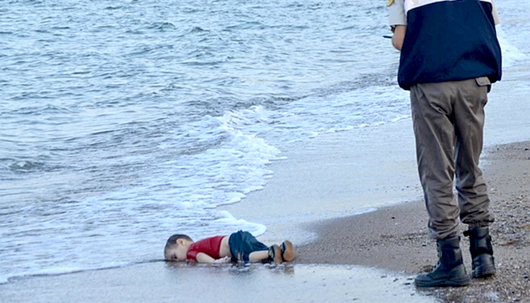
Shocking image of dead child washed up on Turkish beach lays bare Europe's migrant crisis

September 3, 2015

Ankara, Sep 3: An image of a drowned toddler washed up on the beach in one of Turkey's prime tourist resorts swept across social media on Wednesday, after at least 12 presumed Syrian refugees died trying to reach the Greek island of Kos.

child

The picture showed a little boy wearing a bright red t-shirt and shorts lying face-down in the surf on a beach near the resort town of Bodrum. In a second image, a grim-faced policeman carries the tiny body away.

The hashtag "KiyiyaVuranInsanlik" - "humanity washed ashore" - became the top trending topic on Twitter after the picture was retweeted heavily.

The two boats, carrying a total of 23 people, had set off separately from the Akyarlar area of the Bodrum peninsula, a senior Turkish naval official said.

The confirmed dead included five children and one woman. Seven people were rescued and two reached the shore in lifejackets. The official said hopes were fading of saving the two people still missing.

Television images showed the lifeless body of a small boy dressed in a red t-shirt and blue shorts lying face-down on the sand in Bodrum, one of Turkey's most popular beach resorts.

Tens of thousands of Syrians fleeing the war in their homeland have descended on Turkey's Aegean coast this summer to board boats to Greece, their gateway to the European Union.

The official said almost 100 people in all had been rescued by Turkish vessels overnight as they tried to reach Kos.

Aid agencies estimate that, over the past month, about 2,000 people a day have been making the short crossing to Greece's eastern islands on rubber dinghies.

A ship bringing about 1,800 migrants and refugees from one of the islands arrived at the port of Piraeus near Athens on Tuesday night, the Greek coastguard said.

Thousands of people, mainly Africans, have also been trying to reach Europe via boat from Libya to Italy. The United Nations refugee agency UNHCR said four bodies had been pulled from the central Mediterranean on Tuesday and 781 migrants rescued, mostly from Nigeria, Ivory Coast and Senegal.

So far this year, more than 2,500 people have died trying to cross the Mediterranean, the UNHCR said.

Comments

Add new comment

  • Coastaldigest.com reserves the right to delete or block any comments.
  • Coastaldigset.com is not responsible for its readers’ comments.
  • Comments that are abusive, incendiary or irrelevant are strictly prohibited.
  • Please use a genuine email ID and provide your name to avoid reject.
News Network
April 26,2020

Apr 26: The remarkable story of an airman who overcame prejudice to become one of only a handful of Indian fighter pilots in the First World War has emerged in newly-released archive files by the UK's Commonwealth War Graves Commission (CWGC).

Lieutenant Shri Krishna Chanda Welinkar is one of the thousands of moving stories from the war preserved in family correspondence and being brought alive as part of a digitisation project.

The never-before-published files contain thousands of letters, pictures and other papers sent between the Commission and the next of the kin of First World War dead.

Among them is the story of Welinkar, who hailed from Bombay in colonial India. After much hardship and discrimination, he eventually became a pilot and went missing while on patrol over the skies above the Western Front in June 1918.

His family had to wait nearly three years before they finally knew for certain that he had died, and his grave was located.

“For everyone who died in the First World War, there was inevitably a partner, parent or child back home who had questions. The heartbreaking letters in CWGC's archive give us an insight into what it was like for those families trying to come to terms with their loss,” said Andrew Fetherston, chief archivist for CWGC.

“They are stories that show desperate searches for closure, former enemies uniting and, on many occasions, the sad realisation that a missing loved one would always remain so. We are pleased to be able to make this invaluable piece of World War history accessible to a new generation and help deepen our understanding of how the First World War impacted those who were left behind,” he said.

Welinkar was one of the 1.3 million Indians who answered the call to fight for the British Empire. Nearly 74,000 never saw their homeland again and are remembered today in cemeteries and memorials throughout the world, including France, Belgium, the Middle East and Africa.

Welinkar was a well-educated man studying at Cambridge University. He trained to become an aviator in Middlesex and wished to join the Royal Flying Corps, later known as the Royal Air Force.

Upon attempting to enlist, Welinkar encountered the same prejudices as his other fellow Indian airmen and was encouraged to become an air mechanic instead.

He was eventually given a commission in the Royal Flying Corps as an Officer. In 1918, he was posted to France and patrolled the skies above the Western Front.

In June 1918, Lieutenant Welinkar embarked on what would be his final patrol; he did not return and was reported missing. His fate remained unknown for many months afterwards.

The newly-released e-files chronicle the remarkable discovery of Welinkar and his final resting place long after the war had ended. Colonel Barton, who knew Welinkar, acted on behalf of his mother and helped find her missing son. They spoke to former enemies and honed their search to the grave of an unidentified man, buried by the Germans as “Oberleutnant S.C. Wumkar” in a grave in Rouvroy, Belgium.

The body was later moved and reinterred in Hangard Communal Cemetery Extension but it wasn't until the vital clue, found in the original German burial records in February 1921, that it was confirmed beyond doubt this grave was of Welinkar's.

In May 1921, Colonel Barton, on behalf of Welinkar's mother, requested that a Commission headstone be placed on the grave with the following personal inscription: “To the Honoured Memory of One of the Empire's Bravest Sons”.

This records – known as Enquiry Files – are part of a collection of nearly 3,000 files which have never been made available to the public before. Nearly half have been digitised so far, alongside a previously unreleased collection of more than 16,000 photographs held in negatives in the Commission's archive.

The files, internally referred to simply as E-Files, contain correspondence between the CWGC and the next of kin of the war dead. They often contain letters, typed memos between Commission staff and on occasion photos, maps and diagrams.

CWGC only holds an enquiry file for a small proportion of the 1.7 million people it commemorates from the Commonwealth. Today it is only possible to release those surviving records from the First World War because correspondence with families of Second World War casualties often involves people still alive today and cannot be made public for many years, due to the UK's data protection rules.

To date, more than 1,300 of the surviving 3,000 First World War enquiry files have been digitised.

The CWGC commemorates the 1.7 million Commonwealth servicemen and women who died during the two World Wars. It also holds and updates an extensive and accessible records archive, while operating over 23,000 locations in more than 150 countries and territories.


Comments

Add new comment

  • Coastaldigest.com reserves the right to delete or block any comments.
  • Coastaldigset.com is not responsible for its readers’ comments.
  • Comments that are abusive, incendiary or irrelevant are strictly prohibited.
  • Please use a genuine email ID and provide your name to avoid reject.
News Network
June 17,2020

Washington, Jun 17: The United States is closely monitoring the situation following a fierce clash between Indian and Chinese forces in eastern Ladakh and hopes that the differences will be resolved peacefully, officials said here.

Twenty Indian Army personnel including a colonel were killed in the clash with Chinese troops in the Galwan Valley in eastern Ladakh on Monday night, the biggest military confrontation in over five decades that has significantly escalated the already volatile border standoff in the region.

"We are closely monitoring the situation between Indian and Chinese forces along the Line of Actual Control," a State Department spokesperson said.

"We note the Indian military has announced that 20 soldiers have died, and we offer our condolences to their families," the official said.

Both India and China have expressed their desires to de-escalate and the US supports a peaceful resolution of the current situation, the spokesperson said.

"During their phone call on June 2, 2020, President Donald Trump and Prime Minister Narendra Modi had discussed the situation along the India-China border," the official added.

Comments

Add new comment

  • Coastaldigest.com reserves the right to delete or block any comments.
  • Coastaldigset.com is not responsible for its readers’ comments.
  • Comments that are abusive, incendiary or irrelevant are strictly prohibited.
  • Please use a genuine email ID and provide your name to avoid reject.
Agencies
August 5,2020

Ninety per cent of a sample group of coronavirus-recovered patients from a prominent hospital in China's Wuhan city where the pandemic broke out have reported lung damage and five per cent of them are again in quarantine after testing positive for the virus, according to a media report on Wednesday.

A team at the Zhongnan Hospital of Wuhan University led by Peng Zhiyong, director of the hospital's Intensive Care Unit, has been conducting follow-up visits with '100 recovered patients' since April.

The first phase of this one-year programme finished in July. The average age of the patients in the study is 59.

According to the first phase results, 90 per cent of the patients' lungs are still in a damaged state, which means their lungs ventilation and gas exchange functions have not recovered to the level of healthy people, state-run Global Times reported.

Peng's team conducted a six-minute walking test with the patients. They found that the recovered patients could only walk 400 metres in six minutes while their healthy peers could walk 500 metres in the same period.

Some recovered patients have to rely on oxygen machines even three months after being discharged from the hospital, Liang Tengxiao, a doctor from the Dongzhimen Hospital, Beijing University of Chinese Medicine, was quoted as saying by the report.

Liang's team is also conducting follow-up visits with recovered patients aged above 65.

The results also showed that antibodies against the novel coronavirus in 10 per cent of the 100 patients have disappeared.

Five per cent of them received negative results in Covid-19 nucleic acid tests but positive results in Immunoglobulin M (IgM) tests, and thus have to be quarantined again, the report said.

IgM is usually the first antibody produced by the immune system when a virus attacks. A positive result in an IgM test usually means that a person has just been infected by the virus.

It is still unclear if this means these people have been infected again.

The 100 patients' immune systems have not fully recovered as they showed a low level of B cells -- - a primary force for killing viruses in the human body -- but a high level of T cells which only recognise viral antigens outside infected cells.

"The results revealed that the patients’ immune systems are still recovering," Peng said.

The patients also suffered from depression and a sense of stigma. Most of the recovered patients told the team that their families were not willing to have dinner with them at the same table, the report said.

Less than half of the recovered patients have returned to work, it said.

The findings are significant as the coronavirus first emerged in Wuhan city.

Hubei province for which Wuhan is the provincial capital has reported a total of 68,138 confirmed Covid-19 cases till now. The disease has claimed 4,512 lives in the province, according to the official data.

China reported 27 new confirmed Covid-19 cases on Tuesday, including 22 locally-transmitted cases, the National Health Commission (NHC) said on Wednesday.

Comments

Add new comment

  • Coastaldigest.com reserves the right to delete or block any comments.
  • Coastaldigset.com is not responsible for its readers’ comments.
  • Comments that are abusive, incendiary or irrelevant are strictly prohibited.
  • Please use a genuine email ID and provide your name to avoid reject.