


Shocking image of dead child washed up on Turkish beach lays bare Europe's migrant crisis

September 3, 2015

Ankara, Sep 3: An image of a drowned toddler washed up on the beach in one of Turkey's prime tourist resorts swept across social media on Wednesday, after at least 12 presumed Syrian refugees died trying to reach the Greek island of Kos.
child

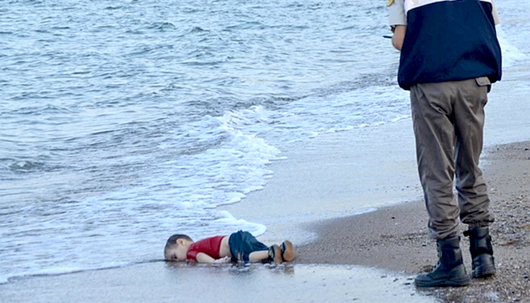
The picture showed a little boy wearing a bright red t-shirt and shorts lying face-down in the surf on a beach near the resort town of Bodrum. In a second image, a grim-faced policeman carries the tiny body away.

The hashtag "KiyiyaVuranInsanlik" - "humanity washed ashore" - became the top trending topic on Twitter after the picture was retweeted heavily.

The two boats, carrying a total of 23 people, had set off separately from the Akyarlar area of the Bodrum peninsula, a senior Turkish naval official said.

The confirmed dead included five children and one woman. Seven people were rescued and two reached the shore in lifejackets. The official said hopes were fading of saving the two people still missing.

Television images showed the lifeless body of a small boy dressed in a red t-shirt and blue shorts lying face-down on the sand in Bodrum, one of Turkey's most popular beach resorts.

Tens of thousands of Syrians fleeing the war in their homeland have descended on Turkey's Aegean coast this summer to board boats to Greece, their gateway to the European Union.

The official said almost 100 people in all had been rescued by Turkish vessels overnight as they tried to reach Kos.

Aid agencies estimate that, over the past month, about 2,000 people a day have been making the short crossing to Greece's eastern islands on rubber dinghies.

A ship bringing about 1,800 migrants and refugees from one of the islands arrived at the port of Piraeus near Athens on Tuesday night, the Greek coastguard said.

Thousands of people, mainly Africans, have also been trying to reach Europe via boat from Libya to Italy. The United Nations refugee agency UNHCR said four bodies had been pulled from the central Mediterranean on Tuesday and 781 migrants rescued, mostly from Nigeria, Ivory Coast and Senegal.

So far this year, more than 2,500 people have died trying to cross the Mediterranean, the UNHCR said.

Comments

Add new comment

  • Coastaldigest.com reserves the right to delete or block any comments.
  • Coastaldigset.com is not responsible for its readers’ comments.
  • Comments that are abusive, incendiary or irrelevant are strictly prohibited.
  • Please use a genuine email ID and provide your name to avoid reject.
News Network
May 27,2020

Washington, May 27: Most viruses and other germs do not spread easily on flights, the US Center for Disease Control and Prevention has said in its COVID-19 guidelines which do not recommend following social distancing between two passengers inside a plane or keeping the middle seat unoccupied.

As a result of coronavirus pandemic, air traffic inside the US has come to a near halt. Air traffic is said to be down to about 90 per cent. For all travellers coming from overseas, the Center for Disease Control and Prevention (CDC) has recommended 14 days quarantine.

"Most viruses and other germs do not spread easily on flights because of how air circulates and is filtered on aeroplanes," the CDC has said in its set of COVID-19 guidelines for air travellers.

However, it noted that the air travellers were not risk-free especially in the time of the coronavirus pandemic and recommended Americans to avoid travel as far as possible.

"Air travel requires spending time in security lines and airport terminals, which can bring you in close contact with other people and frequently touched surfaces," it said.

"Social distancing is difficult on crowded flights, and you may have to sit near others (within six feet), sometimes for hours. This may increase your risk for exposure to the virus that causes COVID-19," the CDC said.

But instead of recommended social distancing inside commercial planes, the CDC has advised a series of preventive and hygienic measures to be taken by the airlines pilot and crew to prevent the spread of coronavirus.

The US Department of Transportation and Federal Aviation Administration in its latest safety alerts for operators on May 11 said that air carriers and crews conducting flight operations having a nexus to the US, including both domestic and foreign air carriers, should follow CDC's occupational health and safety guidance.

The CDC issued its guidelines in first guidelines for the airlines and airline crew on March and again in May.

The CDC, which has issued an exhaustive social guideline measures in various sections, is silent on keeping the middle seat of a plane unoccupied so as to maintain the six feet distance between two passengers.

It calls for the plane crew to report to the CDC a traveller with specific COVID-19 symptoms like fever, persistent cough, difficulty in breathing and appearing unwell.

Asking the airlines and cabin crew to review infection control guidelines for cabin crew, the CDC recommends several measures for cabin crew to protect themselves and others, manage a sick traveller, clean contaminated areas, and take actions after a flight.

Prominent among them include washing hands often with soap and water for at least 20 seconds, particularly after assisting sick travellers or touching potentially contaminated body fluids or surfaces and use of alcohol-based hand sanitizer (containing at least 60 per cent alcohol) if soap and water are not available.

Airlines should consider providing alcohol-based hand sanitizer to cabin and flight crews for their personal use, it said.

The CDC guidelines do not recommend following social distancing inside a plane between two passengers or keeping the middle seat unoccupied. But it asks to minimise contact between passengers and cabin crew and the sick person.

"If possible, separate the sick person from others (by a distance of 2 meters or 6 feet, ideally) and designate one crew member to serve the sick person. Offer a facemask, if available and if the sick person can tolerate it. If a facemask is not available or cannot be tolerated, ask the sick person to cover their mouth and nose with tissues when coughing or sneezing," said the CDC guidelines.

If no symptomatic passengers were identified during or immediately after the flight, the CDC recommends airlines to follow routine operating procedures for cleaning aircraft, managing solid waste, and wearing PPE.

"If symptomatic passengers are identified during or immediately after the flight, routine cleaning procedures should be followed, and enhanced cleaning procedures should also be used," it said.

Clean porous (soft) surfaces (e.g, cloth seats, cloth seat belts) at the seat of the symptomatic passengers and within 6 feet of the symptomatic passengers in all directions, it added.

Comments

Add new comment

  • Coastaldigest.com reserves the right to delete or block any comments.
  • Coastaldigset.com is not responsible for its readers’ comments.
  • Comments that are abusive, incendiary or irrelevant are strictly prohibited.
  • Please use a genuine email ID and provide your name to avoid reject.
News Network
May 6,2020

Singapore, May 6: Oil prices slipped back Wednesday after two days of gains, although Brent crude remained above $30 a barrel, as renewed US-China tensions offset optimism about the easing of coronavirus lockdowns.

Brent, the international benchmark, fell 1.1 per cent to $30.63 a barrel in early Asian trade. On Tuesday, the contract surged 14 per cent and rose above $30 for the first time since mid-April.

US marker West Texas Intermediate slipped 1.9 per cent and was changing hands for $24.13 a barrel.

Oil markets have been battered as the virus strangled demand due to business closures and travel restrictions, with US crude falling into negative territory last month for the first time.

They started rallying strongly this week as countries from Europe to Asia ease curbs and economies start shuddering back to life.

But gains were capped Wednesday as dealers follow a brewing US-China row after Donald Trump hit out at Beijing over its handling of the outbreak, saying it began in a Wuhan lab, but so far offering no evidence.

"Traders are incredibly cautious this morning, weighing all the possible China responses," said Stephen Innes, chief global market strategist at AxiCorp.

"And the one that would hurt the most would be for China to reduce imports of US oil."

This week's rally was in part driven by a deal agreed between top producers to reduce output by almost 10 million barrels a day, which came into effect on May 1.

There have also been signs that the massive oversupply in the market is starting to ease as demand slowly comes back.

Energy data provider Genscape said earlier this week that stockpiles at the main US oil depot in Cushing, Oklahoma had increased by only 1.8 million barrels last week following weeks of major rises.

Comments

Add new comment

  • Coastaldigest.com reserves the right to delete or block any comments.
  • Coastaldigset.com is not responsible for its readers’ comments.
  • Comments that are abusive, incendiary or irrelevant are strictly prohibited.
  • Please use a genuine email ID and provide your name to avoid reject.
News Network
May 19,2020

May 18: Risk managers expect a prolonged global recession as a result of the coronavirus pandemic, a report by the World Economic Forum showed on Tuesday.

Two-thirds of the 347 respondents to the survey - carried out in response to the outbreak - put a lengthy contraction in the global economy top of their list of concerns for the next 18 months.

Half of risk managers expected bankruptcies and industry consolidation, the failure of industries to recover and high levels of unemployment, particularly among the young.

“The crisis has devastated lives and livelihoods. It has triggered an economic crisis with far-reaching implications and revealed the inadequacies of the past," said Saadia Zahidi, managing director of the World Economic Forum.

Environmental goals risk being discarded as a result of the pandemic, the report said, but governments should try to carve out a "green recovery".

"We now have a unique opportunity to use this crisis to do things differently and build back better economies that are more sustainable, resilient and inclusive," Zahidi said.

The report was compiled by the World Economic Forum’s Global Risks Advisory Board together with Marsh & McLennan Companies Inc and Zurich Insurance Group.

Risk managers were surveyed between April 1 and 13.

Comments

Add new comment

  • Coastaldigest.com reserves the right to delete or block any comments.
  • Coastaldigset.com is not responsible for its readers’ comments.
  • Comments that are abusive, incendiary or irrelevant are strictly prohibited.
  • Please use a genuine email ID and provide your name to avoid reject.