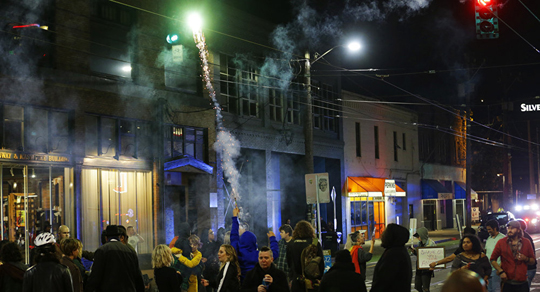
Shooting reported near anti-Trump rally in Seattle

November 10, 2016

Washington, Nov 10: The Seattle police said on Wednesday night that they were investigating a report of a shooting with “multiple victims” not far from the scene of protests over the surprise victory of Republican Donald Trump in the U.S. presidential election.

Shooting

The Seattle fire department said on Twitter shortly after 7 p.m. local time that some crew were treating five patients with gunshot wounds, two of them with life-threatening injuries.

It was not immediately clear if the shooting was related to the demonstrations.

Police said on Twitter that more details would be released “as they become available.”

Local KIRO-TV reported that the suspect remained at large following the shooting.

'Not my president!'

The raw divisions exposed by the presidential race were on full display across America, as protesters flooded city streets to condemn Donald Trump's election.

From New England to heartland cities like Kansas City and along the West Coast, demonstrators carried flags and anti-Trump signs, disrupting traffic and declaring that they refused to accept Mr. Trump's triumph.

In Chicago, where thousands had recently poured into the streets to celebrate the Chicago Cubs' first World Series victory in over a century, several thousand people marched through the Loop. They gathered outside Trump Tower, chanting “Not my president!”

A similar protest in Manhattan drew about 1,000 people. Outside Trump Tower on Fifth Avenue in midtown, police installed barricades to keep the demonstrators at bay.

In Boston, thousands of anti-Trump protesters streamed through downtown, chanting “Trump's a racist” and carrying signs that said “Impeach Trump” and “Abolish Electoral College.” Clinton appears to be on pace to win the popular vote, despite losing the electoral count that decides the presidential race.

In Oregon, dozens of people blocked traffic in downtown Portland, burned American flags and forced a delay for trains on two light-rail lines. Earlier, the protest in downtown drew several Trump supporters, who taunted the demonstrators with signs. A lone Trump supporter was chased across Pioneer Courthouse Square and hit in the back with a skateboard before others intervened.

The only major violence was reported in Oakland, California, during a protest that began shortly before midnight and lasted into early Wednesday morning.

Back in New York, several groups of protesters caused massive gridlock as police mobilized to contain them under a light rain. They held signs that read “Trump Makes America Hate” and chanted “hey, hey, ho, ho Donald Trump has got to go.” and “Impeach Trump.”

Comments

Add new comment

  • Coastaldigest.com reserves the right to delete or block any comments.
  • Coastaldigset.com is not responsible for its readers’ comments.
  • Comments that are abusive, incendiary or irrelevant are strictly prohibited.
  • Please use a genuine email ID and provide your name to avoid reject.
News Network
April 15,2020

Wuhan, Apr 15: In the six days after top Chinese officials secretly determined they likely were facing a pandemic from a new coronavirus, the city of Wuhan at the epicenter of the disease hosted a mass banquet for tens of thousands of people; millions began traveling through for Lunar New Year celebrations.

President Xi Jinping warned the public on the seventh day, Janaury 20. But by that time, more than 3,000 people had been infected during almost a week of public silence, according to internal documents obtained by The Associated Press and expert estimates based on retrospective infection data.

That delay from Jan 14 to Jan. 20 was neither the first mistake made by Chinese officials at all levels in confronting the outbreak, nor the longest lag, as governments around the world have dragged their feet for weeks and even months in addressing the virus.

But the delay by the first country to face the new coronavirus came at a critical time — the beginning of the outbreak. China's attempt to walk a line between alerting the public and avoiding panic set the stage for a pandemic that has infected almost 2 million people and taken more than 126,000 lives.

A This is tremendous, a said Zuo-Feng Zhang, an epidemiologist at the University of California, Los Angeles. If they took action six days earlier, there would have been much fewer patients and medical facilities would have been sufficient. We might have avoided the collapse of Wuhan's medical system.

Other experts noted that the Chinese government may have waited on warning the public to stave off hysteria, and that it did act quickly in private during that time.

But the six-day delay by China's leaders in Beijing came on top of almost two weeks during which the national Center for Disease Control did not register any cases from local officials, internal bulletins obtained by the AP confirm. Yet during that time, from Jan 5 to Jan 17, hundreds of patients were appearing in hospitals not just in Wuhan but across the country.

It's uncertain whether it was local officials who failed to report cases or national officials who failed to record them. It's also not clear exactly what officials knew at the time in Wuhan, which only opened back up last week with restrictions after its quarantine.

But what is clear, experts say, is that China's rigid controls on information, bureaucratic hurdles and a reluctance to send bad news up the chain of command muffled early warnings. The punishment of eight doctors for rumor-mongering, broadcast on national television on Jan. 2, sent a chill through the city's hospitals.

Doctors in Wuhan were afraid, said Dali Yang, a professor of Chinese politics at the University of Chicago. It was truly intimidation of an entire profession. Without these internal reports, it took the first case outside China, in Thailand on Jan 13, to galvanize leaders in Beijing into recognising the possible pandemic before them. It was only then that they launched a nationwide plan to find cases distributing CDC-sanctioned test kits, easing the criteria for confirming cases and ordering health officials to screen patients, all without telling the public.

The Chinese government has repeatedly denied suppressing information in the early days, saying it immediately reported the outbreak to the World Health Organization.

Allegations of a cover-up or lack of transparency in China are groundless, said foreign ministry spokesman Zhao Lijian at a Thursday press conference.

The documents show that the head of China's National Health Commission, Ma Xiaowei, laid out a grim assessment of the situation on Jan. 14 in a confidential teleconference with provincial health officials.

A memo states that the teleconference was held to convey instructions on the coronavirus from President Xi Jinping, Premier Li Keqiang and Vice Premier Sun Chunlan, but does not specify what those instructions were.

The epidemic situation is still severe and complex, the most severe challenge since SARS in 2003, and is likely to develop into a major public health event, the memo cites Ma as saying.

The National Health Commission is the top medical agency in the country. In a faxed statement, the Commission said it had organised the teleconference because of the case reported in Thailand and the possibility of the virus spreading during New Year travel. It added that China had published information on the outbreak in an open, transparent, responsible and timely manner," in accordance with important instructions repeatedly issued by President Xi.

The documents come from an anonymous source in the medical field who did not want to be named for fear of retribution. The AP confirmed the contents with two other sources in public health familiar with the teleconference. Some of the memo's contents also appeared in a public notice about the teleconference, stripped of key details and published in February.

Under a section titled sober understanding of the situation, the memo said that clustered cases suggest that human-to-human transmission is possible. It singled out the case in Thailand, saying that the situation had changed significantly because of the possible spread of the virus abroad.

With the coming of the Spring Festival, many people will be traveling, and the risk of transmission and spread is high, the memo continued.


Comments

Add new comment

  • Coastaldigest.com reserves the right to delete or block any comments.
  • Coastaldigset.com is not responsible for its readers’ comments.
  • Comments that are abusive, incendiary or irrelevant are strictly prohibited.
  • Please use a genuine email ID and provide your name to avoid reject.
News Network
June 16,2020

Seoul, Jun 16: North Korea blew up an inter-Korean liaison office on its side of the border on Tuesday, the South's Unification Ministry said, after days of increasingly virulent rhetoric from Pyongyang.

"North Korea blows up Kaesong Liaison Office at 14:49," the ministry, which handles inter-Korean relations, said in a one-line alert sent to reporters.

The statement came minutes after an explosion was heard and smoke seen rising from the long-shuttered joint industrial zone in Kaesong where the liaison office was located, Yonhap news agency reported citing unspecified sources.

Its destruction came after Kim Yo Jong, the powerful sister of North Korean leader Kim Jong Un, said at the weekend: "Before long, a tragic scene of the useless north-south joint liaison office completely collapsed would be seen."

Since early June, North Korea has issued a series of vitriolic condemnations of the South over activists sending anti-Pyongyang leaflets over the border -- something defectors do on a regular basis.

Last week it announced it was severing all official communication links with South Korea.

The leaflets -- usually attached to hot air balloons or floated in bottles -- criticise North Korean leader Kim Jong Un for human rights abuses and his nuclear ambitions.

Analysts say Pyongyang may be seeking to manufacture a crisis to increase pressure on Seoul while nuclear negotiations with Washington are at a standstill.

Earlier Tuesday, North Korea's army said it was "fully ready" to take action against the South, included re-entering areas that had been demilitarised under an inter-Korean agreement.

"North Korea is frustrated that the South has failed to offer an alternative plan to revive the US-North talks, let alone create a right atmosphere for the revival," said Cheong Seong-chang, a director of the Sejong Institute's Center for North Korean Studies.

"It has concluded the South has failed as a mediator in the process."

Comments

Add new comment

  • Coastaldigest.com reserves the right to delete or block any comments.
  • Coastaldigset.com is not responsible for its readers’ comments.
  • Comments that are abusive, incendiary or irrelevant are strictly prohibited.
  • Please use a genuine email ID and provide your name to avoid reject.
News Network
April 15,2020

Seoul, Apr 15: Wearing masks and gloves, South Korean voters cast their ballots on Wednesday to elect 300 parliamentary lawmakers amid the coronavirus outbreak.

Voting kicked off at 6 am (local time) and was to run until 6 pm (local time) at 14,330 polling stations across the country, according to the National Election Commission (NEC). The number of eligible voters is 44 million, according to Yonhap news agency.

The once-in-four-years legislative election is widely seen as a referendum on President Moon Jae-in, whose five-year term will end in mid-2022, as well as a test of the country's fight against COVID-19 under the leadership of Moon, The Strait Times reported.

South Korea has received international praise for its massive testing capability and other innovative measures, such as drive-through testing and high-tech contact tracing.

Experts, therefore, expect the ruling Democratic Party (DP) to extend its lead in Parliament, given that the government's handling of the virus outbreak is viewed positively both at home and abroad, as per The Strait Times.

At least 10,564 people in the country have been infected by coronavirus, which has claimed 222 lives. About 2,800 patients are undergoing treatment.

The number of new cases has fallen from a high of 813 on February 29 to below 50 for six days in a row as an intensive social distancing campaign that started on March 21 remained in place.

Several surveys cited by the newspaper also showed that voters consider the pandemic as the biggest factor in their decision. A recent poll showed that 72.6 per cent of respondents rated the government's response to the outbreak as positive.

The NEC has said that public safety at polling stations will be a priority to prevent any possible spread of the virus.

All 14,330 polling stations and 251 counting stations will be disinfected on polling day, the NEC was quoted.

Voters will undergo temperature screening and those registering temperatures of 37.5 degrees Celsius or higher or display respiratory symptoms will have to exercise their franchise at a separate booth.

Tuesday was the last of 13 days of campaigning, which saw most candidates reducing their ground activities and face-to-face encounters with voters. Instead, the candidates boosted their online presence with videos and social media engagements in a bid to win votes, according to The Strait Times.

In addition, the government has also decided to temporarily lift quarantine rules to permit self-isolators to vote in the elections. Some 50,000 people in self-isolation who have no symptoms and expressed a willingness to vote will be allowed to cast ballots after the regular voting ends in the evening.

Comments

Add new comment

  • Coastaldigest.com reserves the right to delete or block any comments.
  • Coastaldigset.com is not responsible for its readers’ comments.
  • Comments that are abusive, incendiary or irrelevant are strictly prohibited.
  • Please use a genuine email ID and provide your name to avoid reject.