


Shooting reported near anti-Trump rally in Seattle

November 10, 2016

Washington, Nov 10: The Seattle police said on Wednesday night that they were investigating a report of a shooting with “multiple victims” not far from the scene of protests over the surprise victory of Republican Donald Trump in the U.S. presidential election.
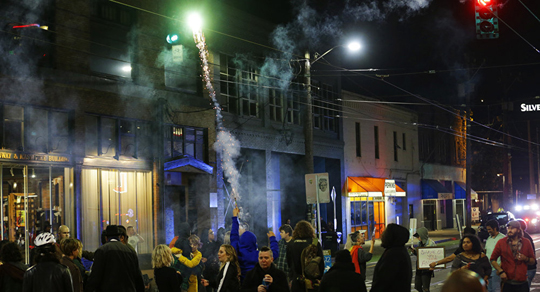
Shooting

The Seattle fire department said on Twitter shortly after 7 p.m. local time that some crew were treating five patients with gunshot wounds, two of them with life-threatening injuries.

It was not immediately clear if the shooting was related to the demonstrations.

Police said on Twitter that more details would be released “as they become available.”

Local KIRO-TV reported that the suspect remained at large following the shooting.

'Not my president!'

The raw divisions exposed by the presidential race were on full display across America, as protesters flooded city streets to condemn Donald Trump's election.

From New England to heartland cities like Kansas City and along the West Coast, demonstrators carried flags and anti-Trump signs, disrupting traffic and declaring that they refused to accept Mr. Trump's triumph.

In Chicago, where thousands had recently poured into the streets to celebrate the Chicago Cubs' first World Series victory in over a century, several thousand people marched through the Loop. They gathered outside Trump Tower, chanting “Not my president!”

A similar protest in Manhattan drew about 1,000 people. Outside Trump Tower on Fifth Avenue in midtown, police installed barricades to keep the demonstrators at bay.

In Boston, thousands of anti-Trump protesters streamed through downtown, chanting “Trump's a racist” and carrying signs that said “Impeach Trump” and “Abolish Electoral College.” Clinton appears to be on pace to win the popular vote, despite losing the electoral count that decides the presidential race.

In Oregon, dozens of people blocked traffic in downtown Portland, burned American flags and forced a delay for trains on two light-rail lines. Earlier, the protest in downtown drew several Trump supporters, who taunted the demonstrators with signs. A lone Trump supporter was chased across Pioneer Courthouse Square and hit in the back with a skateboard before others intervened.

The only major violence was reported in Oakland, California, during a protest that began shortly before midnight and lasted into early Wednesday morning.

Back in New York, several groups of protesters caused massive gridlock as police mobilized to contain them under a light rain. They held signs that read “Trump Makes America Hate” and chanted “hey, hey, ho, ho Donald Trump has got to go.” and “Impeach Trump.”

Comments

Add new comment

  • Coastaldigest.com reserves the right to delete or block any comments.
  • Coastaldigset.com is not responsible for its readers’ comments.
  • Comments that are abusive, incendiary or irrelevant are strictly prohibited.
  • Please use a genuine email ID and provide your name to avoid reject.
News Network
June 8,2020

Wellington, Jun 8: New Zealand lifted all domestic coronavirus restrictions on Monday after its final COVID-19 patient was given the all clear, with Prime Minister Jacinda Ardern revealing she danced around her living room when told about the milestone.

While strict border controls will remain in place, Ardern said restrictions such as social distancing and limits on public gatherings were no longer needed.

"We are confident we have eliminated transmission of the virus in New Zealand for now," she said in a televised address, saying Kiwis had "united in unprecedented ways to crush the virus".

The South Pacific nation, with a population of five million, has had 1,154 confirmed COVID-19 cases and 22 deaths.

There have been no new infections for 17 days and, until Monday, just one active case for more than a week.

Details of the final patient were not released for privacy reasons but it is believed to be a woman aged in her 50s who was linked to a cluster at an Auckland nursing home.

Ardern said the sacrifices made by New Zealanders, including a drastic seven-week lockdown that helped curb infection rates, had been rewarded now that there were no active cases in the country.

Asked about her reaction upon hearing the news, she replied: "I did a little dance" with baby daughter Neve.

"She was caught a little by surprise but she joined in, having absolutely no idea why I was dancing around the lounge."

New Zealand's move down to Level 1, the lowest rating on its four-tier virus response system, means nightclubs can operate without dance floor restrictions and theatres will reopen.

It also means sporting events can proceed with crowds in the stands, a change New Zealand Rugby (NZR) said offered its Super Rugby Aotearoa competition the opportunity to achieve a world first when it kicks off this weekend.

"We're incredibly proud, and grateful, to be the first professional sports competition in the world to be in a position to have our teams play in front of their fans again," NZR chief executive Mark Robinson said.

While many other sporting competitions around the globe have announced plans to restart, the vast majority will be played either with no crowds or with numbers severely restricted.

On a broader level, Ardern said easing restrictions would help New Zealand's economy.

"We now have a head start on economic recovery because at level one we become one of the most open, if not the most open, economies in the world," she said.

The prime minister said modelling showed the economy would operate at just 3.8 percent below normal at Level 1, compared with a 37 percent impairment at Level 4 lockdown.

Comments

Add new comment

  • Coastaldigest.com reserves the right to delete or block any comments.
  • Coastaldigset.com is not responsible for its readers’ comments.
  • Comments that are abusive, incendiary or irrelevant are strictly prohibited.
  • Please use a genuine email ID and provide your name to avoid reject.
News Network
June 15,2020

Jun 15: Oil prices fell on Monday, with U.S. oil dropping more than 2%, as a spike in new coronavirus cases in the United States raised concerns over a second wave of the virus which would weigh on the pace of fuel demand recovery.

Brent crude futures fell 66 cents, or 1.7%, at $38.07 a barrel as of 0016 GMT, while U.S. West Texas Intermediate (WTI) crude futures fell 81 cents, or 2.2%, to $35.45 a barrel.

Both benchmarks ended down about 8% last week, their first weekly declines since April, hit by the U.S. coronavirus concerns: More than 25,000 new cases were reported on Saturday alone as more states, including Florida and Texas, reported record new infection highs.

"Concerns about the recent uptick in COVID-19 infections in the U.S. and a potential 'second wave' are weighing on oil at the moment," said Stephen Innes, chief global market strategist at AxiCorp.

Meanwhile, an OPEC-led monitoring panel will meet on Thursday to discuss ongoing record production cuts to see whether countries have delivered their share of the reductions, but will not make any decision, according to five OPEC+ sources.

The Organization of the Petroleum Exporting Countries (OPEC) and its allies, collectively known as OPEC+, have been reducing supplies by 9.7 million barrels per day (bpd), about 10% of pre-pandemic demand, and agreed in early June to extend the cuts for a month until end-July.

Iraq, one of the laggards in complying with the curbs, agreed with its major oil companies to cut crude production further in June, Iraqi officials working at the fields told Reuters on Sunday.

Comments

Add new comment

  • Coastaldigest.com reserves the right to delete or block any comments.
  • Coastaldigset.com is not responsible for its readers’ comments.
  • Comments that are abusive, incendiary or irrelevant are strictly prohibited.
  • Please use a genuine email ID and provide your name to avoid reject.
News Network
February 24,2020

Beijing, Feb 24: The lockdown of Guo Jing's neighbourhood in Wuhan -- the city at the heart of China's new coronavirus epidemic -- came suddenly and without warning.

Unable to go out, the 29-year-old is now sealed inside her compound where she has to depend on online group-buying services to get food.

"Living for at least another month isn't an issue," Guo told news agency, explaining that she had her own stash of pickled vegetables and salted eggs.

But what scares her most is the lack of control -- first, the entire city was sealed off, and then residents were limited to exiting their compound once every three days.

Now even that has been taken away.

Guo is among some 11 million residents in Wuhan, a city in central Hubei province that has been under effective quarantine since January 23 as Chinese authorities race to contain the epidemic.

Since then, its people have faced a number of tightening controls over daily life as the death toll from the virus swelled to over 2,500 in China alone.

But the new rules this month barring residents from leaving their neighbourhoods are the most restrictive yet -- and for some, threaten their livelihoods.

"I still don't know where to buy things once we've finished eating what we have at home," said Pan Hongsheng, who lives with his wife and two children.

Some neighbourhoods have organised group-buying services, where supermarkets deliver orders in bulk.

But in Pan's community, "no one cares".

"The three-year-old doesn't even have any milk powder left," Pan told news agency, adding that he has been unable to send medicine to his in-laws -- both in their eighties -- as they live in a different area.

"I feel like a refugee."

The "closed management of neighbourhoods is bound to bring some inconvenience to the lives of the people", Qian Yuankun, vice secretary of Hubei's Communist Party committee, said at a press briefing last week.

Authorities on Monday allowed healthy non-residents of the city to leave if they never had contact with patients, but restrictions remained on those who live in Wuhan.

Demand for group-buying food delivery services has rocketed with the new restrictions, with supermarkets and neighbourhood committees scrambling to fill orders.

Most group-buying services operate through Chinese messaging app WeChat, which has ad-hoc chat groups for meat, vegetables, milk -- even "hot dry noodles", a famous Wuhan dish.

More sophisticated shops and compounds have their own mini-app inside WeChat, where residents can choose packages priced by weight before orders are sent in bulk to grocery stores.

In Guo's neighbourhood, for instance, a 6.5-kilogramme (14.3-pound) set of five vegetables, including potatoes and baby cabbage, costs 50 yuan ($7.11).

"You have no way to choose what you like to eat," Guo said. "You cannot have personal preferences anymore."

The group-buying model is also more difficult for smaller communities to adopt, as supermarkets have minimum order requirements for delivery.

"To be honest, there's nothing we can do," said Yang Nan, manager of Lao Cun Zhang supermarket, which requires a minimum of 30 orders.

"We only have four cars," she said, explaining that the store did not have the staff to handle smaller orders.

Another supermarket told AFP it capped its daily delivery load to 1,000 orders per day.

"Hiring staff is difficult," said Wang Xiuwen, who works at the store's logistics division, adding that they are wary about hiring too many outsiders for fear of infection.

Closing off communities has split the city into silos, with different neighbourhoods rolling out controls of varying intensity.

In some compounds, residents have easier access to food -- albeit a smaller selection than normal -- and one woman said her family pays delivery drivers to run grocery errands.

Her compound has not been sealed off either, the 24-year-old told AFP under condition of anonymity, though they are limited to one person leaving at a time.

Some districts have implemented their own rules, such as prohibiting supermarkets from selling to individuals, forcing neighbourhoods to buy in bulk or not at all.

"In the neighbourhood where I live, the reality is really terrible," said David Dai, who is based on the outskirts of Wuhan.

Though his apartment complex has organised group-buying, Dai said residents were unhappy with price and quality.

"A lot of tomatoes, a lot of onions -- they were already rotten," he told , estimating over a third of the food had to be thrown away.

His family must "totally depend" on themselves, added the 49-year-old, who has resorted to saving and drying turnip skins to add nutrients to future meals.

The uncertainty of not knowing when the controls will be lifted is also frustrating, said Ma Chen, a man in his 30s who lives alone.

"I have no way of knowing how much (food) I should buy."

Comments

Add new comment

  • Coastaldigest.com reserves the right to delete or block any comments.
  • Coastaldigset.com is not responsible for its readers’ comments.
  • Comments that are abusive, incendiary or irrelevant are strictly prohibited.
  • Please use a genuine email ID and provide your name to avoid reject.