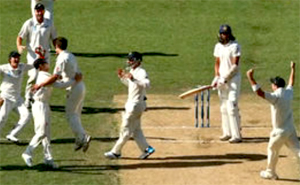
Shot selection, umpiring errors cost India first Test

February 10, 2014

Umpiring_errorsAuckland, Feb 10: Shoddy shot selection and a couple of umpiring errors put paid to India’s hopes of notching up a historic win in the first Test against New Zealand at Eden Park here on Sunday.

Chasing a mammoth 407, India started the fourth day on a shaky note, losing Cheteshwar Pujara after adding nine runs to the overnight score of 87 for one. But a 126-run alliance for the third wicket between centurion Shikhar Dhawan (115) and Virat Kohli (67) put India on course for an improbable victory.

However, poor judgment by both batsmen and umpires ensured that India would end up at 366 all out, losing the match by 40 runs.

Incidentally, this was India’s 10th defeat in the last 11 away Tests under MS?Dhoni.

Kohli’s half-hearted attempt to pull Neil Wagner, the stand-out New Zealand bowler, resulted in a bottom edge that Bradley Watling gobbled up behind the stumps. Then onwards, India steadily lost wickets, with the shot selection of some of the batsmen leaving a lot to be desired.

While Dhawan got a brute of a ball from Wagner that the left-hander gloved to Watling, both Rohit Sharma and Ravindra Jadeja were guilty of throwing their wickets away. Rohit, who looked settled in the middle, returned to the hut in the first ball after tea, edging an away swinger from Tim Southee to the big gloves of Watling.

Jadeja played like a man having no tomorrow when the situation demanded a little more caution. His 21-ball 26 entertained the crowd, but what India needed at that moment was a firm hand at one end so that Dhoni could keep gathering runs at the other side.

Jadeja seemed oblivious to the situation, and his cameo came to an end when he skied?Trent Boult to Ian Sodhi at mid-on. Amidst all that rush of blood, Ajinkya Rahane was adjudged leg before to Boult when the replays suggested a big edge.

Dhoni carried India’s last smidgeon of hope, but the third umpire decided that Wagner’s foot was inside after Dhoni’s bottom edge off a bouncer dishevelled the bails. It was the last nail in India’s coffin, and now they will be eager for a turnaround in the second Test at Wellington, starting on Friday.

Comments

Add new comment

  • Coastaldigest.com reserves the right to delete or block any comments.
  • Coastaldigset.com is not responsible for its readers’ comments.
  • Comments that are abusive, incendiary or irrelevant are strictly prohibited.
  • Please use a genuine email ID and provide your name to avoid reject.
Agencies
April 2,2020

Lausanne, Apr 2: The postponement of the Tokyo Olympics and the shutdown of the sporting calendar because of the coronavirus pandemic are going to hit international sports federations hard financially.

Many sports that are part of the Games depend heavily on the payouts every four years from the International Olympic Committee (IOC).

"The situation is tense and very gloomy. An assessment will be made, but clearly some posts are under threat," said an official of a major international federation.

The 28 international federations (IF) of the sports that were due to be present at the Tokyo Olympics, would have received substantial sums from the IOC.

However, the postponement of the Games until 2021 could lead to a freeze of their payment.

"We have a lot of IF with substantial reserves, but others work on a different business model, they have income from major events which are suspended, which can be a problem for the cashflow if they don't have enough reserves," said Andrew Ryan, director general of the Association of International Olympic Summer Sports Federations (ASOIF), which is responsible for distributing this money.

The five additions to the Tokyo Games programme - karate, surfing, skateboarding, climbing and baseball/softball - are not eligible.

The Olympic payout totalled 520 million after the Rio Games, four years ago.

"The Olympic money could be less than for Rio 2016," Ryan warned before adding: "My advice is to budget the same as in Rio".

The federations receive money on a sliding scale determined by their audience and size.

The three largest (athletics, swimming and gymnastics) can expect approximately 40 million.

For the second tier, made up of cycling, basketball, volleyball, football and tennis, the sum is 25 million.

For group three, which contains eight sports, including boxing, rowing, judo and table tennis, it is 17 million.

The nine sports in the next level (including sailing, canoing and fencing) receive 12 million.

For the three in the last category (rugby, golf, modern pentathlon) the payout is 7 million.

For the largest associations, such as football's FIFA which has a 1.5 billion nest egg, or basketball body FIBA which has CHF 44.4 million (42 million euros) in reserves, IOC aid represents a small proportion of their income.

For others, it is vital.

"Some IF probably don't have the cashflow to survive one year," said Ryan.

For most federations, the postponement of the Olympic Games has a domino effect, forcing them to reschedule their own money-earning competitions.

"The revenues from these events will eventually come in," said Ryan. "But this impacts the cashflow." World Athletics has already postponed the 2021 World Championships in Eugene, Oregon to 2022.

The International Swimming Federation (FINA) will have to do the same for its World Championships scheduled for next summer in Fukuoka, Japan, when they would probably clash with the Tokyo Games.

"One edition of the World Championships means for us 10 million in revenues," said one sports federation official, speaking on condition of anonymity.

"If this income is postponed, totally or partially, for a year, we will face major problems, especially if the IOC money, originally expected in September, is not paid out."

The Singapore-based International Table Tennis Federation has already taken steps, with "the Executive Committee agreeing to reduce their expenses and senior staff offering to take a salary reduction," said marketing director Matt Pound, but, he added,"further cuts will take place if needed."

- 'Significant loss of revenue' -

The ITTF has suspended all its competitions until June and that is costly.

Kim Andersen, the Danish president of London-based World Sailing, said commercial revenues are not immune.

"The IOC will eventually pay out its aid, but what weighs most heavily is the uncertainty about whether our competitions will be held and whether our sponsors will be maintained," he said.

The IOC is not prepared to go into details of what it plans.

"It is not possible at this stage to assess the overall impact" of the postponement of the Tokyo Olympics, an official told AFP.

"It depends on a number of variables that are currently being studied." According to an official of one federation: "the IOC will discuss on a case-by-case basis, sport by sport".

Another option is for the federations to ask for a share of the public aid set up to deal with the coronavirus crisis, in Switzerland, where 22 ASOIF members are based and also in the United Kingdom, home of World Sailing.

"Can sports federations benefit from federal aid? The answer is yes, in principle," Philippe Leuba, State Councillor of the canton of Vaud, in charge of the economy and sport, told.


Comments

Add new comment

  • Coastaldigest.com reserves the right to delete or block any comments.
  • Coastaldigset.com is not responsible for its readers’ comments.
  • Comments that are abusive, incendiary or irrelevant are strictly prohibited.
  • Please use a genuine email ID and provide your name to avoid reject.
News Network
January 15,2020

Jan 15: Australia openers David Warner and Aaron Finch both struck superb centuries to complement their bowlers’ inspired display as the touring side handed out a 10-wicket thrashing to India in the opening one-day international in Mumbai.

India, world-ranked No 2 in ODIs, suffered a middle-order collapse on their way to being bundled out for 255 in the final over of their innings after Australia captain Finch won the toss and opted to field in the first of the three-match series.

Warner and Finch then smashed the Indian bowlers to all corners of the ground, picking up boundaries seemingly at will to chase down the target with 74 balls to spare at the Wankhede Stadium.

Left-handed Warner successfully used the decision review system twice to overturn the umpire’s decision on his way to his 18th ODI century, hitting three sixes and 17 fours in his unbeaten knock of 128, from 112 balls. Finch completed his 16th century in the format, his unbeaten innings 110 from 114 features two sixes and 13 fours.

Earlier, Australia’s left-arm fast bowler Mitchell Starc, who made his ODI debut in India 10 years ago, picked up three wickets to set up Australia’s victory. He struck the first blow with the new ball when he sent back Rohit Sharma for 10.

India managed to recover from that early loss through a second-wicket stand of 121 between opener Shikhar Dhawan, who top-scored for the hosts with 74, and KL Rahul. However left-arm spinner Ashton Agar broke the stand by dismissing Rahul for 47 before Agar caught Dhawan off Pat Cummins in the next over.

The hosts were hoping for a solid innings from captain Virat Kohli, who batted a position lower than his usual No 3 spot to accommodate Rahul, to get them out of trouble. However, he lasted only 14 balls, hitting leg-spinner Adam Zampa for a six before offering a return catch to the bowler on the very next delivery to be out for 16.

Starc then returned to the attack, removing Shreyas Iyer cheaply as India lost four wickets for 30 runs to be reduced to 164 for five. Rishabh Pant and Ravindra Jadeja then fell just short of a half-century partnership, before the remaining four wickets falling for 42 runs, with Cummins and fast bowler Kane Richardson picking up two wickets apiece for Australia.

To compound India’s woes, wicketkeeper Pant suffered a concussion after being hit on his helmet by a short-pitched delivery from Cummins. The Indian cricket board said Pant, who did not come out to keep wicket and was replaced behind the stumps by Rahul, was under observation. The two sides will meet in Rajkot for the second ODI on Friday.

Comments

Add new comment

  • Coastaldigest.com reserves the right to delete or block any comments.
  • Coastaldigset.com is not responsible for its readers’ comments.
  • Comments that are abusive, incendiary or irrelevant are strictly prohibited.
  • Please use a genuine email ID and provide your name to avoid reject.
Agencies
August 7,2020

Islamabad, Aug 7: Former Pakistani fast bowler Shoaib Akhtar, known for his blistering deliveries on the cricket field, recently baffled many with a deadly off-field bouncer by claiming he is willing to eat grass if it enabled an increase in budget for his country's Army!

"If Allah ever gives me the authority, I will eat grass myself but I will increase the budget of the army," said Akhtar in an interview with ARY News.

The 'Rawalpindi Express', considered the fastest bowler in history said he does not understand why the civilian sector cannot work in collaboration with the Armed forces.

"I will ask my army chief to sit with me and make decisions. If the budget is 20 per cent, I will make it 60 per cent. If we insult each other, the loss is ours only," the once feared fast-bowler said.

Akthar had also claimed to ARY News interview that he was willing to take a bullet for his country and had turned down a county stint just because he wanted to fight the 1999 Kargil War.

Ties between India and Pakistan have been strained in the recent months over several issues, the latest being Pakistan's attempt to broach in the UNSC the issue of Kashmir on the first anniversary of the India's move to scrap the special status of Jammu and Kashmir and to split the erstwhile state into two union territories .

Pakistan also has not been in a good financial position and under prime minister Imran Khan, himself an all rounder cricketer, has added nearly USD 22 billion, that is 35 per cent to the nation's international debt pile in the last two years, according to an Asia Times report in July.

While Pakistan recently received USD 1.39 billion from the IMF to cushion the economic shocks caused due to COVID-19 outbreak, Akthar had a few months ago proposed that a joint cricket match be played between India and Pakistan to raise funds to fight the coronavirus. The suggestion that was put down by cricketers in India.

Meanwhile the 'Pindi boy' whose deadly pace and bounce was once dreaded by batsmen had recently taken to Twitter to deny former India cricketer Virender Sehwag's claim of sledging him.

Sehwag along with other Indian crickerters such as Harbhajan Singh and even Rahul Dravid had been at the receiving end of Akthar's sledging and antics during their playing days.

"Yes, totally self made story by him. Mujhe yeh bol k bach k jana kidhar tha us nay," Akthar tweeted to a report in which Sehwag claimed that he had sledged the 'Rawalpindi Express' by telling him that Sachin Tendulkar was his father.

During an awards ceremony Sehwag had recounted that fed up with Akthar's sledging and retaliated by telling him to say the same things to Tendulkar, who smashed the 'Pindi boy' for a six. Sehwag quipped that he told Akthar then that "Baap baap hota hai".

In the recent ARY interview, asked about the allegation made against him by former India cricketer Virendra Sehwag that he makes pro-India comments for greater following on social media channels, Akhtar said, "I cannot talk on the basis of hate." 

Comments

Add new comment

  • Coastaldigest.com reserves the right to delete or block any comments.
  • Coastaldigset.com is not responsible for its readers’ comments.
  • Comments that are abusive, incendiary or irrelevant are strictly prohibited.
  • Please use a genuine email ID and provide your name to avoid reject.