



Shoura holds 62nd session

November 9, 2016

Riyadh, Nov 9: The Shoura Council has called on the Ministry of Environment, Water and Agriculture to conduct a field study to determine citizens’ real consumption of water, accordingly adjust consumption segments, and delay issuing new water bills until handling complaints about the new tariffs.
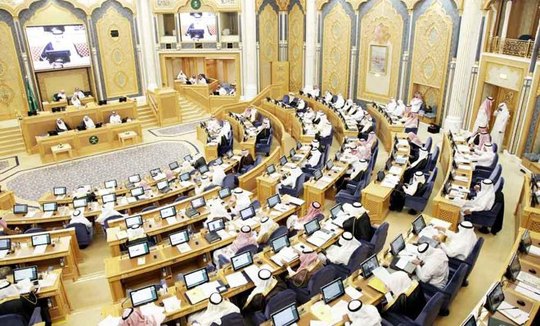
Shoura

This came in the 62nd regular session held on Tuesday under the chairmanship of Deputy Speaker of the Shoura Council Dr. Mohammed bin Amin Al-Jafri.

Assistant Speaker of the Council Dr. Yahya bin Abdullah Al-Samaan said in a statement after the session that the council took this decision after reviewing a report issued by the Committee of Environment, Water and Agriculture concerning council member comments on the annual performance report of the Ministry of Water and Electricity.

The Council also called on the Ministry of Environment, Water and Agriculture to take rationing measures to reduce the high annual consumption of water, and to qualify private companies and institutions to discover leaks in water networks inside homes.

The council also demanded that the Ministry of Environment, Water and Agriculture speed up of implementation of Saudi Building Code in terms of water consumption.

In another decision, the Shoura Council demanded that the Saudi Exports Development Authority (SEDA) encourage the establishment of sectoral associations for exporters that would contribute to the development of multi-export sectors. The council called on SEDA to implement the single-window system to facilitate export procedures.

In addition, the council discussed a report issued by the special committee on the draft bill of the public money protection system, which consists of 26 articles that aim to protect public money.

The council also approved the draft resolution of the cooperation agreement in maritime transportation between the Saudi and Algerian governments, which was signed in Riyadh on Dec. 9, 2015.

Separately, Shoura Council delegation headed by Dr. Khalid bin Abdullah Al-Sabti met Monday with the chairman of the Foreign Affairs Committee of the German Parliament, Dr. Norbert Roettgen at the German Parliament in Berlin.

The meeting marked the beginning of an official visit to Germany by the Saudi delegation, which included Dr. Faleh Al-Sagheer, Dr. Fayez Al-Shahri and Dr. Thuraya Al-Areed. Also taking part in the meeting was Saudi Ambassador to Germany Dr. Awad Al-Awad.

Dr. Sabti highlighted the efforts of the Kingdom, led by the Custodian of the Two Holy Mosques King Salman, to bring about peace in the region.

He also underlined Saudi Arabia’s effort to ease the suffering that is caused by the ongoing crises in the Middle East, and said the Kingdom is exerting all efforts to combat terrorism and extremist ideology.

The meeting discussed other issues of mutual concern and ways to boost cooperation.

Deputy Chairman of the Defense Committee of the German Parliament Dr. Karl Lamers stressed the importance of visits between the two sides.

Comments

Add new comment

  • Coastaldigest.com reserves the right to delete or block any comments.
  • Coastaldigset.com is not responsible for its readers’ comments.
  • Comments that are abusive, incendiary or irrelevant are strictly prohibited.
  • Please use a genuine email ID and provide your name to avoid reject.
Agencies
May 31,2020

Riyadh, May 31: Over 90,000 mosques in Saudi Arabia reopened their doors to worshippers on Sunday morning after over a two-month closure as part of an ease in the curfew restrictions to prevent the spread of the novel coronavirus.

The worshipers were allowed to enter the mosques, except the mosques in Makkah, from Fajr prayers today morning (Shawwal 8) with a limit of 40 per cent capacity.

The reopening of mosques was be undertaken in accordance with the guidance of Minister of Islamic Affairs, Dr Abdullatif Al Asheikh, and in line with advice issued by the Senior Council of Ulemas.

The ministry has embarked on a vigorous media campaign to urge all worshippers to abide by preventive measures for their own safety to curb the spread of Covid-19.Among the instructions are doing ablution at home, hand-washing and using sanitisers before going out to the mosque and after coming back home.

On Saturday, the Custodian of the Two Holy Mosques King Salman has approved opening the Prophet's Mosque in Madinah in stages to the public.

The elderly and those with chronic diseases are advised to perform their prayers at home. Reading and reciting the Holy Quran online is advised, too, from one's own mobile phone or at least reading from a privately owned copy of the Holy Quran.

Bringing one's prayer mat to perform prayers in mosques is highly recommended as well as keeping a two-metre distance between one another prayer.

Accompanying children under the age of 15 to the mosques is prohibited. Putting on a face mask and avoiding shaking hands and other contact is also recommended.

Meanwhile, the ministry managed, during the closure of mosques, to undertaking a massive cleaning, sanitising and maintenance drive in all mosques Kingdom-wide, according to world-class standards and best known practices. This included sanitising over 10 million mosques, 43 million copies of several sizes and volumes of the Quran, more than 600,000 Holy Quran cupboards, in addition to repairing and maintaining about 176,000

water closets, annexed to mosques.


Comments

Add new comment

  • Coastaldigest.com reserves the right to delete or block any comments.
  • Coastaldigset.com is not responsible for its readers’ comments.
  • Comments that are abusive, incendiary or irrelevant are strictly prohibited.
  • Please use a genuine email ID and provide your name to avoid reject.
News Network
March 21,2020

Mar 21: Qatari authorities arrested 10 nationals for breaking home quarantine rules as Doha tightens regulations amid the coronavirus outbreak, local daily The Peninsula Qatar reported on Saturday.

The Ministry of Public Health released a statement naming the detainees and said that the violators were currently being referred to prosecution.

The tiny country, where expatriates comprise the majority of the population, on Thursday reported eight more infections to take its tally to 470, the highest number among the six Gulf Arab states that have reported a total of more than 1,300 coronavirus cases.

Government spokeswoman Lulwa Rashed Al-Khater told a news conference the new cases included two Qataris who had been in Europe, with the rest migrant workers.

Qatari authorities on Tuesday announced the closure of several square kilometers of the industrial area in Doha, the capital, which also contains labor camps and other housing units.

Comments

Add new comment

  • Coastaldigest.com reserves the right to delete or block any comments.
  • Coastaldigset.com is not responsible for its readers’ comments.
  • Comments that are abusive, incendiary or irrelevant are strictly prohibited.
  • Please use a genuine email ID and provide your name to avoid reject.
Agencies
July 16,2020

Riyadh, Jul 16: Prince Abdul Aziz bin Saud bin Naif, minister of interior and chairman of the Hajj Supreme Committee, chaired a virtual meeting on Wednesday with the heads of  security agencies and officials in charge of this year’s Hajj season.

During the meeting, the minister and security officials discussed organizational issues related to Hajj, including preventive and precautionary steps related to fighting the coronavirus disease, procedures related to pilgrims commuting to the holy sites, and mechanisms to facilitate performing the Hajj rituals.

Prince Abdul Aziz confirmed abiding by the directives of King Salman and Crown Prince Mohammed bin Salman to take all precautions to preserve the safety of the pilgrims, and facilitate their performance of their Hajj rituals, according to the highest health standards to contain the new coronavirus pandemic.

Saudi Arabia has decided to allow only a limited number of domestic pilgrims to perform Hajj this year in the wake of the COVID-19 outbreak.

Only those expatriates between the ages of 20 and 50 who are not suffering from any chronic diseases can apply for the pilgrimage.

Earlier, the Ministry of Hajj and Umrah said that requests from people of 160 nationalities in the Kingdom have been screened electronically to select who will perform Hajj this year.

Of the pilgrims who will receive approval, 70 percent will be non-Saudis residing in the Kingdom and the remaining 30 percent will be Saudi citizens.

Meanwhile, the Ministry of Interior said that anyone found entering the sites of Hajj (Mina, Muzdalifah and Arafat) without a permit from July 18 till the end of Dhu Al-Hijjah 12 will be issued with a fine of SR10,000 ($2,600).

The fine will be doubled if the offence is repeated. Security personnel will be posted on roads leading to the holy sites to ensure that anyone who breaks the law will be stopped and fined.

Around 2.5 million foreign and domestic pilgrims performed Hajj last year.

Comments

Add new comment

  • Coastaldigest.com reserves the right to delete or block any comments.
  • Coastaldigset.com is not responsible for its readers’ comments.
  • Comments that are abusive, incendiary or irrelevant are strictly prohibited.
  • Please use a genuine email ID and provide your name to avoid reject.